
8 RF SAFETY ASSESSMENT
8.1 INTRODUCTION
Chapters 6 and 7 described the physical progression from source emissions through external exposure and RF dosimetry to biological response. They also distinguished the corresponding activities of source characterization, exposure assessment, RF dosimetry, and biological-effects assessment. To manage RF exposure in practice, the relevant physical quantities must be determined using measurement, analytical calculation, computational modeling, or an appropriate combination of these methods.
In this book, the term RF safety assessment refers to the process of determining the exposure associated with an RF source and establishing whether it complies with the applicable RF exposure standard. Depending on the source and exposure scenario, the assessment may involve external quantities such as electric-field strength, magnetic-field strength, incident power density, or induced and contact currents. Where internal dosimetric quantities such as induced electric field, specific absorption rate (SAR), or absorbed power density are required, standardized laboratory methods or computational modeling may also be necessary. The methods selected depend on factors including operating frequency, source and antenna characteristics, field region, operating conditions, accessibility, exposure geometry, and the quantities specified by the applicable standard.
RF safety assessment operates within the relationship illustrated in Figure 8.1. Scientific evidence is evaluated to develop health-based exposure guidelines. In Australia, ARPANSA RPS S-1 establishes requirements for limiting human exposure to radiofrequency electromagnetic fields and is aligned with the ICNIRP radiofrequency guidelines. Assessment standards such as AS/NZS 2772.2 provide recognized methods for measuring or calculating the relevant quantities. However, AS/NZS 2772.2 predates RPS S-1 and retains references to the superseded RPS3 exposure criteria. Its technical methods must therefore be applied using the current RPS S-1 quantities, limits, averaging, and summation requirements; RPS S-1 governs the Australian compliance decision wherever the documents differ.
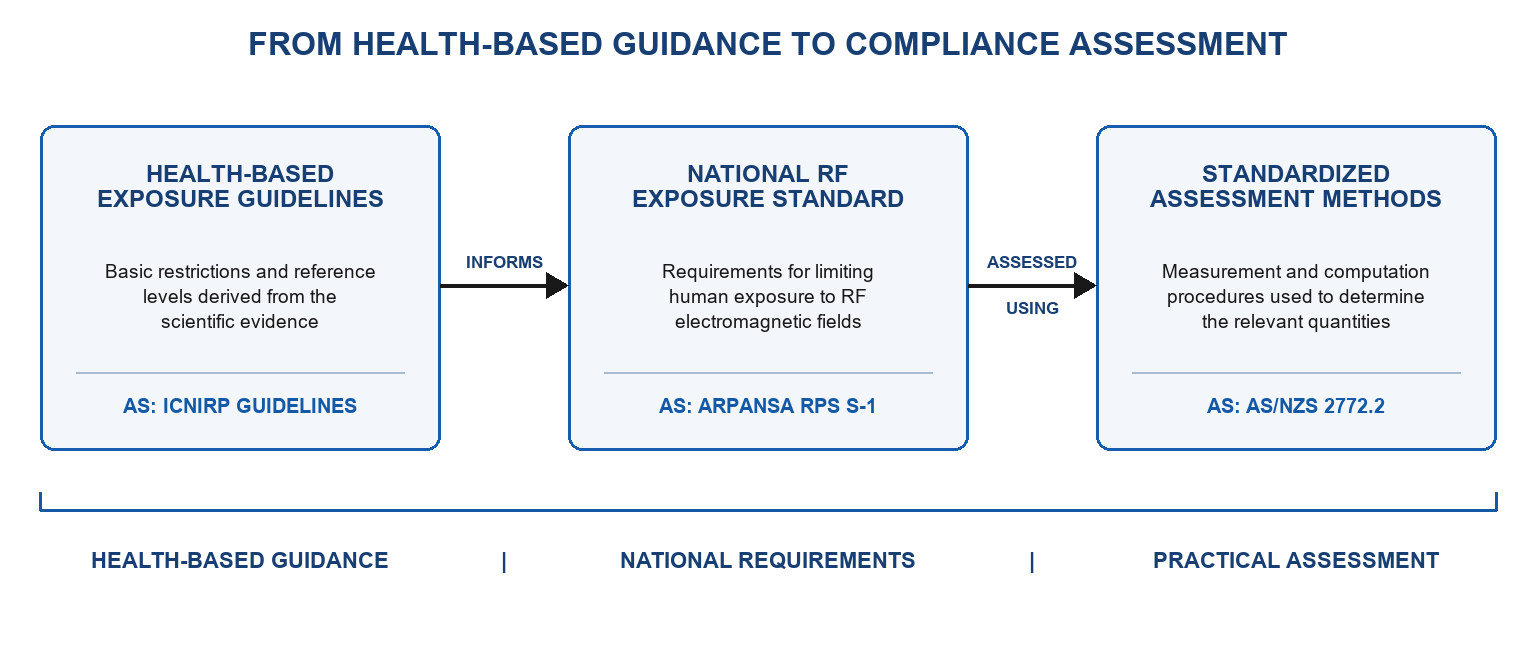
RF safety assessment is therefore much more than obtaining a reading from a field meter. It requires the assessment objective and applicable requirements to be identified, the RF source and operating conditions to be characterized, and suitable measurement or computational methods to be selected. The results must then be interpreted with appropriate consideration of spatial and temporal variation, measurement or modeling uncertainty, and the operating conditions represented by the assessment.
This chapter examines the principal engineering methods used in that process. It describes the quantities that can be assessed, the instruments and sensors used to characterize external electromagnetic fields, the consequences of near-field and far-field conditions, and the practical factors affecting measurement reliability. It then introduces analytical and computational methods for situations in which measurement alone is insufficient and explains how assessment results should be interpreted. Chapter 9 examines the exposure guidelines and standards against which those results are judged.