
1.3 IONIZING AND NON-IONIZING RADIATION
As illustrated in Figure 1.2, electromagnetic radiation is commonly divided into two broad categories according to the energy carried by each photon: ionizing radiation and non-ionizing radiation. This distinction is fundamental and important because the biological effects, the short- and long-term health hazards, and methods of protection differ significantly between the two:
- Ionizing radiation has enough energy to remove tightly bound electrons from atoms, creating ions.
- Non-ionizing radiation does not have enough energy to remove electrons from atoms. It primarily causes excitation or vibration of atoms and molecules.
Both types of radiation must be managed appropriately to minimize risks to health and the environment.
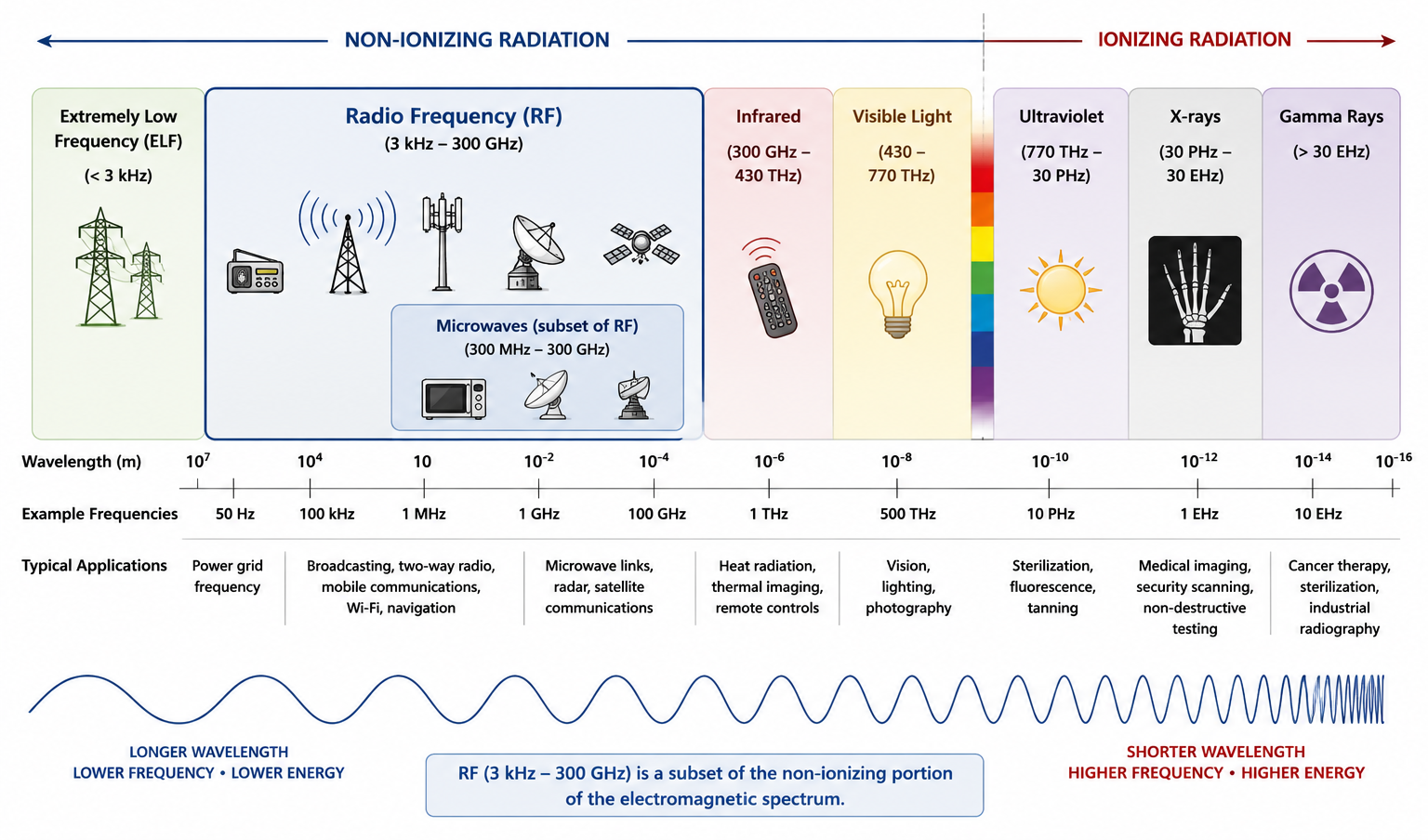
1.3.1 Ionizing Radiation
Ionizing radiation consists of electromagnetic waves or subatomic particles that possess sufficient energy to remove electrons from atoms or molecules, creating electrically charged particles known as ions. This process, called ionization, alters the electrical and chemical properties of the affected atoms and molecules. Within biological tissues, ionization can disrupt the normal structure of important molecules, including proteins, enzymes, and deoxyribonucleic acid (DNA). Depending on the amount of energy absorbed and the tissues affected, this damage may lead to cell death, genetic mutation, or an increased risk of cancer.
The ability to produce ionization distinguishes this form of radiation from non-ionizing radiation. Rather than simply causing atoms and molecules to vibrate or become excited, ionizing radiation has sufficient energy to break chemical bonds directly. The resulting chemical changes may occur within individual cells and, if the body's natural repair mechanisms are unable to correct the damage, can have significant biological consequences. For this reason, the biological effects of ionizing radiation are fundamentally different from those produced by RF electromagnetic fields.
Examples of ionizing radiation include X-rays, gamma rays, and energetic particles such as alpha particles, beta particles, and neutrons. X-rays and gamma rays are both forms of electromagnetic radiation, differing principally in their origin and energy, while alpha particles, beta particles, and neutrons are subatomic particles emitted during radioactive decay or produced in nuclear reactions. Each interacts with matter in different ways and therefore requires different methods of detection and protection.
Despite its potential hazards, ionizing radiation has many valuable applications because of its ability to penetrate materials and interact strongly with matter. In medicine, X-rays are widely used for diagnostic imaging, while carefully controlled beams of ionizing radiation are employed in radiotherapy to destroy cancerous tissue. Industrial radiography uses X-rays and gamma rays to inspect welds, castings, and other components for internal defects without damaging the object being examined. Scientific research, sterilization of medical equipment, food irradiation, and nuclear power generation are further examples of technologies that rely upon ionizing radiation.
Because ionizing radiation can damage living tissues even at comparatively low exposure levels, its use is subject to stringent safety requirements. Protection is based on three fundamental principles: minimizing the time spent near the source, maximizing the distance between the source and the exposed person, and providing appropriate shielding using materials such as lead, concrete, or water. These engineering controls are supported by comprehensive regulatory frameworks governing the use, transport, storage, monitoring, and disposal of radioactive materials.
Although ionizing radiation and RF electromagnetic fields are both forms of electromagnetic radiation, their interaction with biological tissues is fundamentally different. Ionizing radiation acts by removing electrons from atoms and directly altering molecular structure, whereas RF electromagnetic fields do not possess sufficient photon energy to produce ionization. Instead, as described in the following section, RF fields interact with matter principally by inducing electric fields and currents or by transferring energy that may produce tissue heating. This distinction forms the scientific basis for the very different safety standards and protection methods applied to ionizing and non-ionizing radiation.