
10 RF RADIATION SAFETY PLANS
10.1 INTRODUCTION
The preceding chapters have explained how RF emissions lead to external exposure, internal fields and energy absorption, biological response, and health significance. They also described the basic restrictions and reference levels used to limit substantiated adverse health effects. As illustrated in Figure 10-1, health-based guidance informs national exposure requirements; compliance is assessed using standardized methods; and the results are translated into practical safety management. Together, these elements provide the scientific and engineering foundation for RF radiation safety.
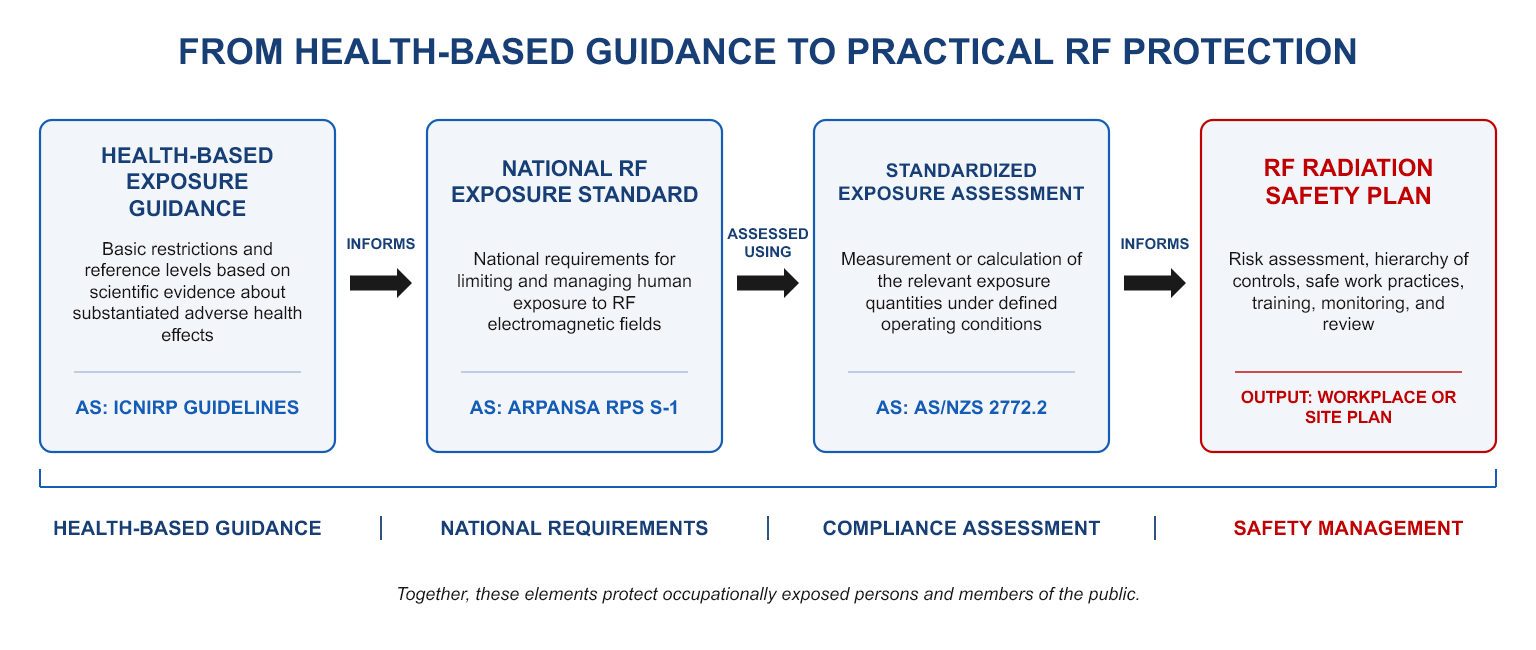
As shown in Figure 10-1, exposure limits and assessment results do not by themselves ensure adequate protection. Effective protection depends on translating the applicable requirements and assessment findings into a plan that integrates risk assessment, the hierarchy of controls, safe work practices, training, monitoring, and review. These elements together protect occupationally exposed persons and members of the public.
Organizations that design, manufacture, supply, install, own, operate, or maintain RF-emitting equipment have responsibilities appropriate to their control of the source, workplace, or work activity. In Australia, the duty holders identified by RPS S-1 include persons conducting a business or undertaking and owners and operators of RF-generating equipment. Comparable responsibilities arise across broadcasting, telecommunications, satellite communications, defense, aviation, maritime operations, public-safety communications, manufacturing, scientific research, and healthcare. Although the equipment and operating environments differ, the fundamental principles of RF safety management remain the same.
Modern RF radiation safety is based on a risk-management approach, not simply on measuring field strengths and comparing them with exposure limits. Occupational exposure above the public limits is permitted only under controlled conditions, following a thorough risk analysis and implementation of an appropriate risk-management regimen. The process identifies hazards before exposure occurs, assesses exposure and risk, implements suitable controls, verifies their effectiveness, and reviews the system whenever equipment, procedures, or workplace conditions change.
A successful RF radiation safety program integrates engineering, management, and human factors. Engineering controls such as shielding, interlocks, automatic power reduction, and antenna design provide the primary means of reducing exposure. Administrative controls, including safe work procedures, access restrictions, work permits, training, supervision, and signage, provide additional protection where higher-order controls do not adequately manage the risk. Personal RF monitors and RF-specific personal protective equipment may support particular tasks, but they are supplementary measures rather than substitutes for elimination, substitution, or engineering controls.
An effective program also depends on clearly defined responsibilities, worker consultation, and coordination among all parties who control sources, workplaces, or work activities. Managers establish policy and provide resources; engineers assess installations and design controls; supervisors implement safe work; and workers follow procedures and report hazards. For each Controlled Area, RPS S-1 requires an appointed Responsible Person to coordinate access, current exposure information, markings, safe working practices, and cooperation with contractors and visitors.
Documentation is another essential component of an RF radiation safety program. Records of source and exposure assessments, site surveys, equipment modifications, maintenance, calibration, training, incidents, and corrective actions demonstrate how hazards have been assessed and managed. Scheduled review of these records helps ensure that the program continues to reflect the actual operating environment throughout the life of the installation.
This chapter examines the practical implementation of RF radiation safety within organizations. It explains how RF Radiation Safety Plans are developed, how hazards are identified and risks assessed, and how controls are selected, implemented, verified, and reviewed. It also addresses responsibilities, training, competency, documentation, incident management, public protection, and the management systems needed to keep RF-emitting equipment safe throughout its operational life.