
3.7.3 Amplitude Phase Shift Keying (APSK)
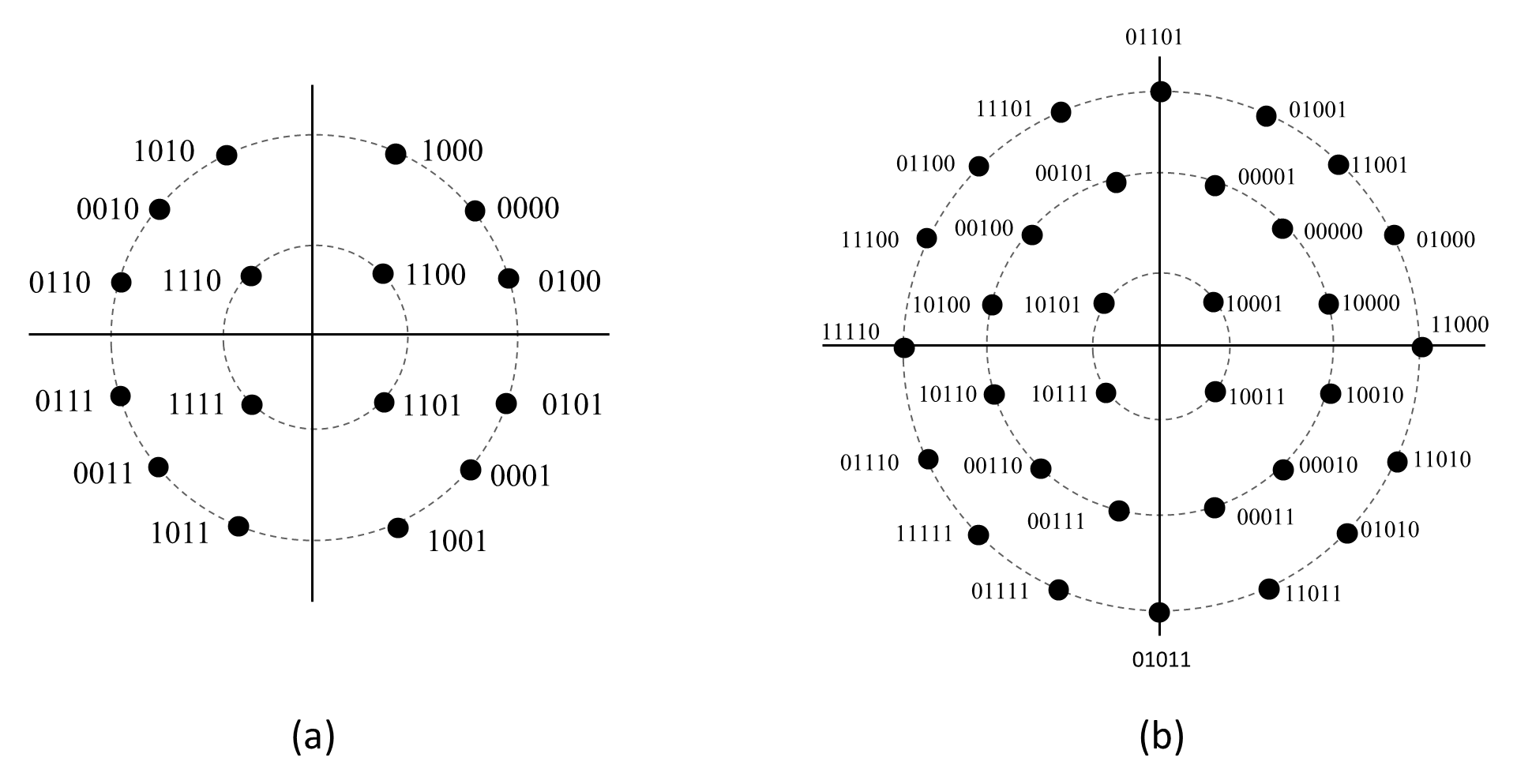
As illustrated in Figure 3.29, amplitude phase-shift keying (APSK) combines elements of both MPSK and QAM. Like QAM, APSK conveys information through variations in both amplitude and phase, but its constellation points are arranged in concentric rings rather than in a rectangular grid.
This structure provides many of the advantages of MPSK and QAM while maintaining wider spacing between symbols in both amplitude and phase. The increased symbol separation improves resistance to additive noise and reduces sensitivity to nonlinear distortion from high-efficiency power amplifiers.
Because of these properties, APSK can achieve improved performance relative to rectangular QAM constellations under nonlinear amplification, making it particularly well suited to satellite systems operating near saturation.
3.7.4 Spectral Efficiency
The spectral efficiency, η, of a modulation scheme is defined as the ratio of the baseband bit rate, Rb, to the RF bandwidth, BRF, required to transmit the modulated waveform:
Expressed in terms of symbol rate, Rs, and the number of modulation states, M, this relationship can be generalized as:
For an ideal Nyquist system employing zero roll-off pulse shaping (α = 0), the minimum RF bandwidth equals the symbol rate (BRF = Rs), so that BRFTs=1. In this limiting case:
Consequently, we have the following spectral efficiencies:
- BPSK 1 bps/Hz.
- QPSK 2 bps/Hz.
- 8-PSK 3 bps/Hz.
In practical systems BRFTs=(1+ α), where α is the roll-off factor of the filters in the detector circuit—typically α =0.2–0.35 in modern systems. Assuming a value of α =0.3, practical spectral efficiencies are:
- BPSK 0.77 bps/Hz.
- QPSK 1.54 bps/Hz.
- 8-PSK 2.31 bps/Hz.
These values demonstrate the fundamental trade-off between modulation order, bandwidth, and robustness: higher-order constellations increase throughput per unit bandwidth but require higher signal-to-noise ratios (SNRs) and more precise demodulation.