
1.8 ORGANIZATION OF THIS BOOK
RF radiation safety is an interdisciplinary subject that draws upon communications engineering, electromagnetics, biology, measurement science, engineering standards, and workplace safety management. For this reason, the material in this book has been organized to develop these topics in a logical sequence, with each chapter building upon the concepts introduced previously.
As illustrated in Figure 1.6, the book begins by introducing the engineering principles that determine how RF electromagnetic fields are generated and transmitted. Understanding these principles is essential because the characteristics of an RF source ultimately determine the nature of the electromagnetic fields to which people may be exposed.
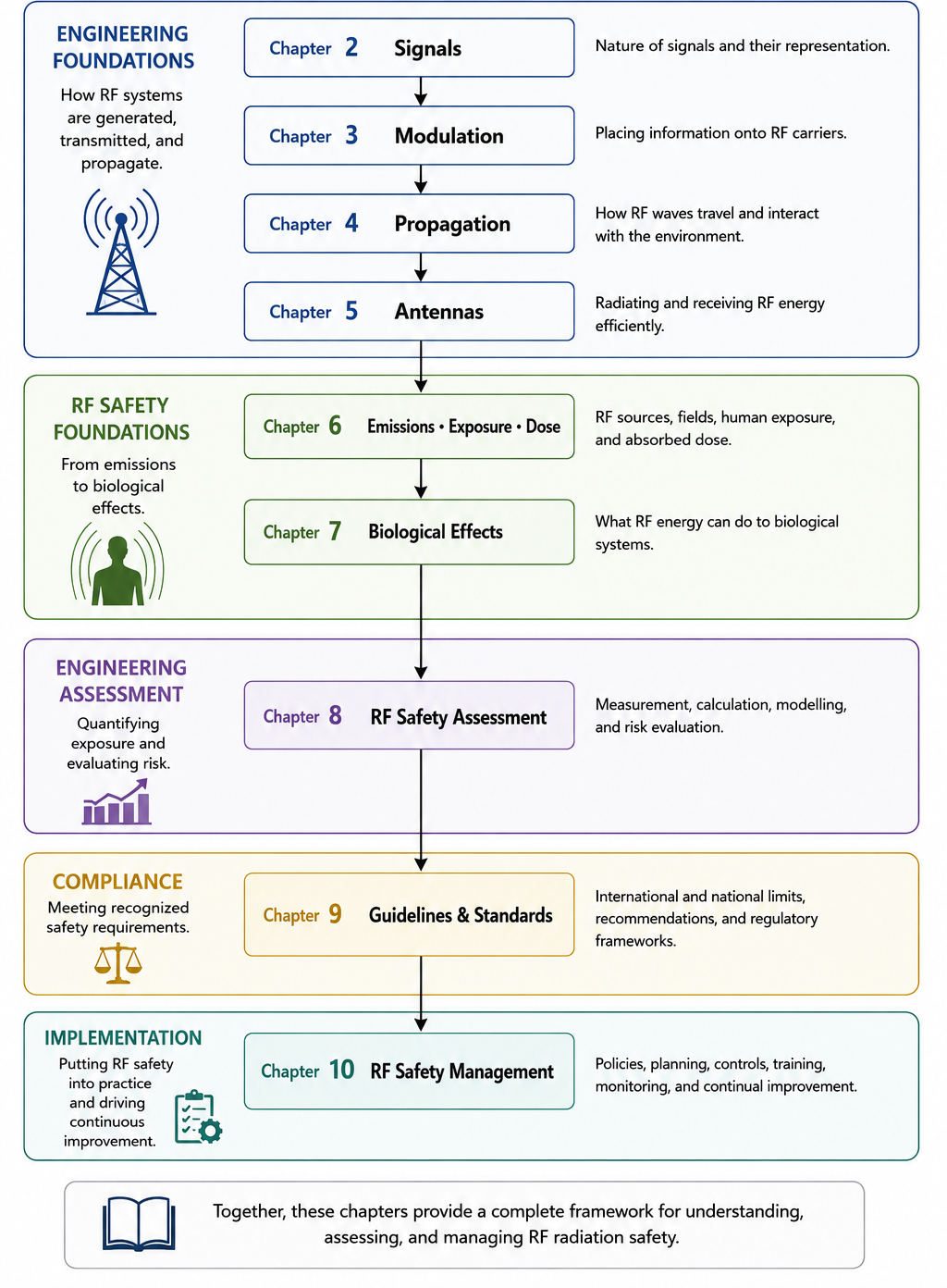
Chapter 2 introduces the fundamental characteristics of analog and digital signals. It explains how information is represented, transmitted, and processed within communications systems and introduces the concepts of frequency, bandwidth, and signal spectra that are central to RF engineering.
Chapter 3 examines modulation, the process by which information is impressed onto radio-frequency carriers for transmission. It introduces the principal analog and digital modulation techniques used in modern communications systems and explains how modulation influences signal bandwidth, transmitter performance, and spectrum utilization.
Chapter 4 describes the propagation of electromagnetic waves through the atmosphere and other media. It examines free-space propagation, reflection, diffraction, scattering, atmospheric absorption, and other mechanisms that determine how RF energy travels from a transmitting antenna to a receiving system or to people located within the electromagnetic field.
Chapter 5 considers antennas, the devices that convert electrical energy into electromagnetic radiation and vice versa. The chapter explains how antenna characteristics—including gain, directivity, polarization, radiation pattern, and beamwidth—influence the distribution of RF energy and therefore the exposure environment surrounding transmitting systems.
Having established the engineering foundations, the book then examines RF safety itself.
Chapter 6 introduces RF emissions, external exposure, and RF dosimetry, providing the framework for understanding how electromagnetic fields are generated, how people are exposed, and how internal fields and energy absorption are determined within the body.
Chapter 7 explains how absorbed RF energy interacts with biological tissues and describes the established adverse health effects associated with excessive exposure. It also introduces the scientific principles that underpin modern RF exposure guidelines and distinguishes between measurable biological effects and established adverse health effects.
Chapter 8 examines the methods used to assess RF exposure in practical engineering environments. It describes the measurement of electromagnetic fields, analytical calculations, computational modeling, and the interpretation of assessment results, providing the engineering techniques required to evaluate human exposure.
Chapter 9 discusses the international guidelines, national standards, and engineering documents that define acceptable RF exposure limits and describe the methods used to demonstrate compliance. It explains how scientific evidence has been translated into practical exposure criteria that are applied throughout the world.
Finally, Chapter 10 brings these elements together by describing the practical implementation of RF radiation safety within organizations. It examines RF Radiation Safety Plans, hazard identification, risk assessment, engineering controls, administrative controls, training, documentation, and the management systems used to ensure the safe design, operation, and maintenance of RF-emitting equipment.
Although each chapter addresses a particular aspect of RF radiation safety, the chapters are closely interconnected. Together they describe a complete progression from the generation of RF electromagnetic fields, through human exposure and biological interaction, to exposure assessment, compliance with recognized standards, and the implementation of effective RF safety management. By following this progression, readers will develop both an understanding of the scientific principles underlying RF safety and an appreciation of how those principles are applied in practical engineering and workplace environments.