7.2 HOW RF ENERGY INTERACTS WITH THE HUMAN BODY
When an RF field encounters the body, some energy is reflected, some may pass through, and some is absorbed. The resulting internal electric fields, currents, absorbed power, and absorbed energy are the dosimetric quantities introduced in Chapter 6.
Their distribution depends on frequency, polarization, direction of incidence, field strength and uniformity, body size and posture, grounding, and the electrical properties of the tissues. Absorption is rarely uniform because the body is electrically and anatomically non-uniform and because not all bodies are identical.
Interaction can occur by direct coupling to the body or indirectly through conductive objects and electronic devices. The coupling pathway determines which biological or safety effects must be considered.
7.2.1 Direct Coupling
Direct coupling occurs when an incident electric or magnetic field interacts with the body itself. Electric fields redistribute charge on the body surface and induce electric fields within tissues, while time-varying magnetic fields can induce circulating currents. Energy dissipated by these internal fields contributes to heating.
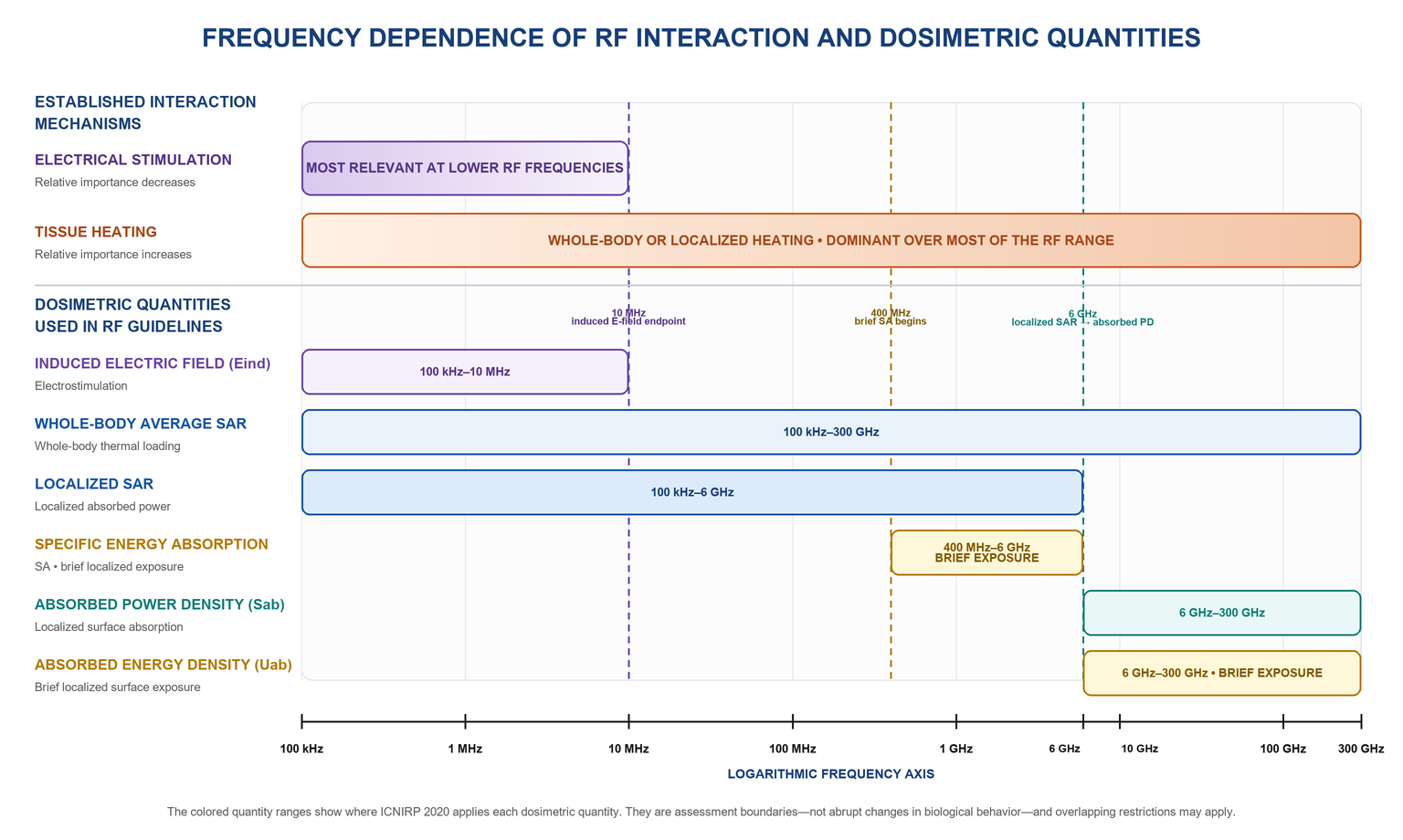
At the lower end of the RF range, sufficiently strong induced electric fields can stimulate excitable tissues. As frequency increases, stimulation becomes less efficient and energy absorption and heating become the dominant established mechanisms. Heating-based restrictions overlap the stimulation range, so the change cannot be represented by a single sharp dividing frequency.
Coupling efficiency depends on wavelength, body dimensions, posture, grounding, polarization, direction of incidence, and field uniformity. For an upright adult in a vertically polarized field, whole-body absorption can be high in the approximate range 70–100 MHz. Smaller bodies, seated or prone postures, different grounding conditions, and other field orientations shift the response; so the range is illustrative rather than universal.
At higher frequencies, absorption becomes increasingly localized and superficial. Localized SAR remains the principal mass-based quantity up to 6 GHz, while absorbed power density is used above 6 GHz for localized surface absorption. These dosimetric transitions support assessment but should not be presented as abrupt changes in biological behavior.
Figure 7.2 provides a qualitative overview of the gradual change in dominant interaction mechanism and the principal dosimetric quantities used across the RF range. The overlapping regions are important: more than one restriction may apply at the same frequency.