
5.7.3 Long Range (>1,500)
The sloping-V can be used for long ranges up to about 3,500 km. However, for greater ranges than 1,500 km, low radiation angles of 10˚ or less are required, and high-gain directional antennas are essential. There are various complicated arrays available, all very large, static and time-consuming and beyond the scope of this book. The rhombic antenna is a traveling wave antenna that has been popular for some time and is about the simplest of these antennas.
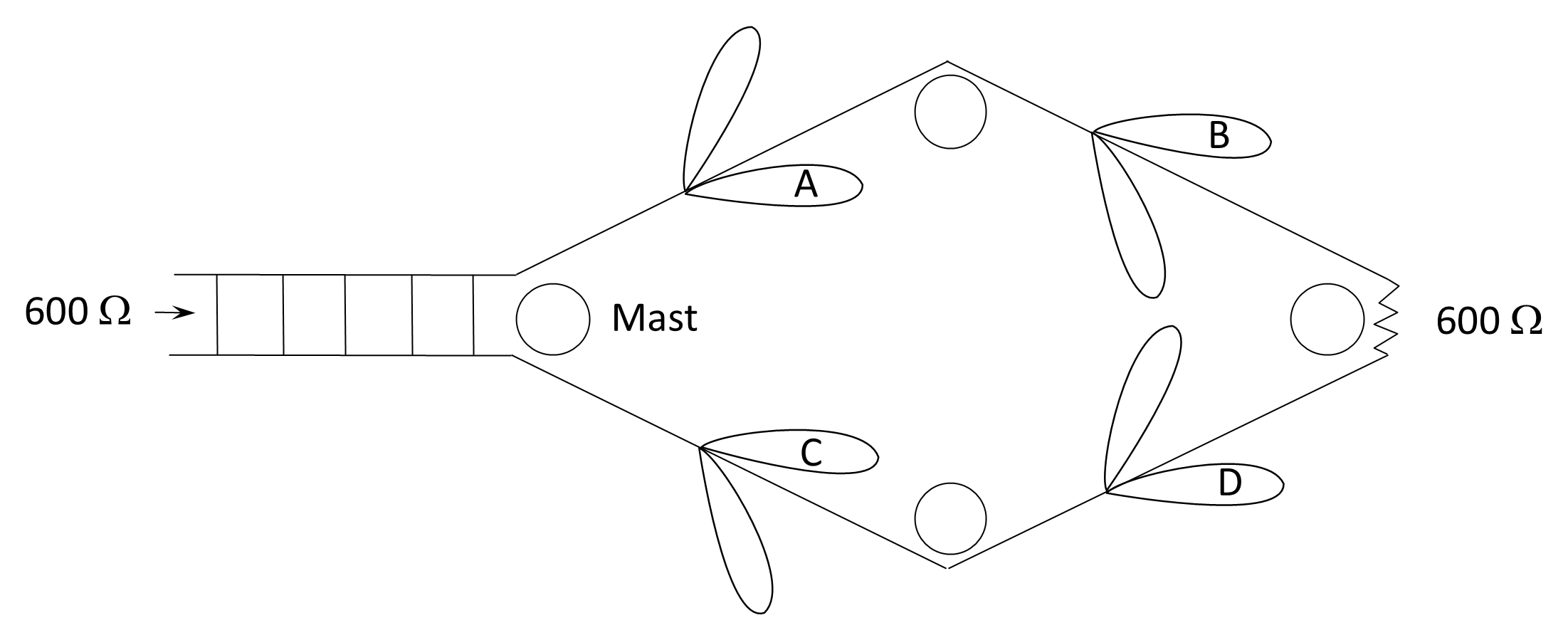
Figure 5.23 shows a rhombic antenna, which is again a variation of the end-fed antennas. The primary purpose of the rhombic is to provide high gain at low angles and to suppress unwanted sidelobes. As shown by Figure 5.23, lobes A, B, C, and D add and all the rest cancel. Gain from this antenna can be 15 dB or more with respect to a dipole. The rhombic design procedure is complicated and the antenna occupies an area of 5–15 acres. It is a difficult field antenna and is principally for long-range static links.
5.7.4 Alignment Of Sky-Wave Antennas
The alignment of sky-wave antennas is determined by a number of factors, including the radiation pattern, the space available, and the effect of the Earth’s magnetic field. For short ranges, where the wave is going straight up and down again, the alignment does not matter, except in the tropics where antennas should be aligned north-south irrespective of the direction of working. Dipoles greater than a quarter wavelength above the ground should be broadside on to the direction of working. For distances greater than 1,000 km, a great circle bearing must be used to align directional antennas—failure to do this may result in an error of 10˚ or more.