5.2 AN ISOTROPIC RADIATOR
Chapter 4 introduced the transverse electromagnetic wave and spherical spreading used in propagation analysis. At sufficiently large distances, the finite size of an antenna can be neglected when calculating the field in a specified direction, and the isotropic radiator provides a convenient point-source reference. A real antenna is not isotropic: its far-field strength varies with direction according to its radiation pattern. The detailed field-region criteria are developed in Section 5.3.8.
As shown in Chapter 4, the power supplied to an ideal isotropic radiator is distributed uniformly over the surface of a sphere. Its power density, Pden(iso), at distance d is therefore determined by the transmitted power Pt and the spherical area 4πd²:
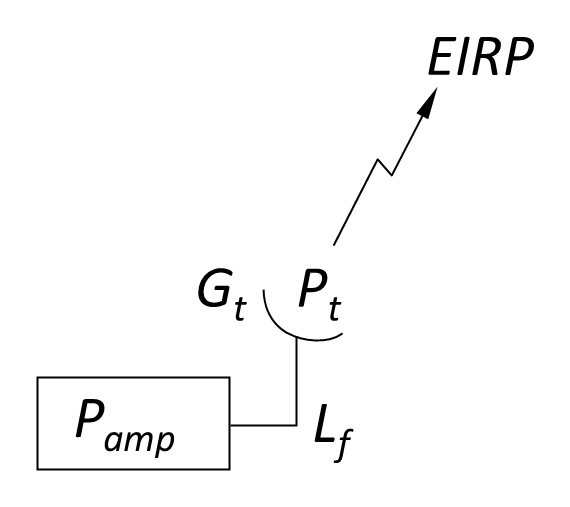
A real antenna has a directional radiation pattern determined by its geometry and current distribution. In any specified far-field direction, its power density can be represented by the effective isotropic radiated power (EIRP), which is the product of radiated power Pt and antenna gain Gt in that direction. EIRP is therefore direction-dependent; using the antenna's maximum gain gives the maximum main-beam EIRP and does not imply that the antenna radiates that power equally in all directions. Figure 5.3 also shows that feeder loss Lf reduces the amplifier output Pamp to the power delivered to the antenna, Pt = Pamp Lf, so that:
EIRP is useful because it combines transmitter power, feeder loss, and antenna gain into the power that an isotropic radiator would require to produce the same far-field power density in the specified direction. It is an equivalent directional reference, not the total power radiated by the real antenna.
The following sections provide an understanding of a number of other basic properties of antennas and describe examples of several important types.