5.3.8 Radiation Resistance And Antenna Efficiency
Before leaving the topic of antenna input impedance, it is useful to formalize the concept of radiation resistance. Radiation resistance is defined as the equivalent resistance that accounts for the power radiated by an antenna. It is the value of resistance that, if it were dissipating power as heat, would dissipate the same amount of power as the antenna actually radiates into space.
For a half-wave dipole in free space, the radiation resistance is approximately 72 Ω. This value arises from the current distribution and geometry of the antenna and is independent of conductor losses.
As illustrated in the effective resistance model in Figure 5.7, the total antenna resistance is the sum of its radiation resistance, RR, associated with radiated power and any loss resistance, RL, associated with conductor losses, connection losses, and (for monopoles) ground losses. For a given RMS current I at the feed point, power will be associated with the radiation resistance and dissipated in the loss resistance.
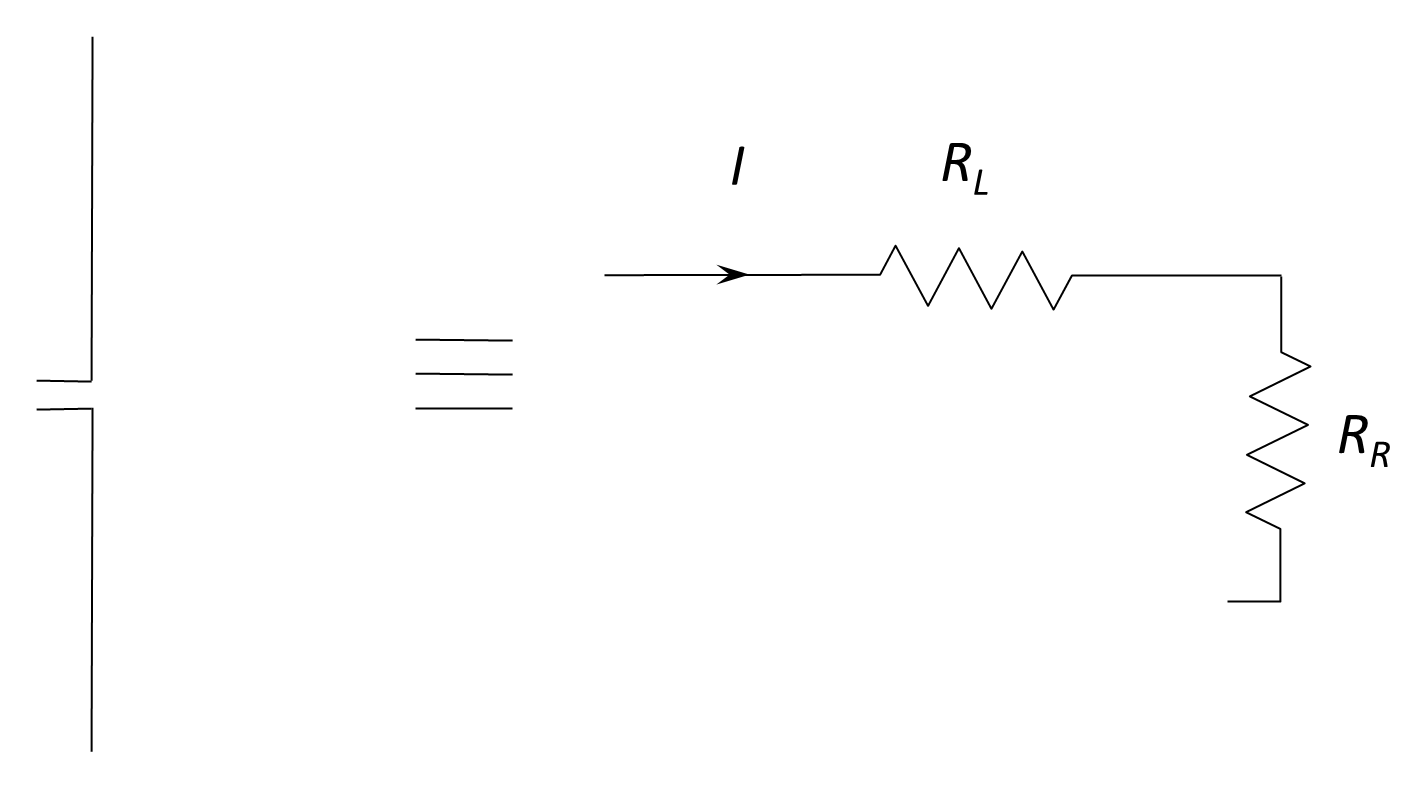
However, since the radiated power will only be from the radiation resistance, RR, with the remaining power dissipated in RL, the antenna’s efficiency is defined as the ratio of radiated power to total input power.
Consequently, antenna efficiency is the ratio of the radiation resistance to the total input resistance:
This expression shows that high antenna efficiency requires the radiation resistance to be large compared with the loss resistance. For full-sized resonant antennas, RR is typically much greater than RL, and efficiency is high. For electrically short antennas, however, radiation resistance becomes small, so even modest loss resistance can significantly reduce efficiency.
Thus, radiation resistance provides a direct link between antenna geometry, current distribution, and radiated power, while antenna efficiency quantifies how effectively the input power is converted into useful radiation rather than dissipated as loss.
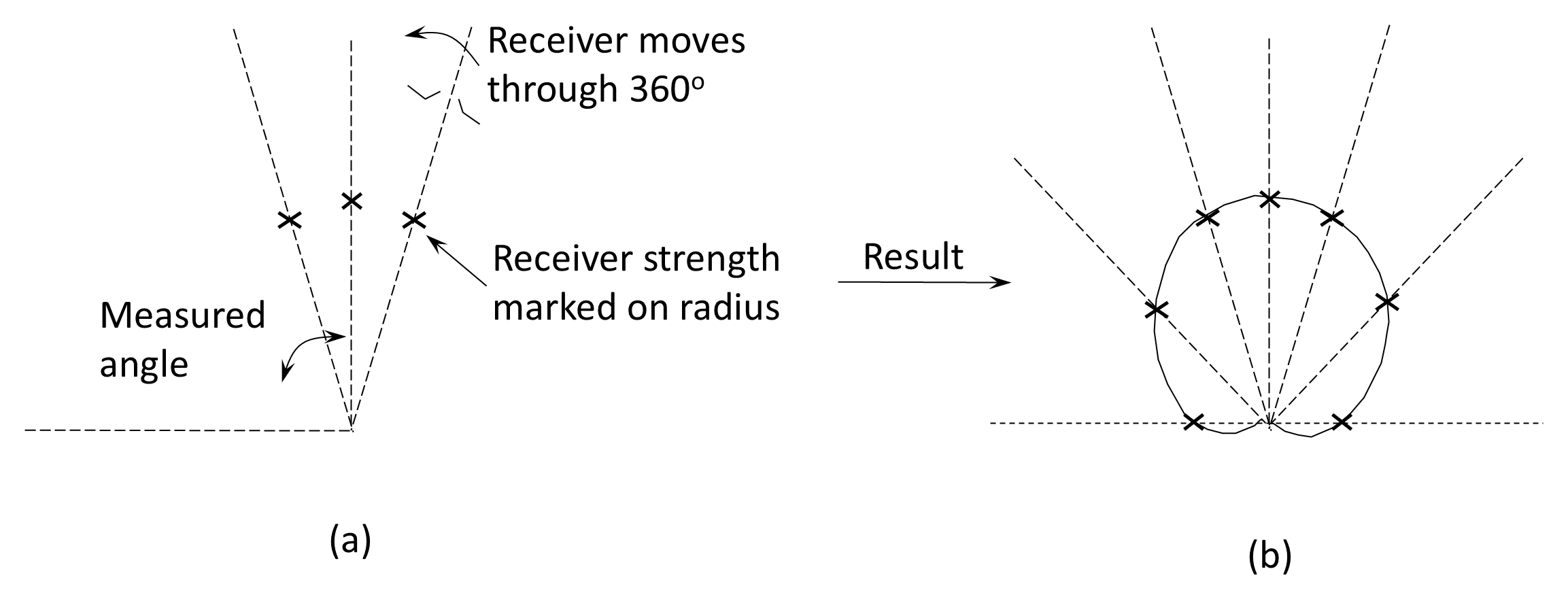
We saw earlier that, in practice, an isotropic radiator is not possible—real antennas have a radiation pattern that must be known so that they can be used effectively. As illustrated in Figure 5.8, this pattern is normally determined by moving around the transmit antenna and measuring the received power at various angles at a constant distance away from the antenna.