
8.6.2 Frequency-Selective Measurement Systems
Frequency-selective measurement systems separate received RF energy into frequency components so that individual services or transmitters can be identified and quantified. A calibrated measurement antenna or probe is connected to a measurement receiver, spectrum analyzer, or equivalent instrument. The system may determine field level, frequency, occupied bandwidth, channel occupancy, modulation characteristics, and time variation, depending on the measurement objective and instrument capability.
Figure 8.3 illustrates the principal elements of a frequency-selective measurement system. The received signal must be converted to the required field quantity using the applicable antenna factor or probe factor, together with cable-loss, impedance, preamplifier, and other system corrections.
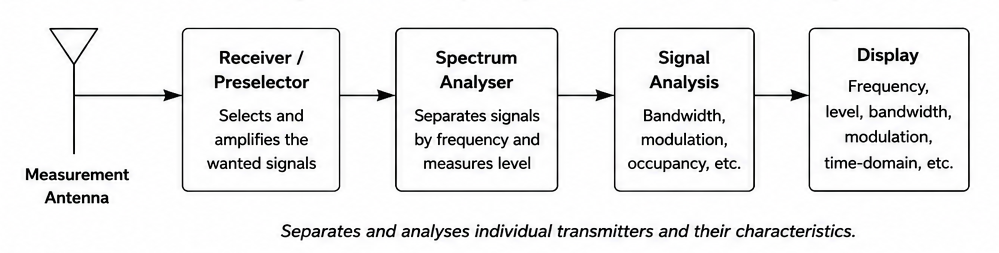
Frequency-selective measurement is particularly valuable at sites containing several transmitters or services. It can identify the principal contributors to exposure and allows contributions at different frequencies to be combined using the summation procedure specified by the applicable exposure standard. The individual field-strength values should not simply be added without regard to frequency, phase, averaging, and the form of the relevant exposure limits.
Instrument settings must be selected for the signal being assessed. Resolution bandwidth, detector mode, sweep or acquisition time, triggering, dwell time, and averaging can materially affect the reported value. Intermittent, pulsed, time-division, and beam-steered signals may require time-domain or specialized measurement functions so that both the relevant instantaneous behavior and the prescribed averaging interval are represented.
Frequency-selective systems generally require more time and operator expertise than broadband meters. They are commonly used to investigate an elevated broadband result, distinguish wanted signals from ambient sources, evaluate complex multi-frequency environments, or support a source-specific compliance assessment. Broadband and frequency-selective measurements should therefore be regarded as complementary.