
1.2 WHAT IS RF RADIATION?
Radio frequency (RF) radiation is a form of non-ionizing electromagnetic radiation used to transfer energy and information through space. Like visible light, infrared radiation, ultraviolet radiation, X-rays, and gamma rays, RF radiation forms part of the electromagnetic spectrum. These different forms of radiation differ primarily in their frequency and wavelength, which determine how they interact with matter and the applications for which they are used—see Figure 1.1.
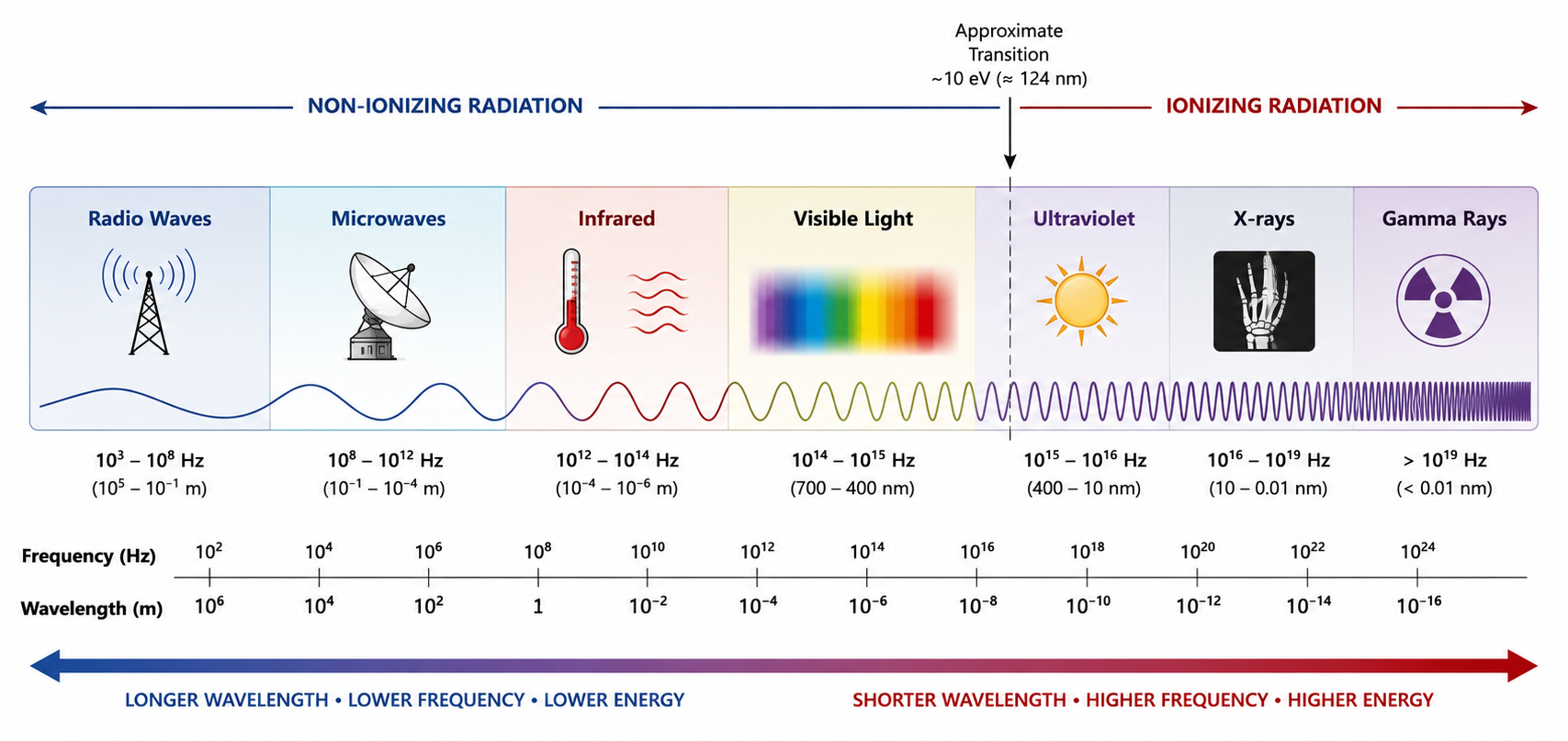
An electromagnetic wave consists of oscillating electric and magnetic fields that propagate through space at the speed of light. The electric and magnetic fields are mutually perpendicular and are also perpendicular to the direction in which the wave travels. As the wave propagates, it transports electromagnetic energy from the transmitting source to a receiving antenna or to any other object that intercepts the wave.
Unlike sound waves, electromagnetic waves do not require a physical medium through which to travel. They can propagate through air, water, many solid materials, and the vacuum of space. This property makes RF radiation particularly suitable for wireless communications, broadcasting, radar, satellite communications, remote sensing, and navigation systems.
The radio frequency spectrum extends from approximately 3 kHz to 300 GHz, although the RF safety guidelines discussed later in this book apply to the frequency range from 100 kHz to 300 GHz. Within this range are many familiar services, including AM and FM broadcasting, television, maritime and aeronautical communications, land mobile radio, mobile telephone networks, Wi-Fi, Bluetooth, satellite communications, microwave links, radar systems, and numerous industrial, scientific, and medical applications.
Although the term radiation is often associated with nuclear materials or X-rays, the word simply describes energy that is radiated or transmitted away from its source. In the context of RF engineering, radiation refers to electromagnetic energy that propagates away from an antenna in the form of electromagnetic waves. It does not imply that the radiation is ionizing or inherently hazardous.
The characteristics of an RF wave are determined principally by its frequency, wavelength, amplitude, polarization, and modulation. These properties influence how efficiently the wave propagates through the environment, how it interacts with transmitting and receiving antennas, and how it is absorbed by biological tissues. The engineering principles governing these characteristics are developed in the following chapters.
Understanding the nature of RF radiation is fundamental to RF safety because the interaction between electromagnetic fields and the human body depends strongly on frequency, field strength, exposure duration, and the distribution of energy within biological tissues. Before considering these interactions in later chapters, however, it is first useful to distinguish RF radiation from the higher-energy forms of electromagnetic radiation that are capable of ionizing atoms and molecules.