
1.6 RF RADIATION SAFETY AND WORK HEALTH AND SAFETY
RF radiation safety forms one element of an organization's overall Work Health and Safety (WHS) management system. Like electrical safety, chemical safety, fire safety, and occupational hygiene, RF safety seeks to identify workplace hazards, assess the associated risks, and implement appropriate control measures to protect workers and other people who may be affected by workplace activities.
Most countries require employers to provide, so far as is reasonably practicable, a safe working environment for employees, contractors, visitors, and members of the public. Although the legislation and terminology vary between jurisdictions, the underlying principles are similar. Hazards should be identified before work begins, the risks arising from those hazards should be assessed, and suitable control measures should be implemented to reduce those risks to an acceptable level.
Within this broader framework, as illustrated in Figure 1.4, RF radiation is treated as a workplace hazard whenever people may be exposed to electromagnetic fields capable of exceeding the applicable occupational or public exposure limits. The objective of an RF radiation safety program is therefore not simply to comply with exposure standards, but to manage RF hazards systematically throughout the entire life cycle of an installation, from initial design and commissioning through operation, maintenance, modification, and eventual decommissioning.
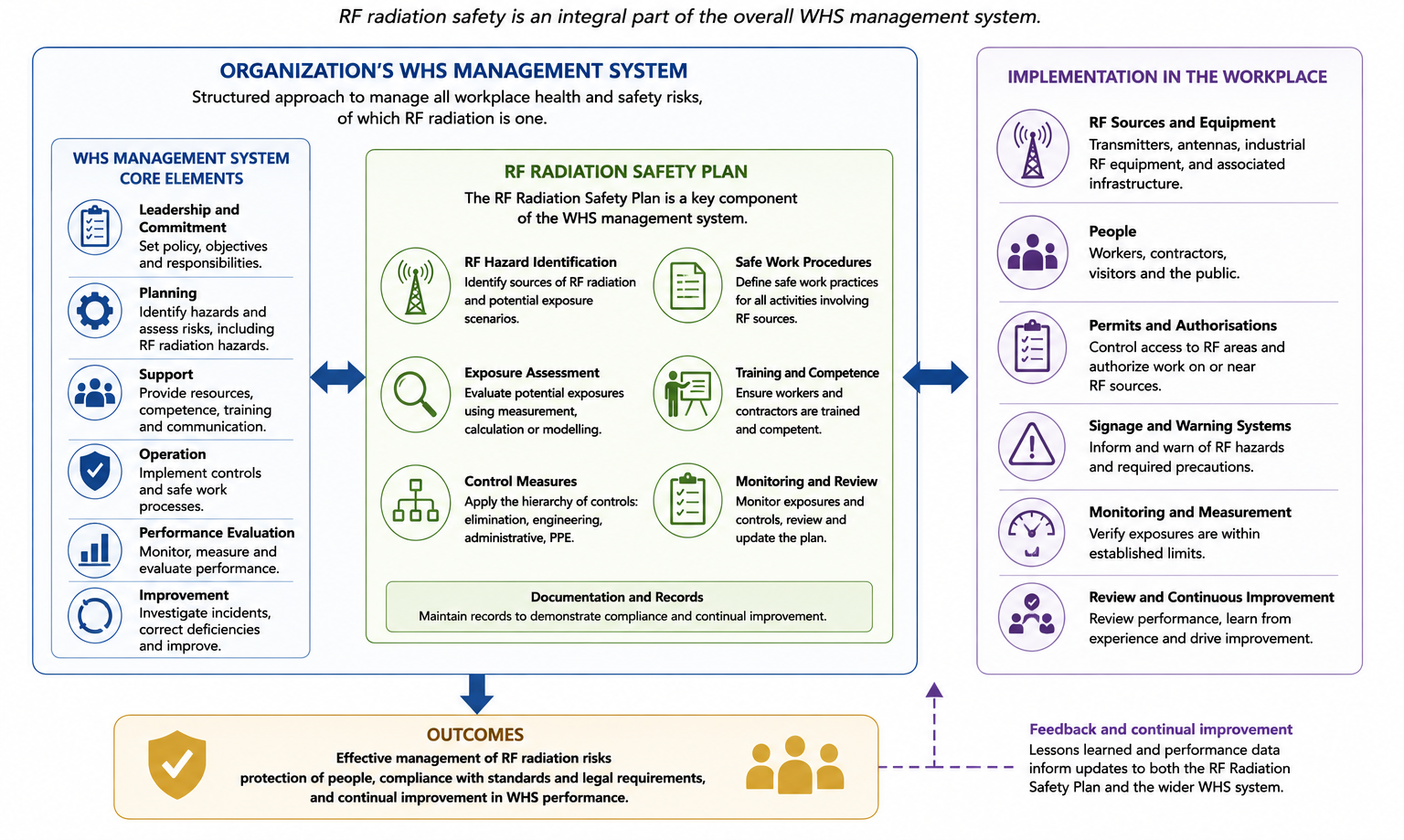
The management of RF hazards follows the same general principles applied to other workplace hazards. The process begins by identifying RF sources and determining who may be exposed. The magnitude and duration of potential exposures are then assessed using recognized engineering methods, including field measurements, analytical calculations, and computational modeling. The resulting exposure estimates are compared with the applicable RF exposure standards to determine whether additional protective measures are required.
Where unacceptable risks are identified, control measures should be implemented in accordance with the recognized hierarchy of controls. The most effective controls eliminate the hazard or reduce exposure through engineering measures, such as increasing separation distance, reducing transmitter power, improving shielding, modifying antenna orientation, or restricting access to high-field areas. Administrative controls, including work procedures, signage, permits, training, supervision, and scheduling of maintenance activities, provide additional layers of protection where engineering controls alone are insufficient. Personal protective equipment (PPE) generally plays only a limited role in RF safety and should not be regarded as the primary means of controlling RF exposure.
Effective RF safety management extends beyond engineering controls. Organizations should establish appropriate policies, assign responsibilities, maintain records, investigate incidents, review risk assessments following system modifications, and ensure that personnel receive suitable training. These activities form part of a comprehensive RF Radiation Safety Plan that integrates RF hazard management into the organization's overall WHS management system.
Although the principles of hazard identification, risk assessment, and risk control are common to many areas of workplace safety, the assessment of RF hazards requires specialized knowledge of electromagnetic fields, biological effects, exposure assessment techniques, and RF safety standards. The following chapters develop these technical foundations before Chapter 10 brings them together in a systematic approach to RF radiation safety management.