
8.6.1 Broadband Field Meters
Broadband field meters are widely used for RF safety surveys because they provide a rapid indication of the combined field from signals within the calibrated response range of the connected probe. They are well suited to locating areas of elevated field strength, checking accessible areas and exclusion zones, and determining whether a more detailed investigation is required. They do not normally identify the frequencies or transmitters responsible for the reading.
A broadband system usually consists of a portable meter and an electric-field, magnetic-field, or power-density probe. Isotropic probes commonly use three mutually perpendicular sensing elements whose outputs are combined to estimate the resultant field. Electric-field and magnetic-field probes remain different sensors. A power-density value may be measured by a suitable specialized sensor or derived from a field-strength measurement only where the required plane-wave relationship is valid.
Figure 8.2 shows the functional elements of a typical broadband RF field meter. The detector, signal processing, and display must all remain within their specified operating ranges for the indicated result to be valid.
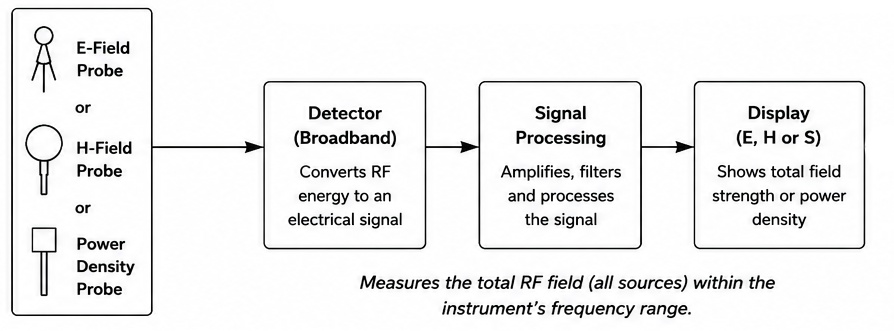
Detector technologies include diode, thermocouple, thermistor, and other true-RMS or digital detection arrangements. Their useful ranges and responses to continuous, modulated, intermittent, and pulsed signals differ. Accuracy therefore depends not only on detector type but also on signal waveform, crest factor, response time, averaging mode, dynamic range, and whether the detector is operating within its calibrated linear or square-law region.
Important limitations include frequency-response variation, imperfect isotropy, probe size, response time, and susceptibility to overload or out-of-band signals. A broadband result that combines several frequency bands cannot automatically be compared with a single exposure limit when different limits apply to the contributing frequencies. A shaped-response probe or a conservative assessment method may provide a valid screening result; otherwise, frequency-selective measurements are required.
Broadband measurements are consequently most useful as a direct compliance method where the field quantity, frequency range, response characteristics, and applicable limit are sufficiently well defined. They also provide an efficient first-stage survey before more detailed measurements are undertaken.