
7 RF INTERACTION WITH BIOLOGICAL SYSTEMS
7.1 INTRODUCTION
Chapter 6 followed RF energy through the first three stages of the physical progression: source emissions, external exposure, and the internal fields and energy absorption determined through RF dosimetry. This chapter examines the fourth stage—the biological response of the human body—and the biological-effects assessment used to determine whether a response is harmless, potentially adverse, or capable of causing injury.
RF electromagnetic fields do not possess sufficient photon energy to ionize atoms. Their established interactions with the body arise instead from induced electric fields and currents and from the absorption of electromagnetic energy. At the lower end of the RF range, sufficiently strong induced fields may stimulate nerves and muscles. Over most of the range, excessive absorbed power or energy may raise tissue temperature.
Figure 7.1 expands the final stage of the Chapter 6 framework. RF dosimetry determines the internal physical conditions; biological-effects assessment considers the resulting physiological response, whether it is adverse, and the evidence used to identify an adverse-health-effect threshold or conservative operational threshold for health protection.
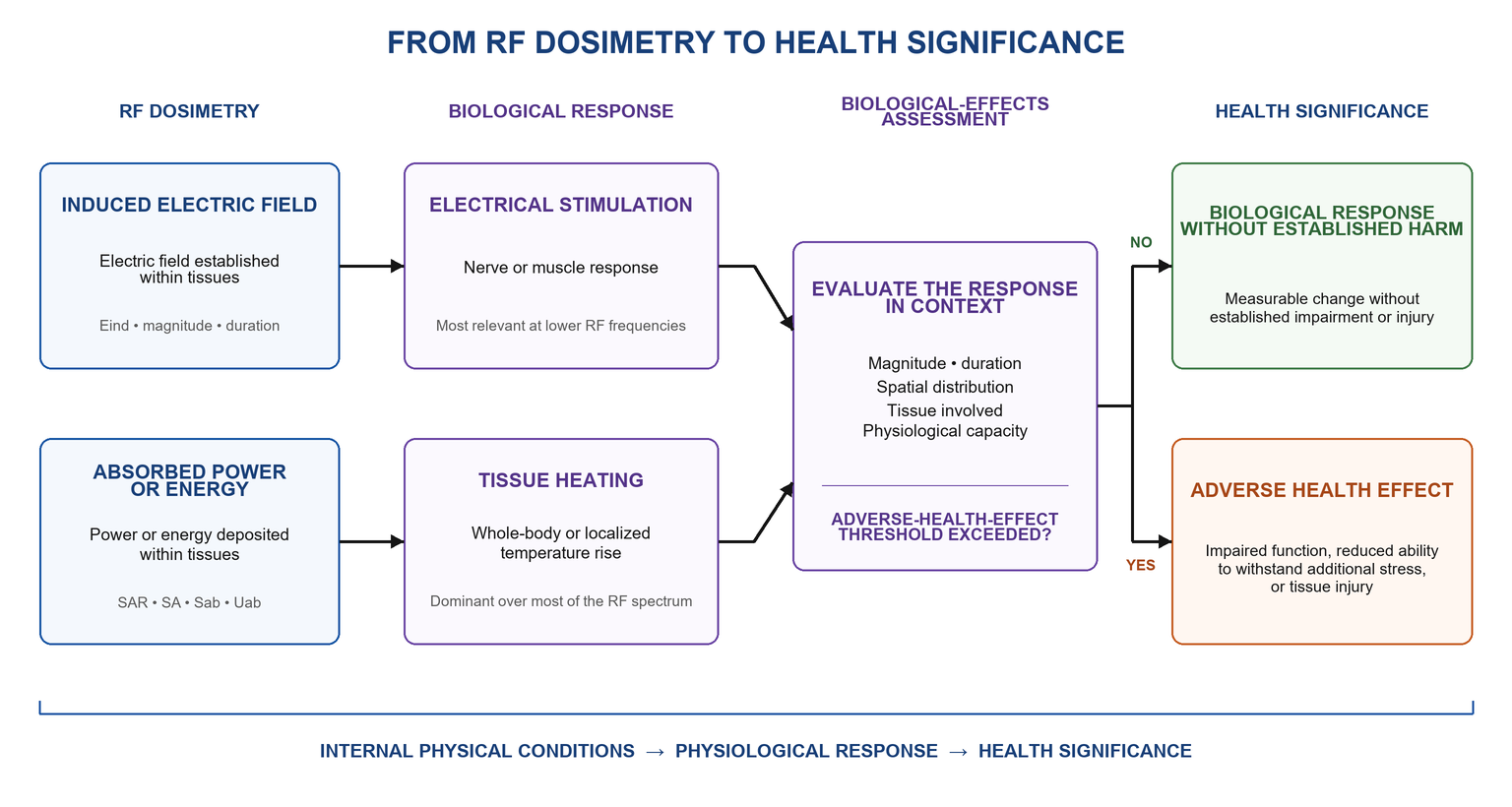
A biological response is a measurable change in a biological system and is not necessarily harmful. An adverse health effect impairs normal function, reduces the ability to withstand additional stress, or causes injury. Modern exposure guidelines are based on adverse effects supported by the weight of scientific evidence, not on every measurable response.
This chapter explains direct and indirect coupling, frequency-dependent absorption, the established interaction mechanisms, and the evaluation of reported effects. It then shows how biological evidence is translated into health-based restrictions, considers the recognition and management of suspected overexposure, and provides the bridge to the practical assessment methods in Chapter 8 and the standards discussed in Chapter 9.