
7.3 ESTABLISHED BIOLOGICAL EFFECTS
A biological response is any measurable change in a biological system following exposure. An adverse health effect is a response that impairs normal function, reduces the ability to withstand additional stress, or causes injury. Exposure restrictions are based on the latter rather than on every measurable response.
RF exposure is not assessed using the stochastic cumulative-dose model applied to ionizing radiation. Its established effects depend on the instantaneous and time-averaged internal fields, absorbed power or energy, exposure duration, spatial distribution, and the body's physiological response. RF exposure is therefore characterized by the relevant internal quantities and their time course rather than by a single cumulative dose.
The established adverse effects relevant to general RF exposure guidelines arise principally from electrostimulation at the lower frequencies and excessive whole-body or localized heating. Contact currents, spark discharges, and electromagnetic interference with medical devices are related indirect safety concerns.
7.3.1 Thermal Effects
Heating is the principal established mechanism by which RF energy can produce adverse effects over most of the RF spectrum. Absorbed electromagnetic energy is converted into heat through electrical losses in tissue. At ordinary exposure levels the additional heat is small compared with normal metabolic heat production and is removed through blood flow, thermal conduction, perspiration, respiration, and exchange with the environment.
An adverse effect becomes possible when RF energy is absorbed faster than the body or a local tissue region can dissipate the resulting heat. The outcome depends on the absorbed power, duration, spatial distribution, baseline temperature, tissue properties, blood perfusion, environmental conditions, and the body’s ability to thermoregulate.
Whole-body heating raises core temperature and can add to heat strain from work, clothing, humidity, and ambient temperature. ICNIRP treats a rise of approximately 1°C in core body temperature as the operational adverse-health-effect threshold used to derive the whole-body restrictions. The exposure restrictions are set below this threshold by applying reduction factors; they should not be interpreted as temperatures at which tissue damage suddenly begins.
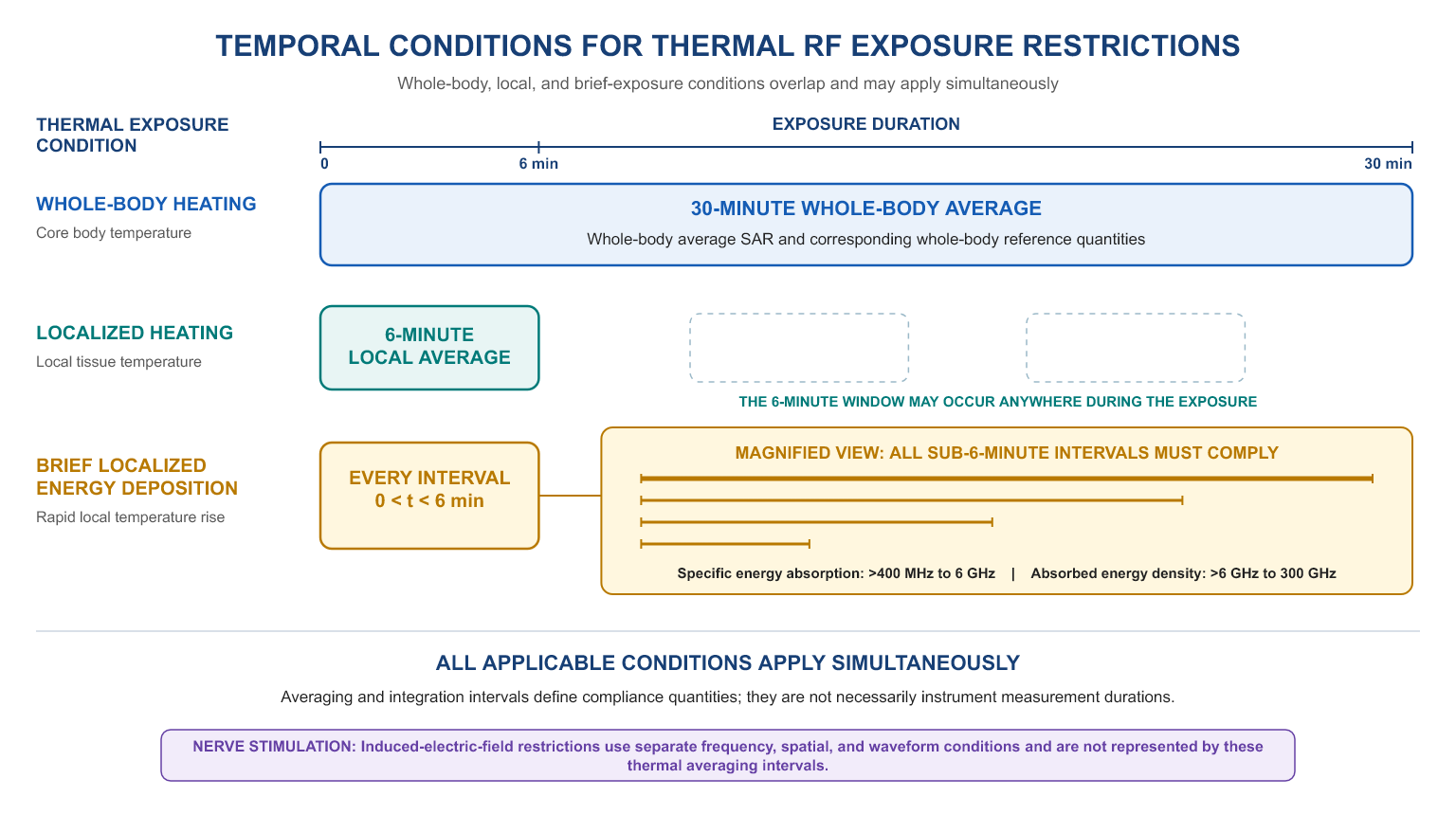
Whole-body and localized heating occur on different timescales. For whole-body exposure, ICNIRP averages whole-body SAR over 30 minutes to represent the time required for core body temperature to approach a steady state under thermal loading. This averaging provision does not permit shorter localized exposures to be ignored: all applicable whole-body, localized, and brief-exposure restrictions must be satisfied simultaneously.
For localized exposure, localized SAR up to 6 GHz and absorbed power density above 6 GHz are averaged over 6 minutes. This shorter period approximates the thermal time constant for localized exposure, including the redistribution and removal of heat through conduction and blood perfusion. It limits local temperature rise that might occur without materially changing core body temperature.
A 6-minute average alone may not adequately control a brief, intense exposure if energy is deposited faster than it can diffuse through the tissue. ICNIRP therefore imposes additional time-dependent restrictions for brief localized exposure above 400 MHz. Specific energy absorption is used above 400 MHz and up to 6 GHz, and absorbed energy density is used above 6 GHz. These restrictions must be satisfied for every applicable integration interval greater than zero and shorter than 6 minutes, including individual pulses, groups of pulses, portions of a pulse train, and the total exposure delivered during the interval. Below or at 400 MHz, ICNIRP does not require an additional brief-exposure restriction because the penetration depth and the 6-minute localized-SAR restriction adequately control temperature rise, as illustrated in Figure 7.3.
Localized heating occurs when absorption is concentrated in a limited part of the body, such as near a source used close to the body or in a strongly non-uniform field. It can produce discomfort or thermal injury without materially changing core temperature. Local response depends on the tissue and its ability to distribute and remove heat, so a single universal local temperature-rise threshold is not appropriate for every body region.
The eyes and testes have historically received particular attention because of their thermal characteristics. Severe experimental exposure can damage ocular tissues, including the lens, and excessive testicular heating can impair reproductive function. These observations should not be taken to imply that ordinary exposure below applicable restrictions presents a demonstrated risk of cataract or reproductive injury.
Heating patterns vary continuously with frequency and exposure geometry. Lower-frequency fields may contribute to deeper or whole-body absorption, while at higher microwave and millimeter-wave frequencies absorption becomes progressively more superficial. Grounding and posture can also concentrate current in parts of the body, including the legs and ankles, but this is exposure-specific rather than a universal anatomical bottleneck.