
6 EMISSIONS, EXPOSURE, AND DOSIMETRY
6.1 INTRODUCTION
When considering how RF sources may affect people, it is useful to distinguish the four stages in the physical progression illustrated in Figure 6-1: source emissions → external exposure → internal fields and energy absorption → biological response. Each stage has a corresponding assessment activity: source characterization → exposure assessment → RF dosimetry → biological effects assessment.
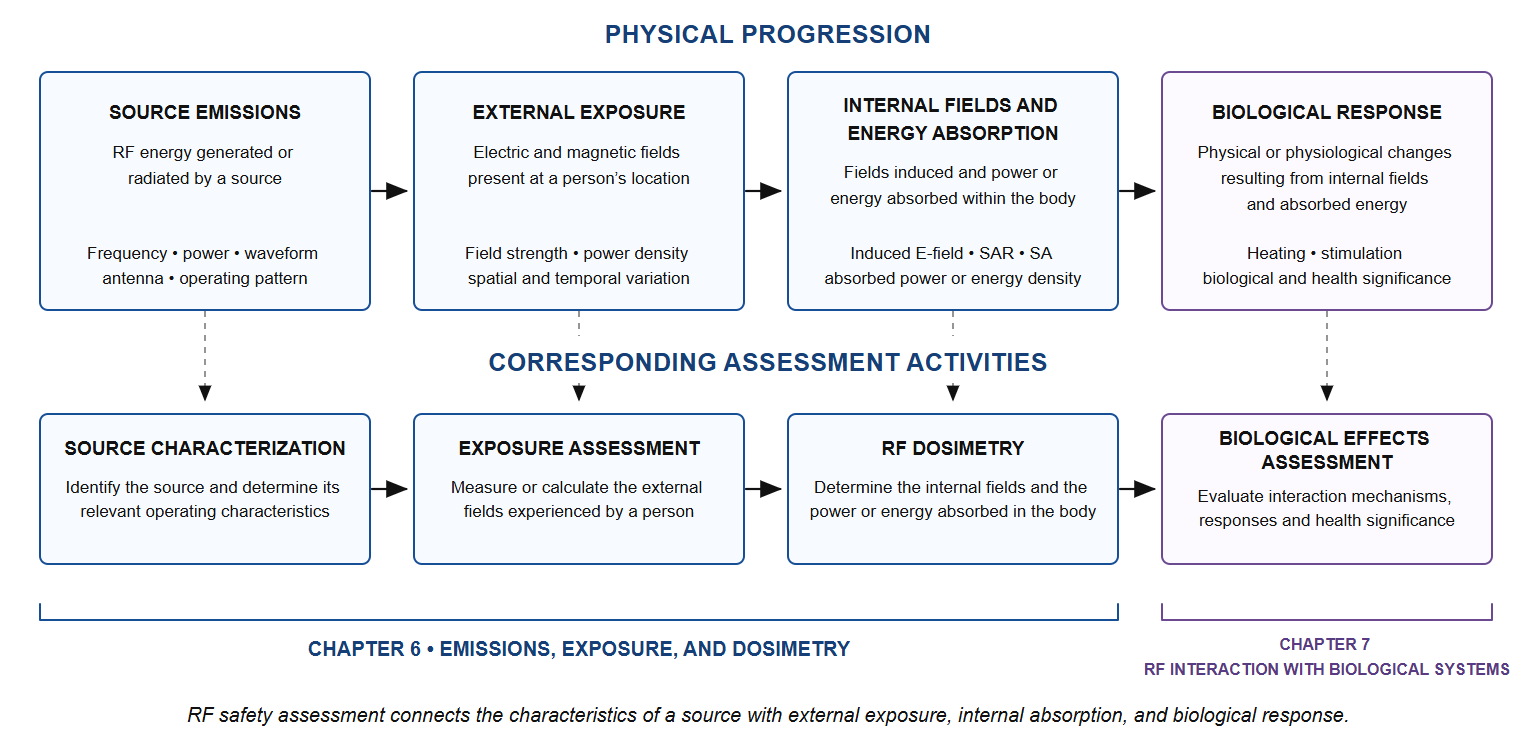
This chapter considers the first three activities. It examines the characteristics of RF sources, the external fields to which people may be exposed, and the dosimetric methods used to determine the fields induced and the power or energy absorbed within the body. Chapter 7 examines the resulting biological responses and their significance for RF radiation safety.
Source characterization establishes the operating conditions and emission characteristics of an RF source. Relevant characteristics include its operating frequency, transmitter power, frequency-domain and time-domain distributions, modulation, duty cycle, polarization, and antenna radiation pattern. Together, these factors determine how much RF energy is emitted, when it is emitted, and how it is distributed in frequency, time, and space.
Exposure assessment determines the external electromagnetic fields present where a person may be located. These fields depend not only on the nature of source emissions but also on the person’s distance and orientation relative to the source, whether the exposure occurs in the near field or far field, and the influence of the surrounding environment. Reflection, shielding, diffraction, and scattering can substantially alter the fields. Exposure is therefore assessed using quantities such as electric field strength, magnetic field strength, and, where appropriate, incident power density, as measured at the exposed person, not the source.
Being able to characterize the fields to which a person is exposed is not sufficient, however, since the health effects will be related to the internal response of the body. RF dosimetry relates these external exposure conditions to the fields induced and the power or energy absorbed within the body. The resulting internal quantities depend on operating frequency, body size and posture, orientation relative to the field, and the electrical properties of the tissues. When an RF source is used very close to or against the body, the source and the person may be mutually coupled: the presence of the body alters the source’s radiation characteristics, and internal absorption cannot be inferred reliably from free-space emissions alone. In these situations, source characterization, exposure assessment, and RF dosimetry must be considered together.
RF emissions arise from both natural and human-made sources, although human-made sources dominate most practical exposure situations. The following sections introduce the principal natural and human-made RF sources and summarize their typical operating characteristics.