
5.3.4 Low Sidelobes
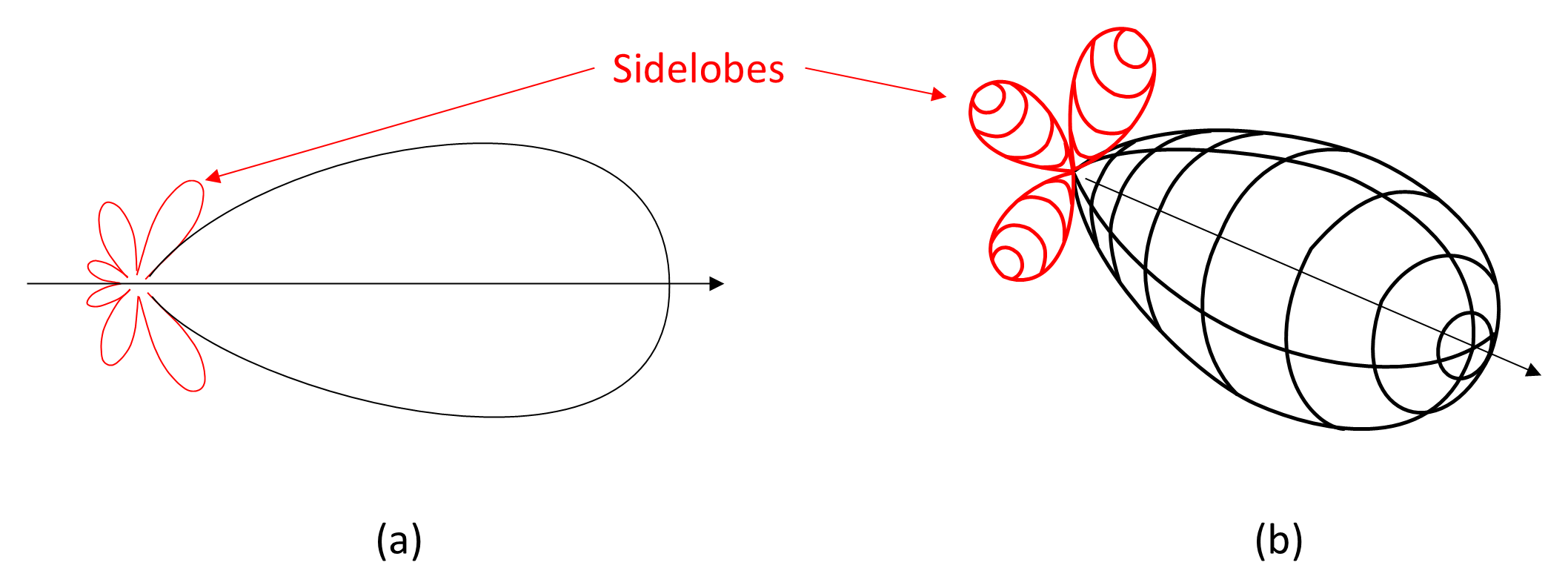
We should also note at this point that the gain function in Figure 5.4 is unrealistic because real gain functions are the result of the addition of fields that are in and out of phase, which results in the desired gain function but also results in a number of sidelobes that provide an amount of gain in other than the intended direction. Figure 5.5 shows the sidelobes in two and three dimensions. Sidelobes are not desirable for a number of reasons: first, they waste power because some power is transmitted in unwanted directions; and second, they cause interference in collocated transmitters receivers.
5.3.5 Polarization
Chapter 4 defined the polarization of an electromagnetic wave by the orientation of its electric field. In Figure 5.2, the electric field lies in one plane as it moves away from the wire, so the radiated wave is linearly polarized. For a simple wire antenna, the polarization is normally parallel to the wire: a vertical wire produces vertical polarization and a horizontal wire produces horizontal polarization.
The polarization of an antenna is an important property. Clearly, for example, if the current on a vertical transmit antenna results in a radiated field with a vertical polarization, that energy will only be induced into current in the wire of a vertical receive antenna. That is, for wire antennas such as a dipole or monopole, a vertically polarized transmission requires both transmit and receive antennas to be vertical; horizontally polarized transmission requires horizontal antennas, and so on.