
1.7 HOW RF SAFETY IS ACHIEVED
RF radiation safety is achieved through a systematic process that combines scientific understanding, engineering practice, exposure assessment, recognized standards, and effective safety management. Rather than relying on a single protective measure, modern RF safety employs multiple complementary controls that together ensure people are not exposed to electromagnetic fields capable of producing established adverse health effects.
As illustrated in Figure 1.5, the process begins with an understanding of the RF source itself. Every transmitting system produces electromagnetic fields whose characteristics depend upon factors such as operating frequency, transmitter power, antenna design, modulation, and the surrounding environment. These characteristics determine how RF energy propagates through space and the manner in which people may be exposed.
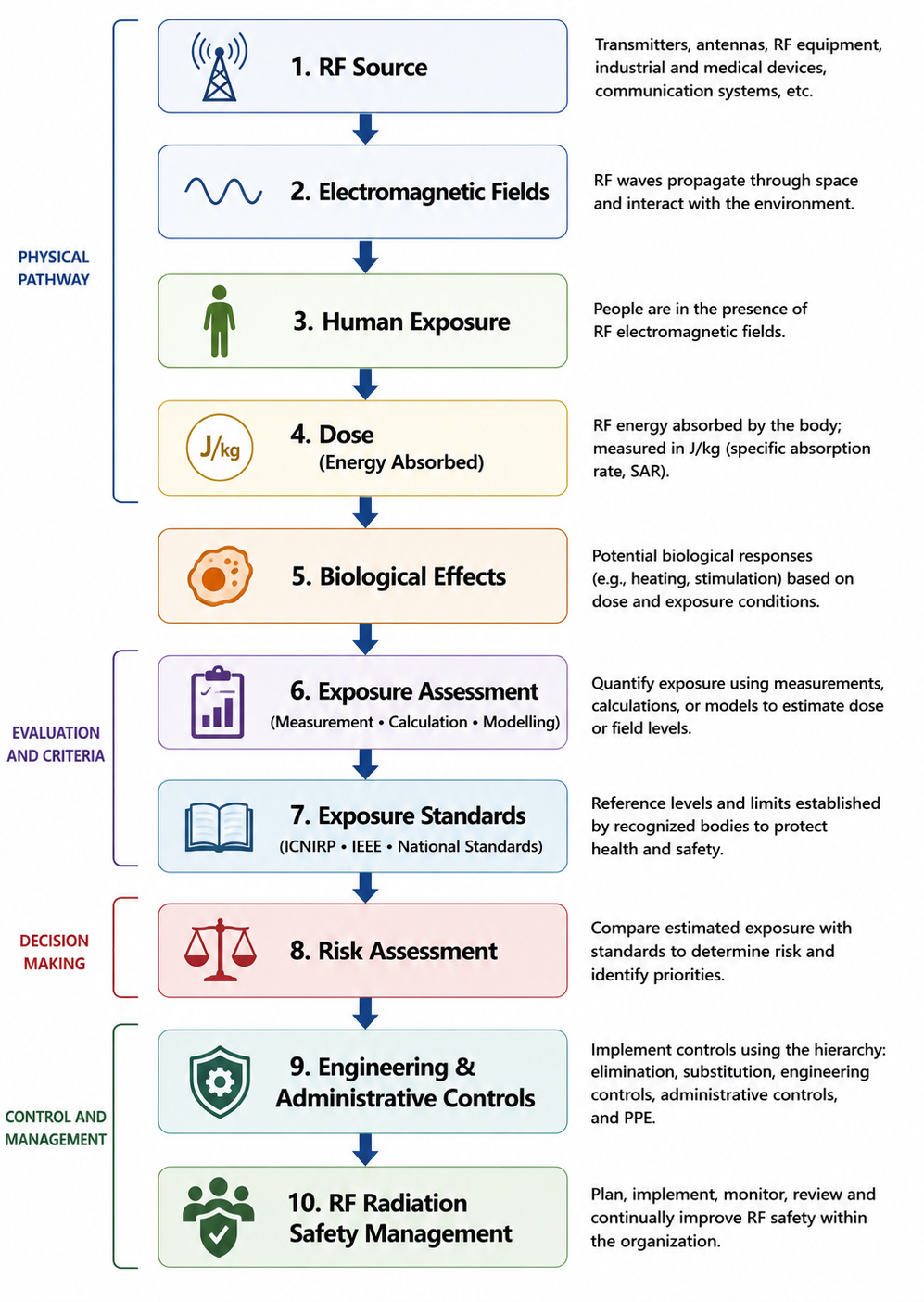
The next step is to determine the exposure that may result from the RF source. Exposure depends not only on the transmitter but also on the distance from the antenna, its radiation pattern, the presence of reflections from surrounding structures, and the duration of the exposure. Because these factors vary from one installation to another, each exposure situation must be assessed individually.
Exposure alone does not determine whether a hazard exists. The biological effects of RF radiation depend upon the amount of electromagnetic energy absorbed by the body and the distribution of that energy within biological tissues. Modern RF safety is therefore based on dosimetric quantities, such as induced electric field strength, specific absorption rate (SAR), absorbed power density, and absorbed energy density, which are directly related to the mechanisms responsible for established adverse health effects.
Once the potential exposure has been identified, it must be assessed using recognized engineering methods. Depending upon the characteristics of the RF source, this assessment may involve direct measurements of electric and magnetic fields, analytical calculations, computational modeling, or combinations of these techniques. The objective is to determine the physical quantities that are compared with the applicable exposure limits.
The measured or calculated quantities are then evaluated against recognized RF exposure standards. International organizations such as the International Commission on Non-Ionizing Radiation Protection (ICNIRP) and the Institute of Electrical and Electronics Engineers (IEEE) publish scientifically based exposure recommendations that are incorporated into national standards and regulations. These standards specify exposure limits that are intended to protect both occupationally exposed workers and members of the general public from established adverse health effects.
Where assessments indicate that exposures may approach or exceed the applicable limits, appropriate control measures are implemented. These may include engineering controls, such as increasing separation distances, modifying antenna orientation, reducing transmitter power, or improving shielding, together with administrative controls such as restricted access, warning signs, safe work procedures, permit systems, and personnel training. The objective is to ensure that RF exposure remains within the recognized limits throughout the operational life of the installation.
Effective RF safety is therefore not achieved by any single activity but through the integration of science, engineering, standards, and safety management into a comprehensive process. Each stage builds upon the previous one, ensuring that exposure is understood, assessed, controlled, and managed using internationally accepted principles and engineering practice.