
1.4 SOURCES OF RF RADIATION
Radio frequency (RF) electromagnetic radiation occurs naturally throughout the universe and is also generated intentionally by an enormous variety of human-made systems. Although modern communications technologies have greatly increased the number of artificial RF sources, natural RF radiation has existed since long before the appearance of life on Earth. Consequently, people have always lived in the presence of naturally occurring electromagnetic fields while increasingly sharing that environment with RF systems developed for communications, navigation, scientific, industrial, and medical applications. Figure 1.3 illustrates examples of natural and artificial sources of RF radiation.
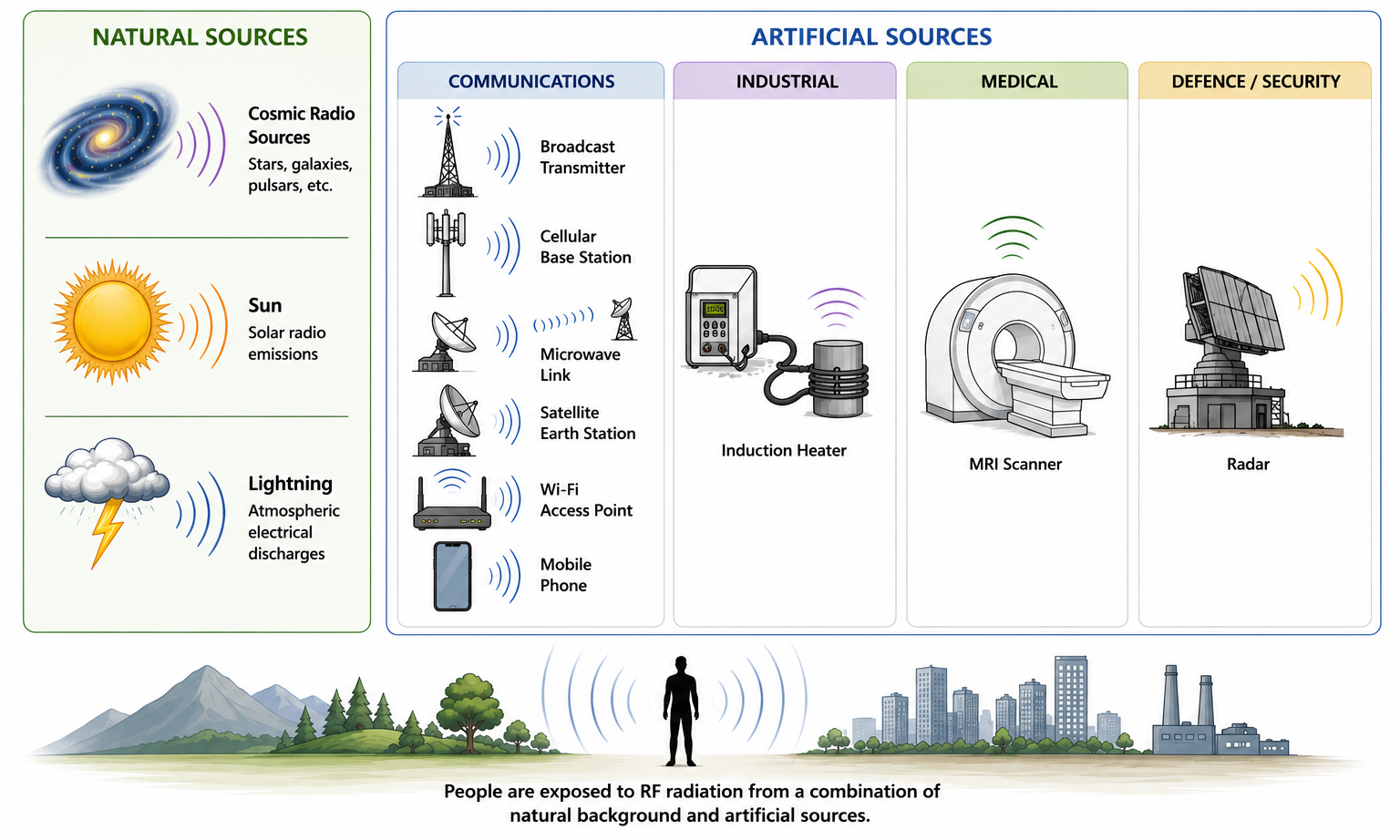
1.4.1 Natural Sources
Natural RF radiation arises from a variety of physical processes occurring both within the Earth's atmosphere and throughout the universe.
The Sun is the most significant natural source of radio-frequency electromagnetic radiation. In addition to visible light and infrared radiation, the Sun continuously emits radio waves generated by activity within its atmosphere. During periods of increased solar activity, such as solar flares and coronal mass ejections, these emissions can become sufficiently intense to affect radio communications, satellite systems, and navigation services.
Lightning discharges are another important natural source of RF energy. Every lightning strike generates a broad spectrum of electromagnetic radiation extending from very low frequencies into the microwave region. These emissions contribute to the natural background radio noise present throughout the atmosphere and are responsible for the characteristic crackling heard on radio receivers during thunderstorms.
Additional natural sources include cosmic radio emissions from distant stars and galaxies, the Earth's own thermal radiation, and weak atmospheric emissions produced by natural electrical activity. Although these sources contribute to the background electromagnetic environment, they are generally much weaker than nearby artificial RF transmitters.