
F MODULES
F.1 MODULE—SIMPLE INFLOW / OUTFLOW
F.1.1 General Description
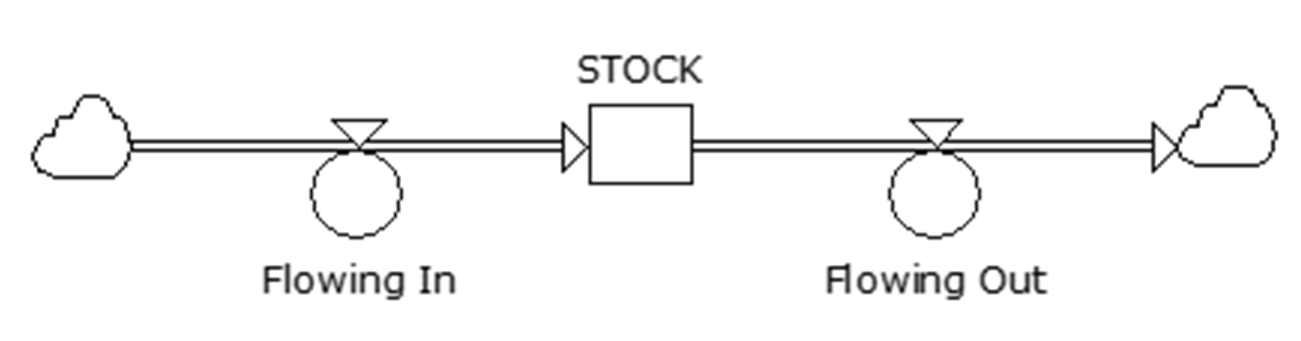
A single stock (level or accumulator) with simple inflow and outflow, which might be conceptualised as a bathtub is simultaneously filled through a pipe from a source outside the defined problem space and drained via another pipe to a sink somewhere else outside the defined problem space. By itself, Flowing In increases the contents of STOCK. By itself, Flowing Out decreases the contents of STOCK. There can be any numbers of flows in and flows out. This module is also known as ‘Level’, ‘State’, ‘Accumulator’ or ‘Integration’.
F.1.2 Module Influence Diagram
The influence diagram for this module is shown in Figure F1-2.

F.1.3 Reference Sources
This module is described here after Roberts, et al. (1983: 289), Wolstenholme (1990: 13), Coyle (1996: 38), Hines, et al. (1996; 1997; 2000: 6-7) and Sterman (2000: 194 and 239-241). Further explanation of this module can be found at Sterman (2000: 194 and 239-241).
F.1.4 Application
All system dynamics models have at least one stock, with at least one inflow and one outflow. This is a most fundamental module. See example described in Chapter 3. This module forms the basis for confirming graphical integration and differentiation exercises described by Sterman (2000: 234-241). In many situations the quantity of a stock cannot be allowed to become negative. Chapter 3 demonstrates how to construct models to ensure that the stock does not produce erroneous negative values.
F.1.5 Application Example—Causal Diagram Representations
The influence diagram for this example is shown in Figure F1-3. The stock-and-flow diagram for this example is shown in Figure F1-4.


F.1.6 Functional Description
The functions of the various parts of the module are described in Table F1-1.
Table F1-1. Functional Description—BATHTUB with Simple Inflow / Outflow
Variable | Function | Comment |
|---|---|---|
Flowing In | Defined as required. See example in Chapter 3. | |
BATHTUB | x | Initial Bathtub + dt * (Flowing In) – dt * (Flowing Out) Initial Bathtub = x Units: <<material>> |
Flowing Out | Defined as required. See example in Chapter 3. |
References
- Roberts, N.R., Andersen, D.F., Deal, R.M., Garet, M.S. and Shafer, W.A., 1983, Introduction to Computer Simulation: The System Dynamics Approach, Productivity Press, Portland Oregon.
- Wolstenholme, E.F., 1990, System Enquiry: A System Dynamics Approach, John Wiley and Sons, Chichester. UK.
- Coyle, R.G., 1996, System Dynamics Modelling: A Practical Approach, Chapman and Hall, London.
- Hines, J., et al., 1996, Molecules of Structure: Building Blocks for System Dynamics Models, Version 1.1, LeapTec and Ventana Systems, Inc.
- Sterman, J.D., 2000, Business Dynamics: Systems Thinking and Modelling for a Complex World, Irwin McGraw-Hill.