
1.1.2 Extending The Physical Example—Simple Pendulum Becomes A Double Pendulum
We now modify our pendulum by attaching at B a second pendulum B-C with mass m2 at C. This is shown diagrammatically at Figure 1-4. As A-B swings, because the position of A is fixed, the end B is constrained to describe a circular arc. C can swing in a circular motion around B. But B is able to move back and forth: it does not follow simple harmonic motion as the simple pendulum A-B did.
Whilst the motion of a simple pendulum is highly predictable, the motion of the double pendulum, with m1 at B, and m2 at C, is complex and can become chaotic.
A system or problem is described as being chaotic when it exhibits behaviour that is complex but that complex behaviour has attributes of both randomness and apparent order, such as patterns of behaviour over time appearing to be similar, but these do not repeat exactly. Chaotic behaviour is observed in systems or systemic problems, where small changes in initial conditions can produce markedly different behaviour.
Assume that these pendulums can only swing in a single plane (we might visualize this plane as the page upon which the diagram is printed, with the page held vertically). For the sake of simplicity, we will again ignore the effects of damping (which has the effect of progressively sapping the system’s energy) produced by resistance to motion through the air or by friction at the joints A and B.
The algebraic expression we must formulate to describe the transferring of energy between component parts and between the potential and kinetic forms, as facilitated by the pin linking the two pendulums, is complicated.
The transferring of energy between the links is defined in terms of angular velocity and angular accelerations which, in turn, are dependent upon the initial angular displacements of each of the pendulums, their masses and their lengths. Simply to demonstrate this point, instantaneous angular accelerations for each of the links A-B and B-C respectively, are:

and

where Δ is the angular displacement θ2–θ1. The equations for instantaneous angular velocities of each of the links are similarly complicated. Energy transfer occurs instantaneously as the combined effect of displacement, angular velocity and angular acceleration. So, the transfers between forms of energy and between pendulums are complicated. They are highly non-linear and their behaviour over time is impossible to describe without the aid of a computer model.
To demonstrate the consequences of highly non-linear feedback from link A-B to link B-C and vice versa, consider Figure 1-5, which shows the angular displacement θ1, of B relative to A, over time. Figure 1-6 shows representative angular displacement θ2, of C relative to B, over time.
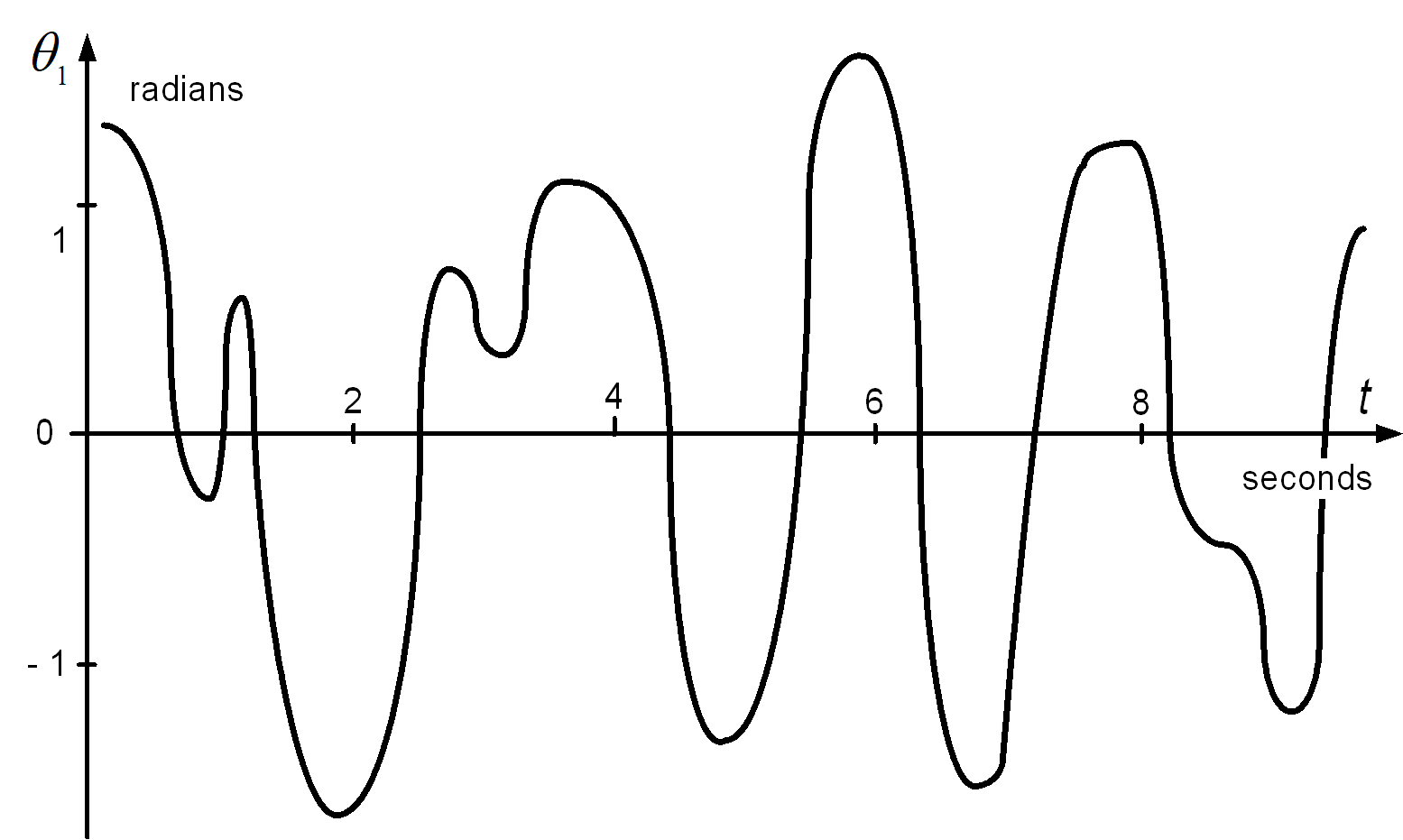
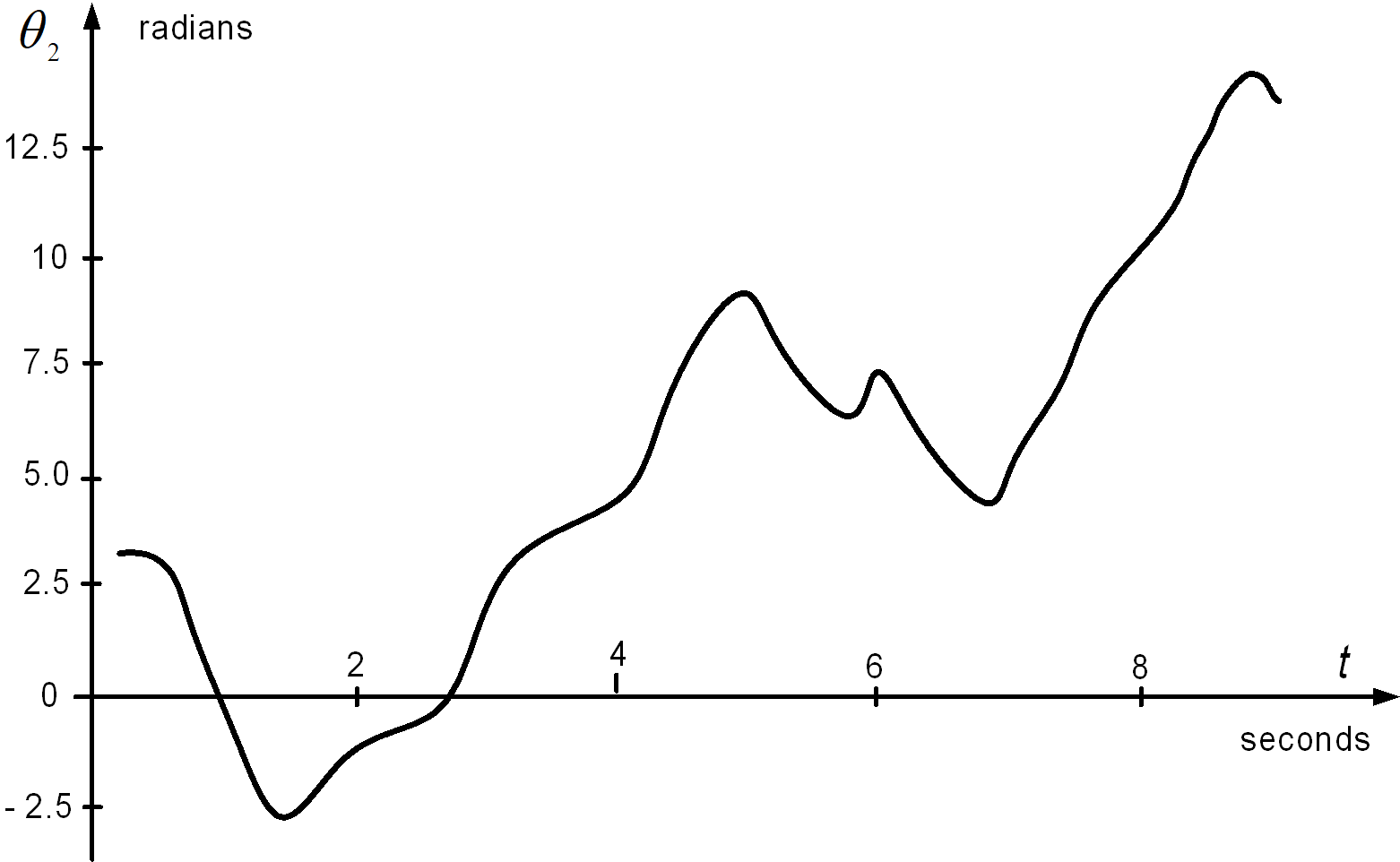
When the two angular displacements, θ1 and θ2 are plotted on the axes of the same graph, we observe motion that is vastly different to that of a simple pendulum. A more complete picture of the complex nature of the swinging of the parts of our double pendulum over time is shown at Figure 1-7.
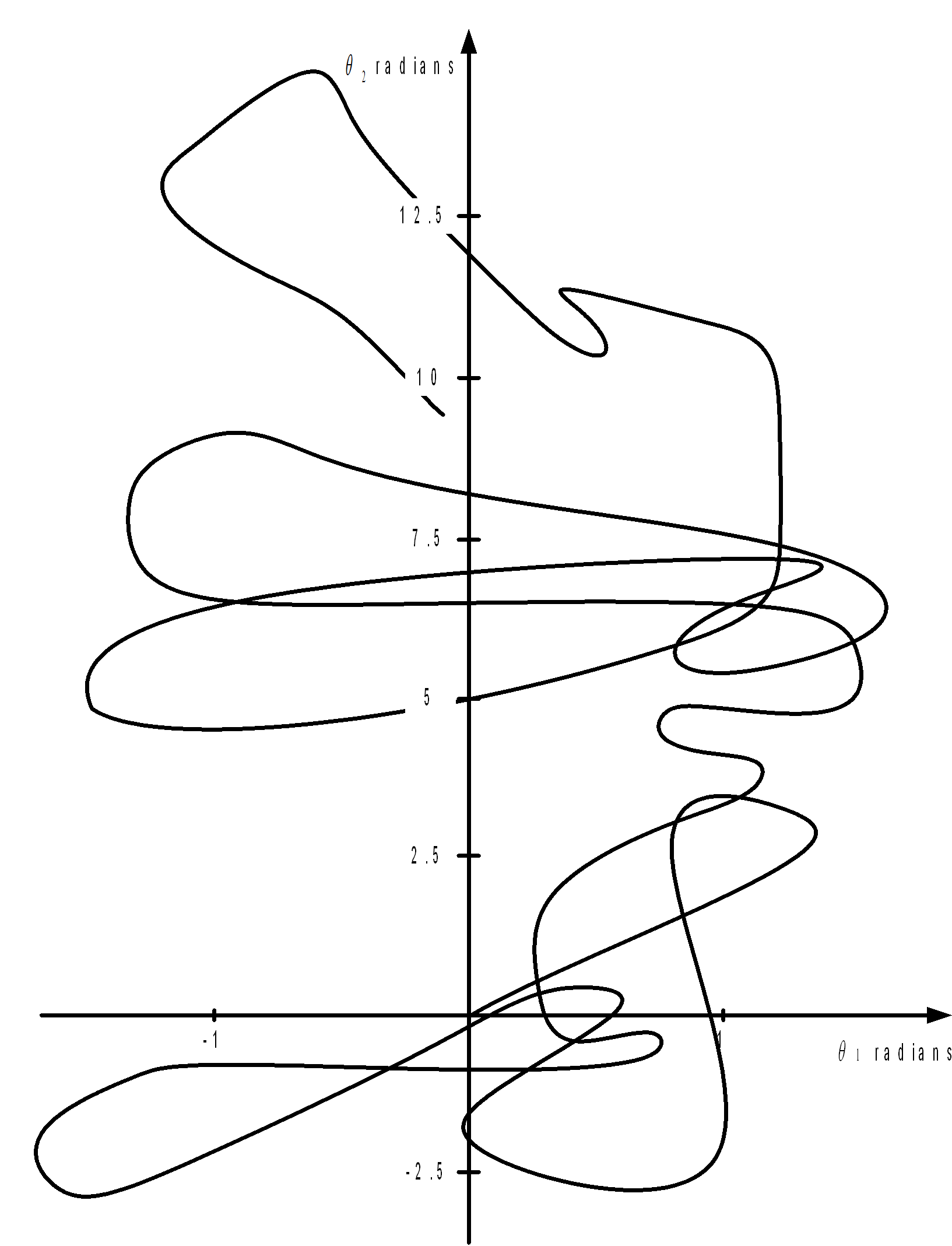
To read Figure 1-7, start at the origin and trace along the line to its free end. At regular intervals, stop and read the values of angular displacement from the relevant axes. The purpose of this example is to demonstrate that dynamic behaviour (behaviour over time) can be complex or even chaotic despite the system being made up of very simple component parts.
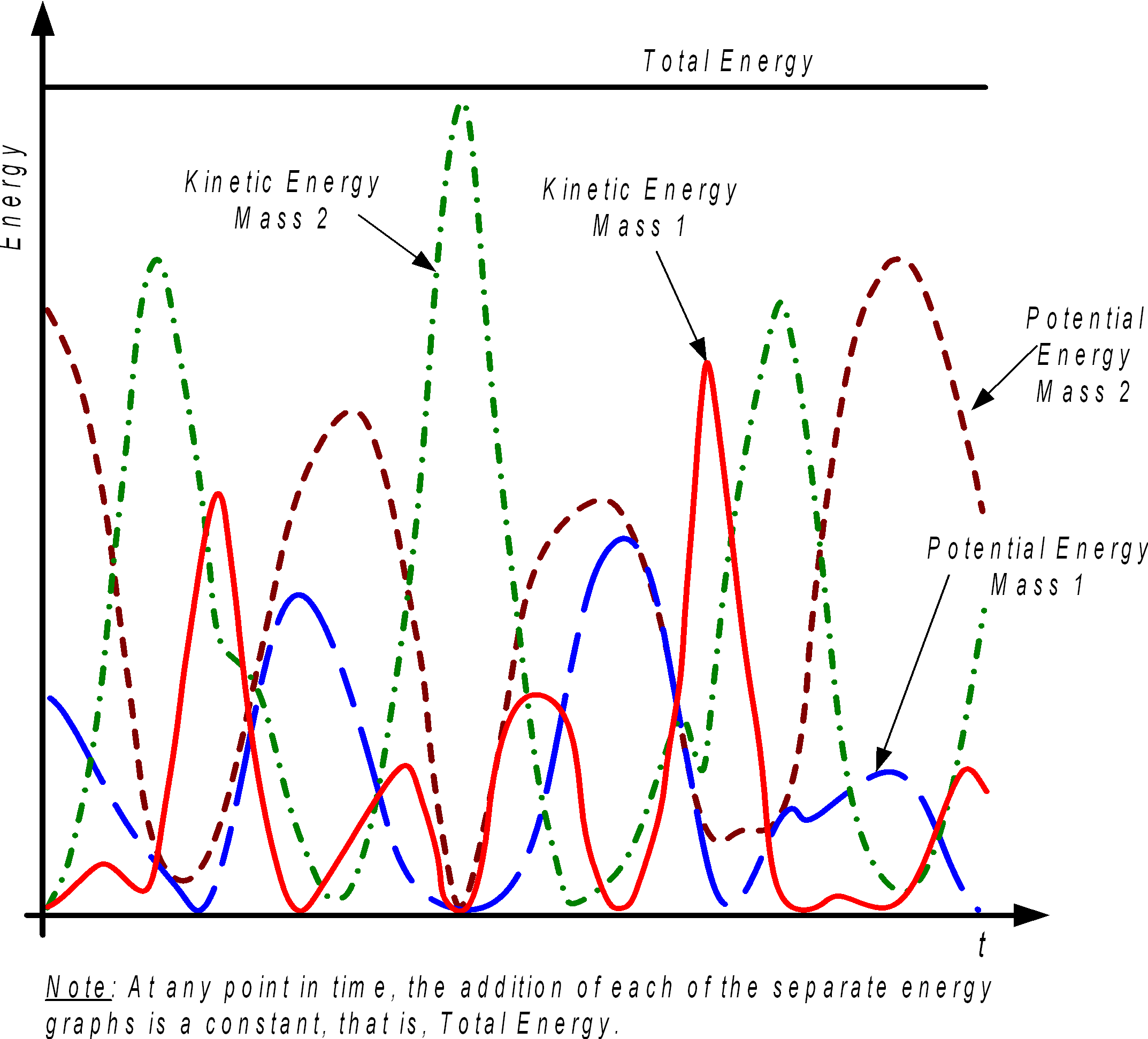
The swapping of forms of energy between each of the masses is depicted at Figure 1-8. Note that the Total Energy remains constant.
It can be daunting for us to visualize or predict the modes of swinging motion of our double pendulum.
The single pendulum is simple. It is a second-order system with simple relationships governing the flows to and from the state variables Kinetic Energy Mass1 and Potential Energy Mass1. We can use intuition to predict its rhythmic, stable and repeating behaviour. Each time we start a simple pendulum swinging, we expect that its behaviour will be exactly the same as each previous time.
We cannot use intuition to predict the behaviour of the double pendulum. Slight differences in the initial or starting conditions can produce vastly different results.
The double pendulum problem is a fourth-order problem. That is, four state variables describe the system. Figure 1-8 indicates this: the four state variables are Kinetic Energy Mass1, Potential Energy Mass1, Kinetic Energy Mass2, and Potential Energy Mass2. But the fact that this is a fourth-order problem is only a partial explanation of the difficulties we have understanding it. What makes the behaviour of the double pendulum exceedingly difficult to predict is that the physical feedback operates via the connecting joint at B, instantaneously transferring energy from one pendulum to the other, is highly non-linear. The relationships governing the transfer of energy between Kinetic Energy Mass1, Potential Energy Mass1, Kinetic Energy Mass2 and Potential Energy Mass2 are complex.
Our cognitive capacity is exceeded by the co-existence of two confounding phenomenon: one is feedback and the other is that the feedback mechanism is highly non-linear (Diehl and Sterman, 1995; Forrester, 1987; Kleinmuntz, 1985; 1993; McLucas, 2001; 2003; Mosekilde and Larson, 1988; Richardson, 1991; Sterman, 1989a; 1989b; 1989c.). Further, it is a harsh reality that almost all real-world systemic problems we might wish to address are much more complicated than a double pendulum. Forrester (1975: 63) observes that even the simplest social systems of practical interest lie in the range of tenth to hundredth order, where order is taken to mean the number of integrations (stocks or state variables) within the interconnected feedback loops. Order corresponds to the number of state variables in the problem of interest.
When dealing with complexity, the challenges that confront us are:
- Being able to analyse problems in ways that are effective in that they extend our comparatively limited cognitive skills. Our cognitive skills are outmatched by the complexity of real-world problems we have to face. Kline (1995:49-68) defines a Complexity Index (C), a quantitative measure, to help us categorise such problems. Kline takes Forrester’s point about problem complexity much further and estimates that many socio-technical problems (considered in their entirety) can be categorised by a complexity index, C >>109. Like Kline, Diehl and Sterman (1995), Klienmuntz (1985), Richardson (1991) and Sterman (1989) amongst others argue that our capacity to understand feedback is poor. Sterman (2000) observes that our cognitive capability is limited to solving reliably a first-order linear positive feedback system, the latter being categorised by a value of C approximately equal to four (only four not 104) .
- Being efficient. That is, analysis does not consume undue time and effort. We seek to have methods of analysis which enhance our understanding and enables development of clear strategies for managing complex systemic behaviours.
- Learning from our analysis—we face the questions: when is this learning valuable, and how do we know that it is?
References
- Diehl, E. and Sterman, J., 1995, “Effects of feedback complexity on dynamic decision making”, in: Organisational Behaviour and Human Decision Processes, 62, 2.
- Forrester, J.W., 1987, “Lessons from system dynamics modeling”, in: System Dynamics Review, Vol. 3, No. 2, (Summer) 1987: 136-149.
- Kleinmuntz, D.N., 1985, “Cognitive heuristics and feedback in dynamics decision environment”, in: Management Science, Vol. 31, No. 6: 680-702.
- Kleinmuntz, D.N., 1993, “Information processing and misperceptions of the implications of feedback on dynamic decision making”, in: System Dynamics Review, Vol. 9, No. 3 (Fall 1993): 223-237.
- McLucas, A.C., 2001, An Investigation into the Integration of Qualitative and Quantitiative Techniques for Addressing Systemic Complexity in the Context of Organisational Strategic Decision Making, PhD Dissertation, University of New South Wales, Canberra, Australia.
- McLucas, A.C., 2003, Decision Making, Risk Management, Systems Thinking and Situation Awareness, Argos Press, Canberra.
- Mosekilde, E. and Larsen, E.R., 1988, “Deterministic chaos in the beer production-distribution model”, in: System Dynamics Review, Vol. 4, Nos. 1-2: 131-147.
- Richardson. G.P., 1991, Feedback Thought in Social Science and Systems Theory, University of Pennsylvania Press, Philadelphia.
- Sterman, J.D., 1989a, “Misconceptions of feedback in dynamic decision making”, in Organisational and Human Decision Processes, No. 43: 301-335.
- Sterman, J.D., 1989b, “Modeling managerial behavior: Misperceptions of feedback in a dynamic decision making Experiment”, in: Management Science, Vol. 35, No. 3: 321-339.
- Sterman, J.D., 1989c, “Misperceptions of feedback in dynamic decision making”, in: Milling, P.M. and Zahn E.O.K. (eds), International System Dynamics Conference: Computer-Based Management of Complex Systems. International System Dynamics Society, Stuttgart: 21-31.
- Forrester, J.W., 1975, “The impact of feedback control concepts on the management sciences”, in: Collected Papers of Jay W. Forrester, Productivity Press: 45-60.
- Kline, S.J., 1995, Conceptual Foundations for Multidisciplinary Thinking, Stanford University Press, Stanford, California.
- Sterman, J.D., 2000, Business Dynamics: Systems Thinking and Modelling for a Complex World, Irwin McGraw-Hill.