
F.4 MODULE—TRANSITIONAL (REVERSIBLE) FLOW
F.4.1 General Description
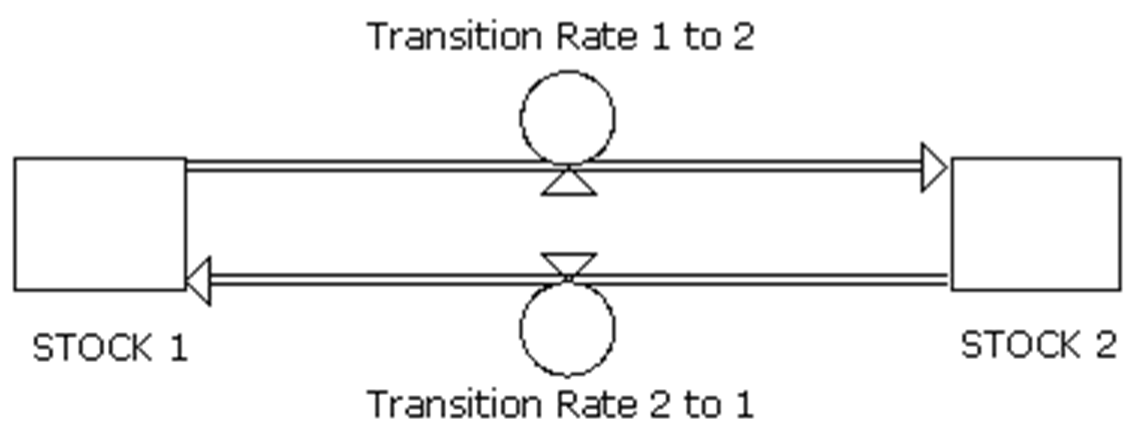
As depicted at Figure F4-1, transitional (reversible) flow occurs back and forth between two stocks. The Transition Rate rate-controlling variable is connected to the valves in each of the pipes. Each of the flows can vary from zero to a maximum value (practically limited by the capacity of the pipes). Without additional outflows or inflows, which are frequently connected in practice, this is a closed-loop system. Each stock can drain to, or fill from, the other.
F.4.2 Module Influence Diagram
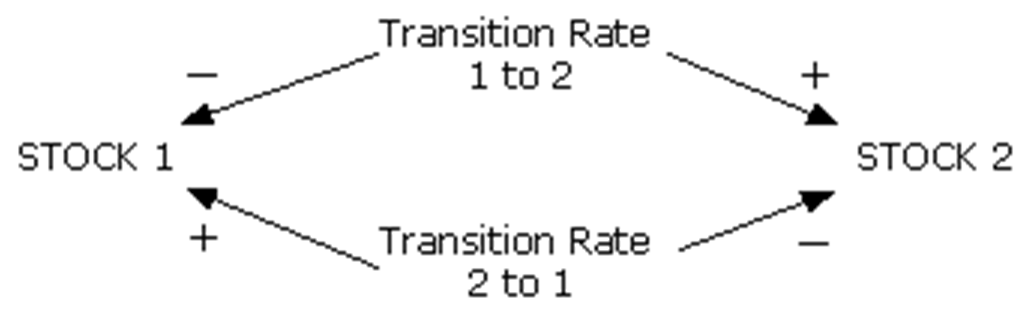
The influence diagram for this module is shown in Figure F4-2.
F.4.3 Reference Source
An application of module is described by Sterman (2000: 342-343).
F.4.4 Application
In continuous models, we would envisage flow of a fixed amount of water from one bathtub to another connected bathtub. One bathtub empties as the other one fills. A physical example of this is the swapping between potential and kinetic energy as a simple (ideal) pendulum swings. This is explained in Chapter 1.
Sterman (2000: 342) describes the Bass diffusion model in which people have adopted a product or are potential adopters of that product, there being only two states ADOPTERS and POTENTIAL ADOPTERS. Those who had adopted the product but discard it re-enter the potential customer pool. Others from the potential customer pool adopt the product.
A variation on this application might depict the deployment of limited resources between two modes. Alternatively, limited resources might be deployed between two sites, as might occur in the management of a project.
In a discrete event model, that is, where rates take on discrete values (either 0 or 1, for example), this module could be used to depict a flip-flop logic device where STOCK 1 would take on the value 0 or 1 when STOCK 2 takes on the corresponding values of 1 or 0. In such a case, Transition Rate 1 to 2 and Transition Rate 2 to 1 would be connected or replaced by a single Transition Rate variable.
F.4.5 Functional Description
The functions of the various parts of the module are described in Table F4-1.
Table F4-1. Functional Description—Transitional (Reversible) Flow
Variable | Function | Comment |
|---|---|---|
STOCK 1 | x | Initial Stock 1 + dt * (Transition Rate 2 to 1) Initial value of STOCK 1 = x Units: <<items>> or <<material>> |
Transition Rate 1 to 2 | Defined as required. | |
STOCK 2 | y | Initial Stock 2 + dt * (Transition Rate 1 to 2) Initial value of STOCK 2 = y Units: <<items>> or <<material>> |
Transition Rate 2 to 1 | Defined as required. |
References
- Sterman, J.D., 2000, Business Dynamics: Systems Thinking and Modelling for a Complex World, Irwin McGraw-Hill.