
2.2 MODELLING METHODOLOGY
This book focuses on investigating and analysing real-world behaviour through experimentation via system dynamics models. To facilitate our understanding of human activity systems, we need a generic modelling methodology. Here, the generic modelling methodology has been derived in part from the Soft Systems Methodology (SSM) developed by Checkland (1981). This is combined with systems engineering practice, systems thinking, and system dynamics modelling. In its simplest form, SSM is depicted diagrammatically in Figure 2-1.
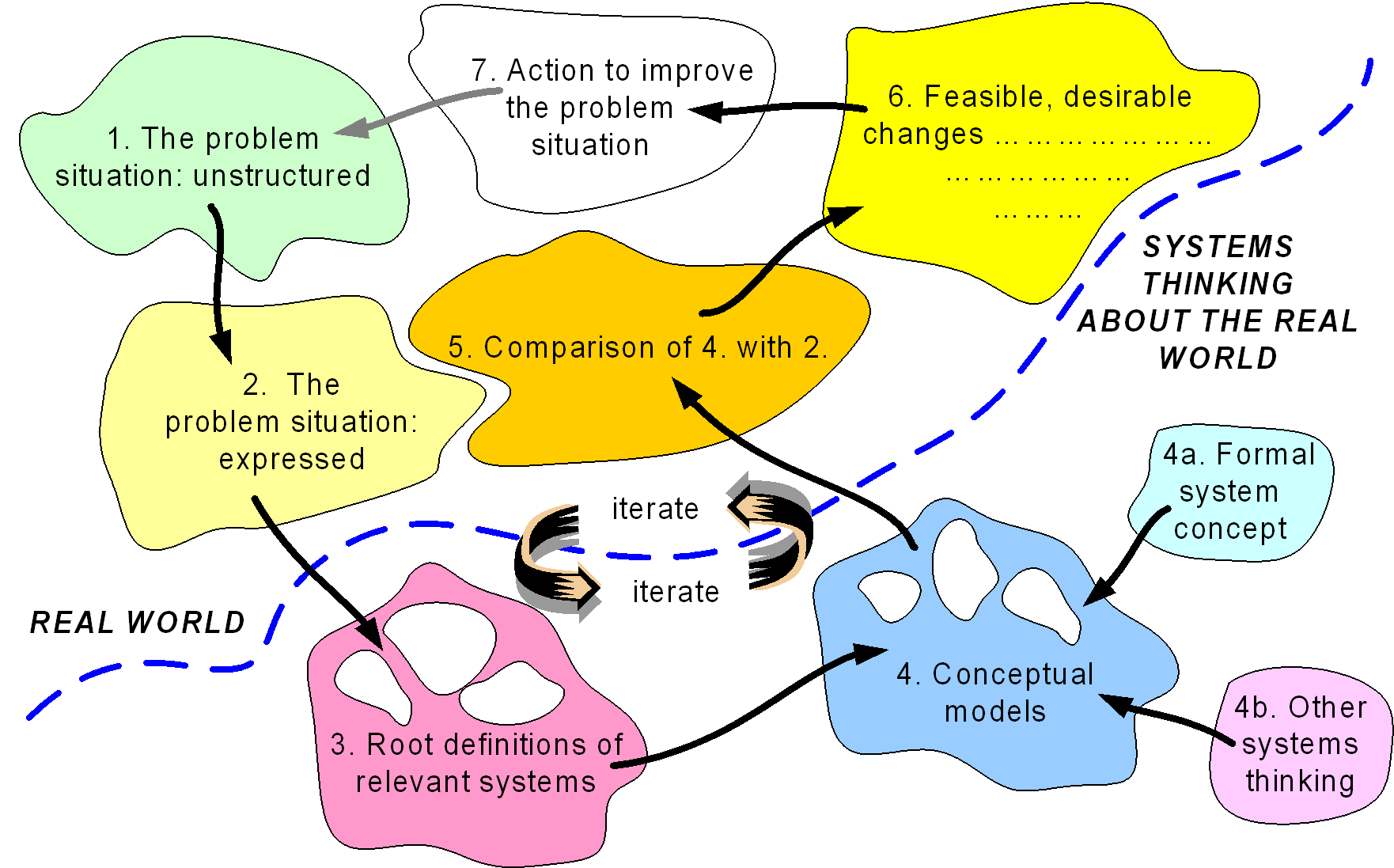
In the model of the system (below the dashed line), unlike the real world systems (depicted above the line), we can make changes to variables and structure of the problem whilst keeping other factors (artificially) unchanged. Forrester (1961) explains that such experimentation will yield new insights—by using a model of a complex problem, more can be learned about internal interactions (which produce dynamic behaviour) than would ever be possible through manipulation of the real system.
References
- Checkland, P.B., 1981, Systems Thinking, Systems Practice, John Wiley, Chichester, England.
- Forrester, J.W., 1961, Industrial Dynamics, Productivity Press, Portland, Oregon.