
1.10 THE SYSTEMS ENGINEERING ‘VEE’ MODEL APPLIED TO SYSTEM DYNAMICS MODELLING PROJECTS
Any model-building activity must be managed as a project designed to deliver specific outcomes. These outcomes include learning through experimentation with the model and delivery of a completed model. The project must be based on requirements:
- elicited with close engagement of key stakeholders, notably the client group for whom the model is being built;
- analysed for logical construction and completeness—here conflicts between requirements must be resolved whilst maintaining a minimum set of requirements which must be met (built into the model) according to priority;
- defined, that is, clearly and unambiguously specified using precise language;
- validated, that is, tested to determine the extent to which the requirements are likely to lead to development of a model which maps sufficiently onto the real-life problem space;
- managed throughout—here the modelling project must be managed in terms of its:
- scope, particularly as the meanings of modelling requirements (interpretations of dynamic hypotheses) are questioned, which often leads to pressure to change the scope of the modelling effort; and
- configuration, that is, what form the model will take and what it will include or exclude must be constantly monitored through a set of formal processes;
- traceable through each step, including:
- back to the original requirements; and
- any changes that may have been permitted through configuration management.
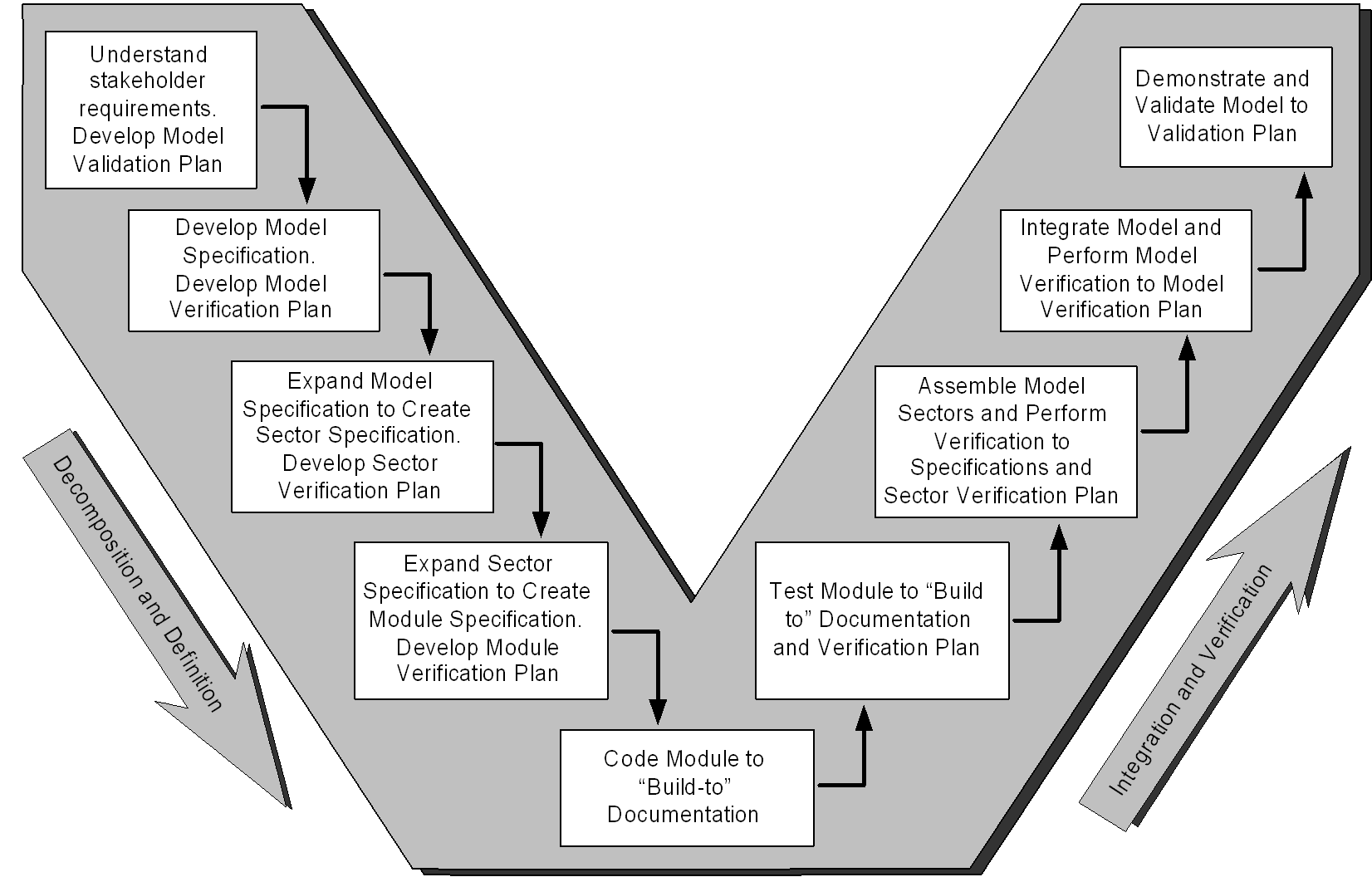
Systems engineering as it is applied to system dynamics modelling can be described as a sequential process of requirements creation and integration into a model following the arrows in Figure 1-17, (adapted after Forsberg, et al., 2000: 116). The development of the system dynamics model follows the sequence from the top left of the ‘Vee’, to the bottom, then back up to the top right.
The ‘Vee’ model is also described in standard systems engineering texts (Blanchard and Fabrycky, 1998; Sage and Rouse, 1999).
References
- Forsberg, L., Mooz, H. and Cotterman, H., 2000, Visualising Project Management, 2nd ed.m John Wiley & Sons.
- Blanchard, B.S., and Fabrycky, W.J., 1998, Systems Engineering and Analysis, 3rd ed., Prentice Hall.
- Sage, A.P., and Rouse, W.B., 1999, Handbook of Systems Engineering and Management., John Wiley and Sons, New York.