3.1.1 Basic Representation—Flowing In
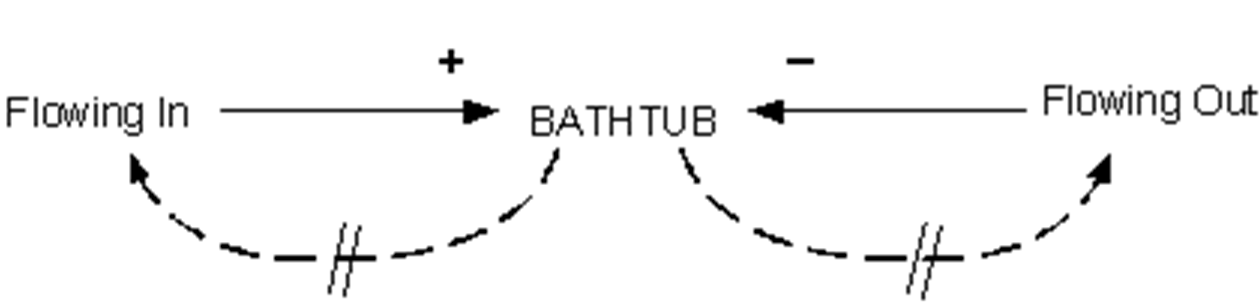
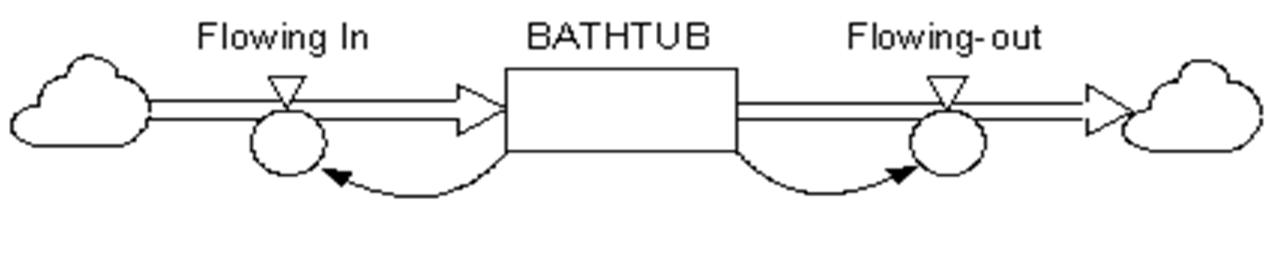
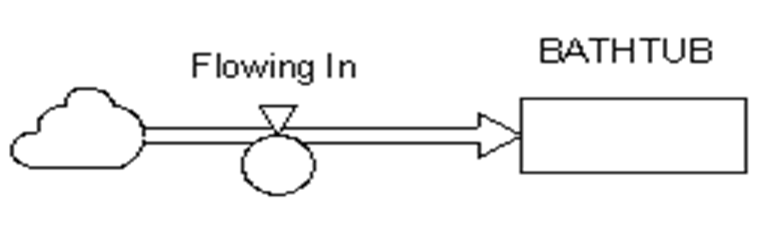
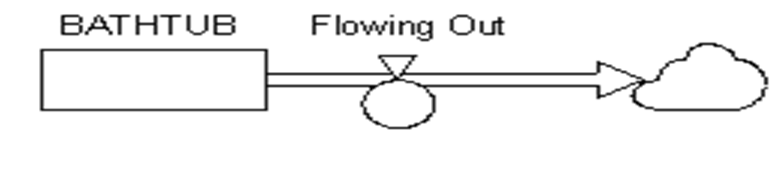
The single stock of interest is named BATHTUB. It contains a quantity of water, measured in litres. Water is added via a pipe and the rate-controlling valve, the latter being Flowing In. The flow rate is measured in litres per minute. Water is removed via a pipe and a rate-controlling valve, Flowing Out at a different rate, also measured in litres per minute.
In system dynamics modelling, bathtubs are often used as conceptual devices. In the consideration of what determines flow rates, the depth of water in the bathtub is ignored. That is, we ignore the effects of hydrostatic pressure and resistance to flow and the impacts these might have on flows through the valves. Both the bathtubs (simple accumulators) and valves (simple rate-controlling devices) are conceptual artefacts whose behaviour is not governed by the Laws of Physics.
The basic influence diagram representation of inflow to BATHTUB is at Figure 3-1. The stock-and-flow representation of inflow into the BATHTUB is at Figure 3-2.
Similar representations for outflow are at Figures 3-3 and 3-4.
In a somewhat more complete representation we might combine the three main functional elements, Flowing In, BATHTUB (a state variable—a stock, level or accumulator) and Flowing Out (a rate-controlling variable and the pipe through which flow to the outside of the defined system occurs) we represent these as an influence diagram, Figure 3-5, or a stock-and-flow diagram, Figure 3-6.




Note that in the influence diagram, Figure 3-5, and the stock-and-flow diagram, Figure 3-6, there is no suggestion that there limits to which we might add water to the bathtub or remove water from the bathtub. In reality, if we add water at rates higher than we remove it, the bathtub will simply overflow. Similarly, if we remove water at rates higher than we add it, the bathtub will drain to the point of being empty.
Further, once the bathtub is empty we can no longer remove water. That is, the stock of water in the bathtub cannot become negative. This would be physically impossible. When we build a computational model of our conceptual bathtub we must include rules, in the form of algebraic expressions that do not allow such ‘common-sense’ constraints to be violated. A more-complete set of diagrams of the influences on the state of BATHTUB, taking into account these common-sense limits, are at Figure 3-7 and Figure 3-8.