
F.2 MODULE—CASCADED STOCKS
F.2.1 General Description
Stocks are frequently daisy-chained together, or cascaded, in a sequence with alternating rate-controlling variables. Flow comes in from outside the defined module boundary via the rate-controlling variable Flowing In and exits via Flowing Out. Material or items can accumulate in each of the stocks in turn before flowing to the outside of the defined module boundary. Whilst not indicated separately, each of the stocks would be populated with initial values. Without these initial values it would take time for the flows to transition through the module, thereby creating a set of transient effects. This module is also known as ‘Chain’.
In models involving cascaded stocks and flows, problems can occur when the algebraic expressions for downstream rate-controlling auxiliaries are not properly constructed with the effect that they draw flow from upstream stocks even after those stocks have become zero. Caution must be exercised during model construction to ensure that stocks representing physical quantities are not allowed to become negative. How to ensure stocks do not become negative is demonstrated in Chapter 3, and applies equally here as it does to simple stocks.
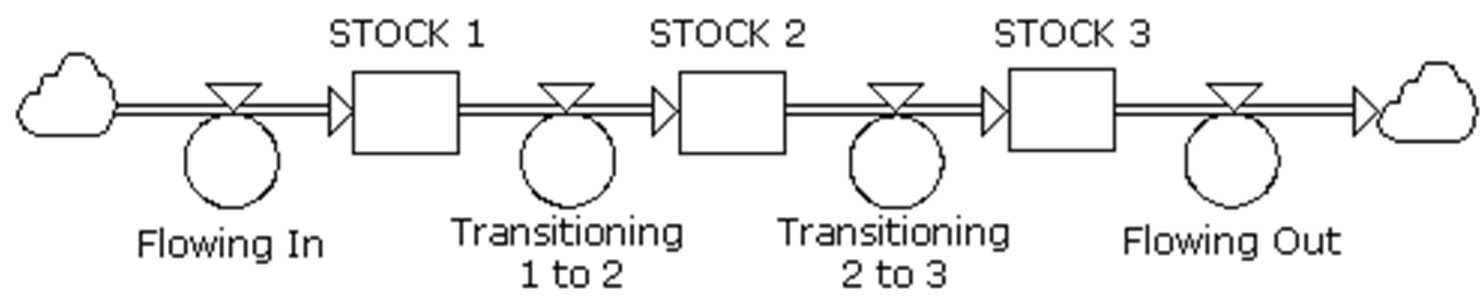
F.2.2 Module Influence Diagram
The influence diagram for this module is shown in Figure F2-2.

F.2.3 Reference Sources
This module is described here after Hines, et al. (1996; 1997; 2000: 8-9), Sterman (2000: 222-230). Further explanation of this module can be found at Sterman (2000: 222-230).
F.2.4 Application
Cascaded stocks are representative of process delays, ageing, processes involving sequences of activities such as manufacturing, supply chains, acquisition of skills and knowledge, and progression of personnel through their careers. Whilst models involving cascaded stocks are rarely as simple as depicted here, the fundamental sequence of alternating flows and stocks repeatedly appears.
F.2.5 Functional Description
The functions of the various parts of the module are described in Table F2-1:
Table F2-1. Functional Description—Cascaded Stocks
Variable | Function | Comment |
|---|---|---|
Flowing In | Defined as required. See example in Chapter 3. | |
STOCK 1 | x | Initial Stock 1 + dt * (Flowing In) – dt * (Transitioning 1 to 2) Initial Stock 1 = x Units: <<items>> or <<material>> Note that if initial values of each stock are set to zero it will take time during the simulation to fill the pipeline of cascaded stocks. This will produce a transient effect which is undesirable in most instances. |
Transitioning 1 to 2 | Defined as required. See example in Chapter 3 | |
STOCK 2 | y | Initial Stock 1 + dt * (Transitioning 1 to 2) – dt * (Transitioning 2 to 3) Initial Stock 1 = y Units: <<items>> or <<material>> |
Transitioning 2 to 3 | Defined as required. See example in Chapter 3 | |
STOCK 3 | z | Initial Stock 1 + dt * (Transitioning 2 to 3) – dt * (Flowing Out) Initial Stock 1 = z Units: <<items>> or <<material>> |
Flowing Out | Defined as required. See example in Chapter 3. |
References
- Hines, J., et al., 1996, Molecules of Structure: Building Blocks for System Dynamics Models, Version 1.1, LeapTec and Ventana Systems, Inc.
- Sterman, J.D., 2000, Business Dynamics: Systems Thinking and Modelling for a Complex World, Irwin McGraw-Hill.