
4.1.6 Dynamic Hypotheses—Birthing
Textual Description. Each year a number of babies are born. This number depends on the size of the population and, hence, the number of females who might bear children. A portion of those become pregnant and bear children each year. The overall contribution is an increase in the population each year that babies are born.
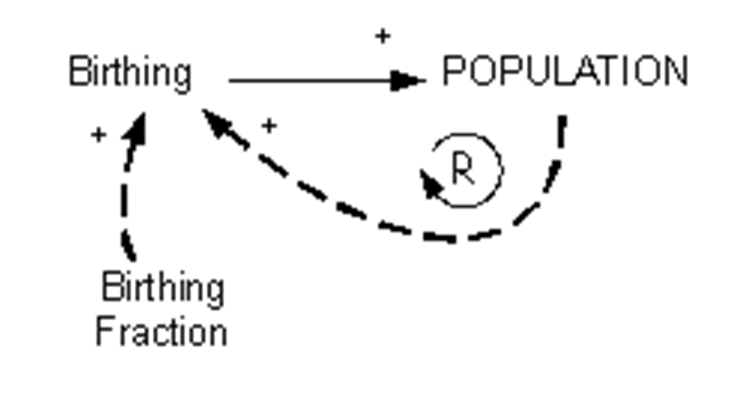
Module Influence Diagram. The influence diagram for this module is shown in Figure 4-1. This, and the stock-and-flow equivalent shown in Figure 4-2, represents an archetypical linear first-order positive feedback module.
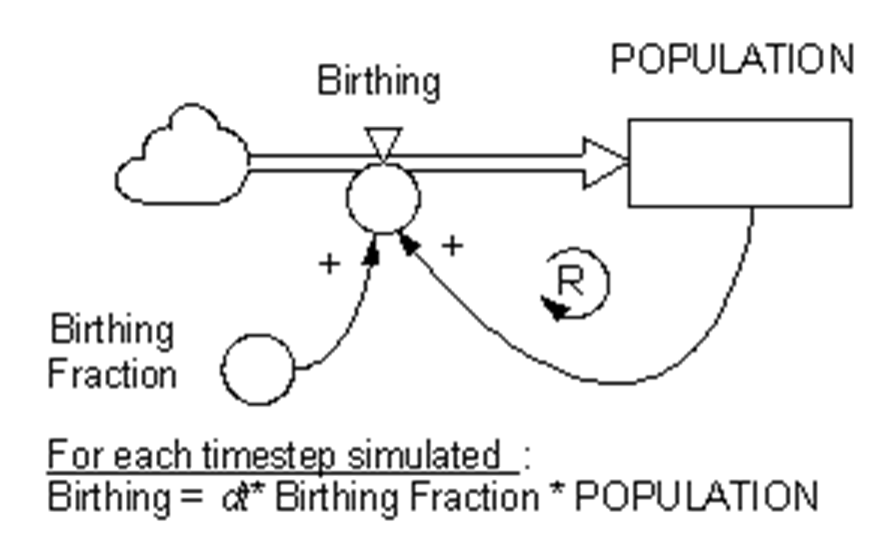
Module Stock-and-Flow Diagram. The stock-and-flow diagram for this module is shown in Figure 4-2. Further details are provided in Appendix F5.
Assumptions. The following assumptions apply to this module and to the model overall:
- Approximately half the population is male.
- Approximately half the population is female.
- A fraction of the female population is fertile, of child-bearing age and in relationships where children might be conceived.
- Multiple births do not occur or, at least, their frequency of occurrence is small. Multiple births are not accommodated in the initial version of this model.
- Age of females is not specifically considered.
Specific Exclusions from This Module. The following are specifically excluded from this module:
- Losses from the population, such as caused by deaths (regardless of how they might be caused).
- Other sources leading to increases in population.
Specific Inclusions in this Module. The following are specifically included in this module:
- Initial size of population.