
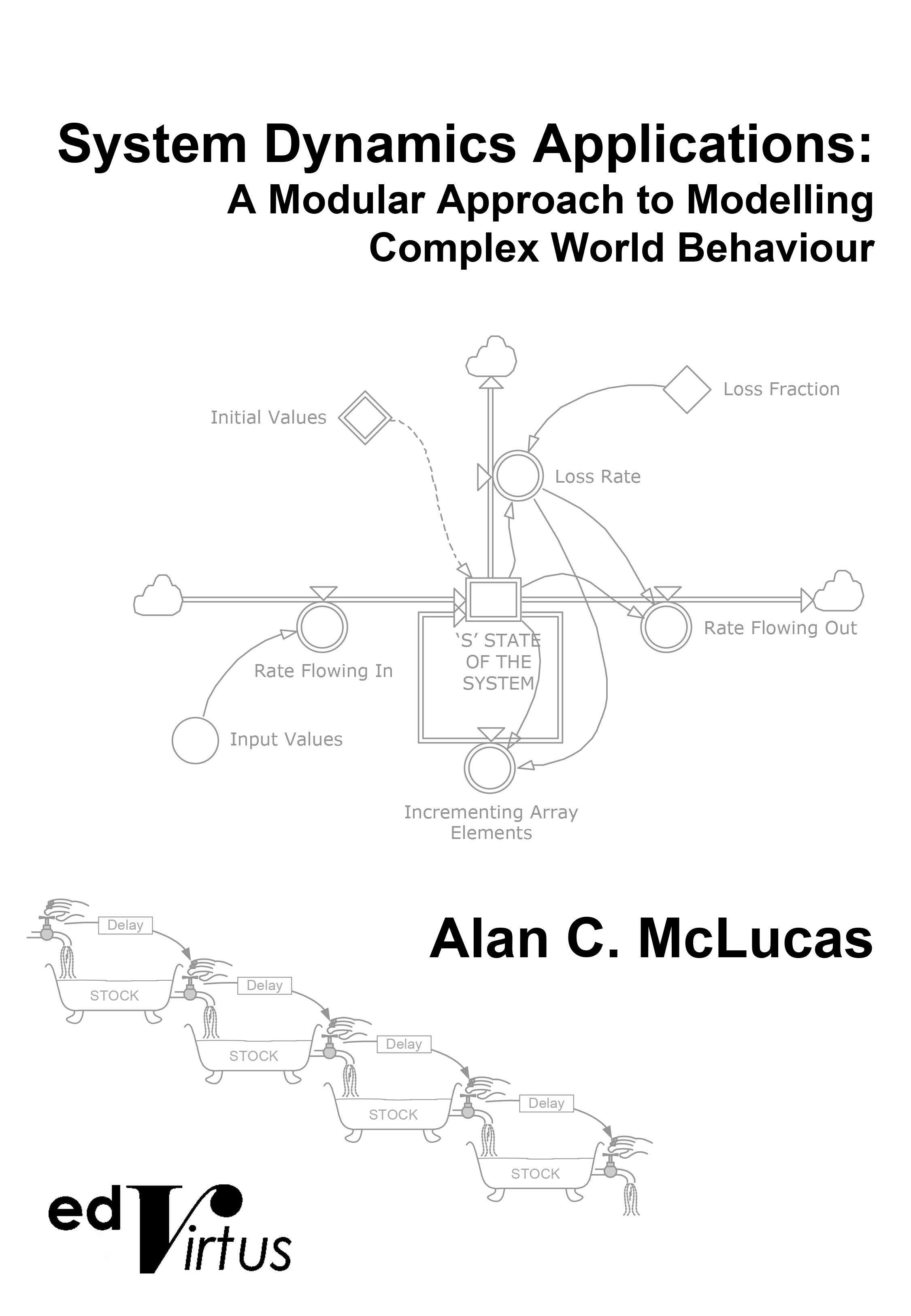
System Dynamics Applications: A Modular Approach to Modelling Complex World Behaviour
This unique book offers an unprecedented opportunity to develop comprehensive practical skills in building models which will enhance understanding of the many problems encountered in a complex and dynamic world. As an enabler to quantitative modelling, systems thinking and qualitative modelling techniques are used to facilitate problem conceptualisation and the formulation of dynamic hypotheses about troublesome systemic problems.
Contents
- Blurb
- Expected Learning and Skills Outcomes
- Preface
- 1 COMPLEXITY AND DYNAMIC BEHAVIOUR
- 1.1 ABOUT COMPLEXITY AND COMPLEX PROBLEMS
- 1.2 WHAT COMPLEX PROBLEM EXAMPLES HAVE IN COMMON
- 1.3 THINKING ABOUT AND MODELLING NATURALLY IN THE TIME DOMAIN
- 1.4 OVERCOMING OUR SOMETIMES CONSTRAINED VIEW OF THE WORLD
- 1.5 ABOUT SYSTEM DYNAMICS MODELLING
- 1.6 A SYSTEMS ENGINEERING APPROACH TO MODEL REQUIREMENTS AND MODEL BUILDING
- 1.7 THE SYSTEM DYNAMICS MODELLING PROCESS
- 1.8 TOP-DOWN COMPARED TO BOTTOM-UP APPROACH TO PROBLEM SOLVING
- 1.9 INTEGRATING SOFT SYSTEMS METHODOLOGY, SYSTEMS THINKING, SYSTEM DYNAMICS MODELLING AND SYSTEMS ENGINEERING
- 1.10 THE SYSTEMS ENGINEERING ‘VEE’ MODEL APPLIED TO SYSTEM DYNAMICS MODELLING PROJECTS
- 1.11 GROUP MODEL BUILDING
- 1.12 SUMMARY
- 2 WHY MODULES ARE IMPORTANT
- 2.1 MODELS AND MODELLING BUILDING BLOCKS
- 2.2 MODELLING METHODOLOGY
- 2.3 TAKING ACTION TO REMEDY THE PROBLEM SITUATION
- 2.4 MODEL AS A NECESSARY AND SUFFICIENT REPRESENTATION
- 2.5 NECESSARY AND SUFFICIENT REPRESENTATIONS—A HUMAN RESOURCES MANAGEMENT EXAMPLE
- 2.6 THE NEED FOR STRUCTURAL BUILDING BLOCKS—MODULES
- 2.7 COMMUNICATING IDEAS ABOUT DYNAMIC HYPOTHESES
- 2.8 IMPORTANCE OF STRUCTURE—MODELS AND REAL-WORLD PROBLEMS
- 2.9 SYSTEMS ENGINEERING—COMPONENT AND MODULE RE-USE
- 2.10 MODULES TO DELIVER SPECIFIC FUNCTIONALITY
- 2.11 COMBINING MODULES—ESSENTIAL CONSIDERATIONS
- 2.12 ARRAY MODULES
- 2.13 MODULE—EXPANDED DEFINITION
- 2.14 MODULE DESCRIPTIONS
- 2.15 SUMMARY
- 3 BUILDING A BASIC POWERSIM™ STUDIO MODEL
- 3.1 BACKGROUND
- 3.1.1 Basic Representation—Flowing In
- 3.1.2 Example Problem To Be Solved
- 3.1.3 Solution By Graphical Integration Method
- 3.1.4 Determining Contributions To Bathtub Made By Flowing In
- 3.1.5 Building The System Dynamics Model
- 3.1.6 Flowing In Powersim™ Studio Module
- 3.1.7 Verifying Functionality Of Flowing In Module
- 3.1.8 Flowing Out Powersim™ Studio Module
- 3.1.9 Verifying Functionality Of Flowing Out Module
- 3.1.10 Building The Complete Bathtub Model
- 3.1.11 Graphical Integration Examples And Challenges
- 3.1.12 Further Development Of The Bathtub Model
- 3.2 SUMMARY
- 3.1 BACKGROUND
- 4 BUILDING A MODEL TO ANALYSE FEEDBACK DYNAMICS
- 4.1 QUALITY THINKING FIRST
- 4.1.1 Example Problem—Population Dynamics Of Charmville
- 4.1.2 Steps To Be Completed Before Starting The Computer
- 4.1.3 Formulate Dynamic Hypotheses
- 4.1.4 Conceptual Models—Important Aids To Evolving Dynamic Hypotheses
- 4.1.5 Capturing Business Rules
- 4.1.6 Dynamic Hypotheses—Birthing
- 4.1.7 Dynamic Hypotheses—Dying
- 4.1.8 Dynamic Hypotheses—Migrating-In
- 4.1.9 Dynamic Hypothesis—Migrating-Out
- 4.1.10 Prioritizing Business Rules
- 4.1.11 Draw Influence Diagram OR Stock-And-Flow Diagram
- 4.1.12 Review Structure And Functioning Of Model
- 4.1.13 Identifying The Problem Boundary
- 4.2 OUTLINE OF REMAINING STEPS—FROM CONCEPTUAL MODEL TO ANALYTICAL MODEL
- 4.2.1 Breaking The Model Down To Individual Modules
- 4.2.2 Deciding On The Governing Business Rules To Be Included In The Model
- 4.2.3 Definitions Table—Population Model
- 4.2.4 Determine Units To Be Assigned
- 4.2.5 Determine Project And Simulation Settings
- 4.2.6 Create Modelling And Simulation Project
- 4.2.7 Developing The Population Model—Demonstrated
- 4.2.8 The Birthing Module
- 4.2.9 The Dying Module
- 4.2.10 The Migrating-In Module
- 4.2.11 The Migrating-Out Module
- 4.2.12 Integrating The Birthing And Dying Modules Into Population Model
- 4.2.13 Integrating The Migrating-In And Migrating-Out Modules Into Population Model
- 4.2.14 Integrating All Modules Into Population Model
- 4.2.15 Analysing The Behaviour
- 4.2.16 Managing Achievement Of Planned 2% Population Growth
- 4.2.17 Discussion Of Analysis
- 4.2.18 Possible Future Developments Of The Model
- 4.3 SUMMARY
- 4.1 QUALITY THINKING FIRST
- 5 BUILDING AN ARRAY MODEL STEP-BY-STEP
- 6 VERIFICATION AND VALIDATION
- A CAUSAL LOOP DIAGRAMMING CONVENTIONS
- B STOCK-AND-FLOW DIAGRAMMING CONVENTIONS
- C INFLUENCE DIAGRAMMING CONVENTIONS
- D INFLUENCE DIAGRAMS AND STOCK-AND-FLOW DIAGRAMS
- E GENERIC MODULE DEFINED
- F MODULES
- F.1 MODULE—SIMPLE INFLOW / OUTFLOW
- F.2 MODULE—CASCADED STOCKS
- F.3 MODULE—TRANSITIONAL (IRREVERSIBLE) FLOW
- F.4 MODULE—TRANSITIONAL (REVERSIBLE) FLOW
- F.5 MODULE—FIRST ORDER LINEAR POSITIVE FEEDBACK
- F.6 MODULE—FIRST ORDER LINEAR NEGATIVE FEEDBACK
- F.7 MODULE—FIRST ORDER LINEAR NEGATIVE FEEDBACK—EXPLICIT GOAL
- F.8 MODULE—FIRST ORDER DELAY
- F.9 MODULE—DELAYED INFLOW
- F.10 MODULE—DELAYED IRREVERSIBLE (TRANSITIONAL) FLOW
- F.11 MODULE—FIRST ORDER (PIPELINE) DELAY—ATTRITION
- F.12 MODULE—FIRST ORDER NON-LINEAR SELF-REFERENCING—FLOWING IN
- F.13 MODULE—FIRST ORDER NON-LINEAR SELF-REFERENCING—FLOWING OUT
- F.14 MODULE—FIRST ORDER NON-LINEAR SELF-REFERENCING
- F.15 MODULE—PIPELINE DELAY ARRAY
- F.16 MODULE—FIRST ORDER (PIPELINE) DELAY—ARRAY—ATTRITION
- Bibliography