
1.8 TOP-DOWN COMPARED TO BOTTOM-UP APPROACH TO PROBLEM SOLVING
Traditional problem solving involves working from the bottom up. The bottom-up approach assembles well-known, well-understood, and manageable components into subsystems. At the next level up, the subsystems are assembled to form the system.
Once assembled, the system is tested to establish the extent to which it delivers desired functionality. Through a series of iterative cycles the design is adjusted and modified as necessary until it performs as intended.
The limitation of this approach is that it works only in situations where problems are well-defined and relatively simple. Complex problems are not amenable to being solved through a bottom-up approach. Further, when we are dealing with systems and systemic problems, a bottom-up approach does not facilitate the discovery of emergent properties. Emergent properties are properties exhibited by a complete (hooked-up) system that cannot be exhibited by the parts of the system in isolation. Emergent properties depend on interactions between components (and between components and the environment).
Stevens, et al., (1998: 94) explain emergent properties by citing the example of a bicycle. A bicycle composed of a frame, two wheels, pedals, a drive chain, saddle, handlebars, brakes etc. The primary emergent property of dynamic balance is only produced by the combination of the rider and the bicycle. Only when human power, control and intelligence (and a road surface) are added does the bicycle become a means of transport. Take any one element away and the system falls apart. Emergent properties therefore cannot be predicted solely by looking at the components.
Systems engineering begins by addressing the complex system as a whole, which facilitates the initial allocation of requirements as well as the subsequent analysis of the system and its interfaces. Once system-level requirements are understood, the system is then broken down into subsystems and the subsystems further broken down into components until a complete understanding is achieved of the system from top to bottom. This top-down approach is a very important element of managing the development of complex systems. It is equally applicable to the development of models we might use to analyse the dynamic behaviour of systems.
By viewing the system as a whole initially and then progressively breaking the system into smaller elements, the interaction between the components can be understood more thoroughly, which assists in identifying and designing the necessary interfaces between components (internal interfaces) and between this and other systems (external interfaces). Figure 1-15 illustrates the ANSI/EIA-632 (ANSI/EIA, 1999) approach to top-down development as described by Faulconbridge and Ryan (2003: 12).
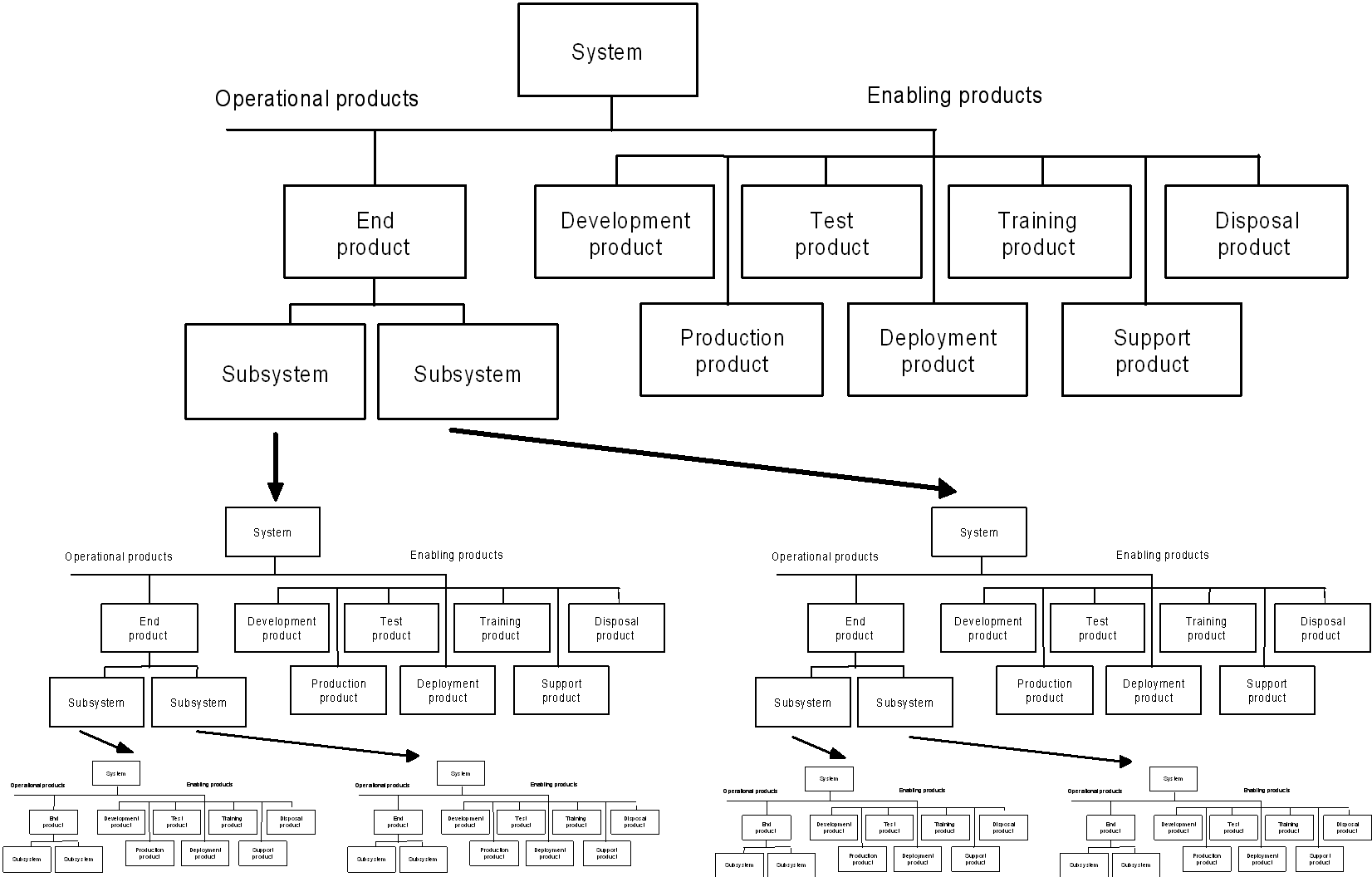
The same approach, further described by Sage and Rouse (1999) is used best in modelling of complex systems using system dynamics modelling. This approach demands clear and unambiguous requirements to be formulated for the design and construction of models of the real world. The approach leads to clear definition of the component parts, or modules, and the interfaces between them. From a process point of view, requirements and design are approached top-down but detailed construction follows a bottom-up approach. The combining of these two approaches must be managed through systems engineering which has the rigour and discipline to assure that none of the system’s functionality is lost. The systems engineering approach also assures that processes of analysis, design, and construction can be reproduced and can be implemented in a way that still enables use of the traditional bottom-up approach.
The same applies to the building of models of complex systems (which is often a part of the broader systems engineering approach). Top-down analysis creates the framework within which bottom-up construction of modules and sectors and ultimately integration into models can then occur. This approach is facilitated by formulation of a clearly defined systemic structure which will lead to creation of models exhibiting the necessary system-level behaviour, that is, models which replicate the reference modes of behaviour (in systems engineering terms, delivers required functionality).
References
- ANSI/EIA-632-1998, 1999, ‘Processes for Engineering a System’, Electronic Industries Association, Washington, D.C.
- Sage, A.P., and Rouse, W.B., 1999, Handbook of Systems Engineering and Management., John Wiley and Sons, New York.