
F.10 MODULE—DELAYED IRREVERSIBLE (TRANSITIONAL) FLOW
F.10.1 General Description
In this module which has component parts and functionality similar to Delayed Inflow, we are concerned about the flows from one stock (or level) to another stock (or level). This module would be used to describe the physical change of state of a continuously flowing resource or of individual items. This could occur as the result of some processing action.
Both Sterman (2000: 464-5) and Coyle (1996: 98-108) caution us that when building system dynamics models we need to be very clear exactly the type of delay mechanism operates. Unless otherwise specified in first order delays, the stock of material in transit are perfectly mixed at all times, meaning that outputs from DELAY CONTENTS are in random order with respect to their input. In higher order delays material is output in the same order as they are input; the order depends on the number of process stages involved. These diagrams do not specify the type of delay mechanism.
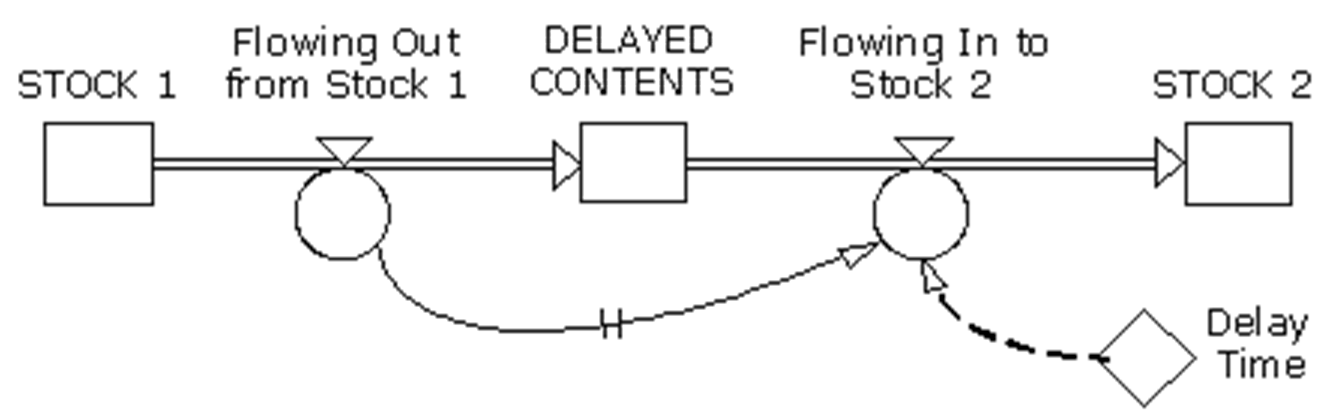
F.10.2 Influence Diagram Representation
The influence diagram representation for this module is shown in Figure F10-2.

F.10.3 Reference Sources
This module is described after Coyle (1996: 38). Delays are described in Sterman (2000: Ch 11) and in the Powersim™ Studio Reference Guide.
F.10.4 Application
A simple, discrete-event example would involve the processing of two slices of bread into toast using a toaster. Two slices of bread are placed in an automatic toaster. The timer is pre-set to three minutes. After three minutes of being in DELAY CONTENTS (our toaster) newly browned toast pops up. STOCK 1, our stock of bread, is now zero slices whilst STOCK 2, our stock of toast, is two slices. An irreversible transformation or transition has taken place. We cannot reverse the process. We cannot convert toast into bread.
A simple continuous example might involve the pasteurisation of milk. 1,000 litres of milk are to be pumped from one refrigerated holding tank through a heating process and pumped into another refrigerated holding tank. The milk passes through a series of tubes heated by steam. Each litre of milk takes 5 seconds to flow from the outflow valve of the first tank through the pasteurisation process and through the inflow valve of the holding tank. Initially: STOCK 1 = 1,000 litres of milk, Delay Time = 5 seconds, DELAY CONTENTS = 0 litres of milk and STOCK 2 = 0 litres of milk. On completion, that is, after 5,000 seconds, LEVEL 2 is 1,000 litres of milk. All other stocks are zero litres of milk.
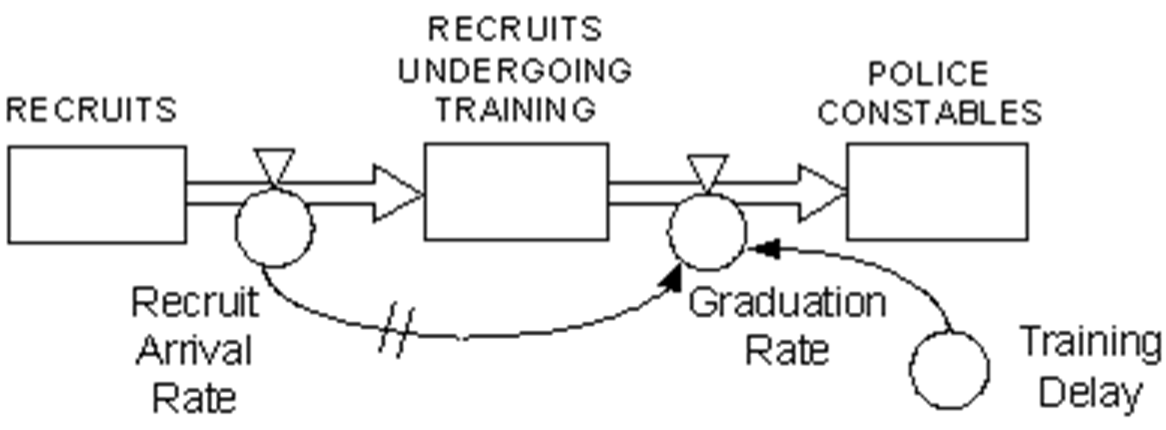
Another discrete event example of Delayed (Irreversible) Transitional Flow might involve the training of recruits. Every so often a new intake of recruits will arrive. These recruits undergo, say, 10 months training to become police constables. At all times there are potential recruits who have applied to join the police force. However, there is only one intake per year and, consequently, one graduation in the same calendar year. It is assumed, initially at least, that all recruits successfully complete the training programme. The basic influence diagram might be as shown at Figure F10-3.
The equivalent stock-and-flow diagram might be as shown at Figure F10-4.

F.10.5 Functional Description
The functions of the variables contained in the module are described in Table F10-1.
Table F10-1. Functional Description—Delayed (Irreversible) Transitional Flow
Variable | Function | Comment |
|---|---|---|
STOCK 1 | x | Initial Stock 1 – dt * (Flowing Out from Stock 1) Initial Stock 1 = x Units: <<items>> |
Flowing Out from Stock 1 | Defined as required. Units: <<items/time>> | |
DELAYED CONTENTS | y | Initial Stock Delayed Contents – dt * (Flowing Out from Stock 1) Initial Stock Delayed Contents = y Units: <<items>> |
Flowing In to Stock 2 | DELAYPPL ( Flowing Out of Stock 1, Delay Time, 0) Units: <<items/time>> Where there is a requirement to change the length of the pipeline delay during the simulation, the material pipeline delay function DELAYPPLMTR must be specified. | |
Delay Time | Defined as required. Units: <<time>> | |
STOCK 2 | z | Initial Stock 2 + dt * (Delayed Flowing In to Stock 2) Initial Stock 2= z Units: <<items>> |
References
- Sterman, J.D., 2000, Business Dynamics: Systems Thinking and Modelling for a Complex World, Irwin McGraw-Hill.
- Coyle, R.G., 1996, System Dynamics Modelling: A Practical Approach, Chapman and Hall, London.