
F.8 MODULE—FIRST ORDER DELAY
F.8.1 General Description
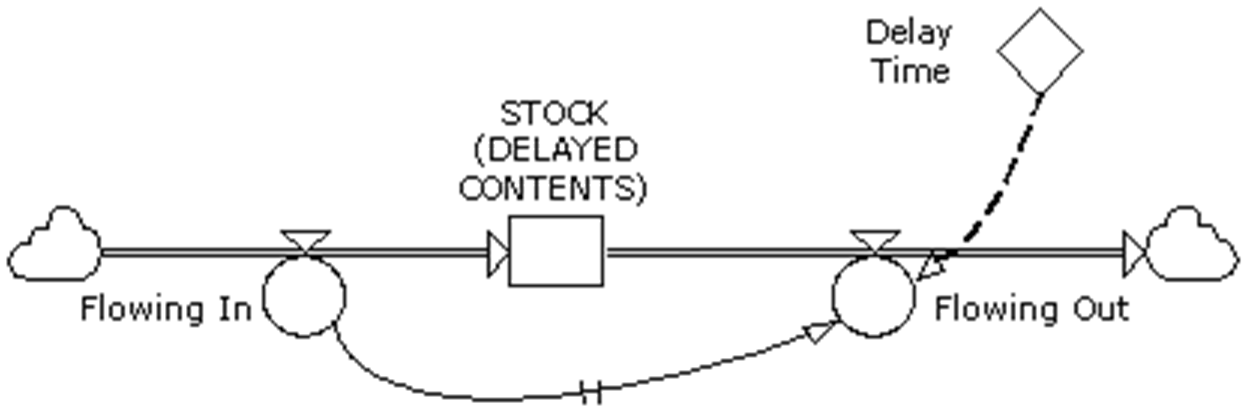
STOCK contains items or material that has been delayed, that is, having entered a delay process they have not exited. Both Sterman (2000: 464-5) and Coyle (1996: 98-108) caution us that when building system dynamics models we need to be very clear of exactly the type of delay mechanism that operates. Unless otherwise specified in first order delays, the stock of material in transit are perfectly mixed at all times, meaning that outputs from DELAY CONTENTS are in random order with respect to their input. In higher order delays material is output in the same order as they are input; the order depends on the number of process stages involved. These diagrams do not specify the type of delay mechanism.
The simplest view of a delay is flow through a pipeline or along a conveyor belt. That specific type of delay is a pipeline delay, discussed here in the first instance. In Powersim™ Studio, the pipeline delay function DELAYPPL describes a process where nothing happens to the output Flowing Out until the Delay Time has elapsed. At this point, the input Flowing In is reproduced exactly.
F.8.2 Influence Diagram Representations
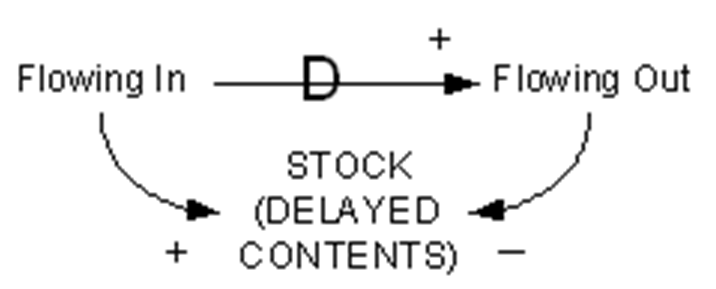
The influence diagram for this module is shown in Figure F8-2.
F.8.3 Reference Sources
This module is described here after Hines, et al. (1996: 16-17) and Sterman (2000: 416). Further explanation of this module can be found at Sterman (2000: 416). Delays are described in Sterman (2000: Ch 11) and in the Powersim™ Studio Reference Guide.
F.8.4 Application
Delays occur where output does not instantaneously follow an input to a stock. The form of the delay can vary from exact reproduction (which is the case for a pipeline delay) to output growing to the value of the input, where growth takes time be fully realised (which is the case for an information delay).
This module forms the basis for representing delays in a wide range of model types. These include processing delays, delivery lags in supply chain models, population ageing and career succession modelling. An example of a pipeline delay is provided in Figure 5-2.
F.8.5 Functional Description
The functions of the variables contained in the module are described in Table F8-1.
Table F8-1. Functional Description—First-order Delay
Variable | Function | Comment |
|---|---|---|
Flowing In | Defined as required. Units: <<items/time>> | |
STOCK | x | Initial Stock + dt * (Flowing In) – dt * (Flowing Out) Initial value of STOCK = x Units: <<items>> |
Flowing Out | DELAYPPL ( Flowing In, Delay Time, 0) Units: <<items/time>> Where there is a requirement to change the length of the pipeline delay during the simulation, the material pipeline delay function DELAYPPLMTR must be specified. | |
Delay Time | Defined as required. Units: <<time>> |
References
- Sterman, J.D., 2000, Business Dynamics: Systems Thinking and Modelling for a Complex World, Irwin McGraw-Hill.
- Coyle, R.G., 1996, System Dynamics Modelling: A Practical Approach, Chapman and Hall, London.
- Hines, J., et al., 1996, Molecules of Structure: Building Blocks for System Dynamics Models, Version 1.1, LeapTec and Ventana Systems, Inc.