
F.11 MODULE—FIRST ORDER (PIPELINE) DELAY—ATTRITION
F.11.1 General Description
This module ages a stock over a period of time, Time Delay, whilst accommodating attrition losses along the way. This is the same as placing items on a conveyor belt and removing a fraction of them before they reach the end.
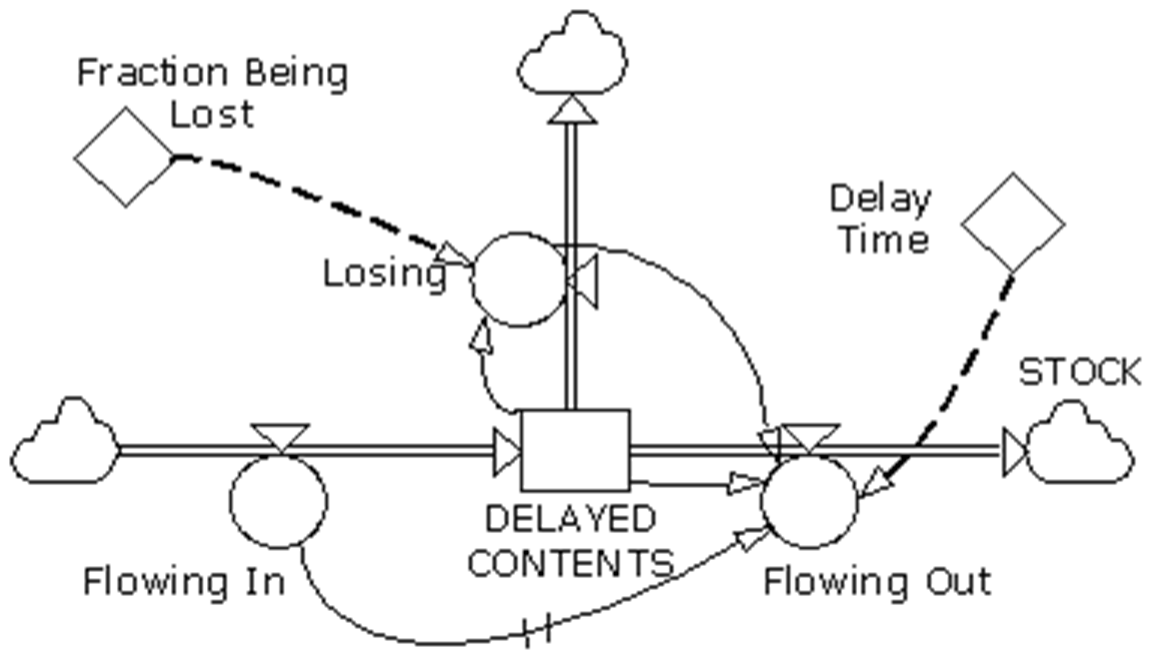
F.11.2 Influence Diagram Representation
The influence diagram representation is shown in Figure F11-2.
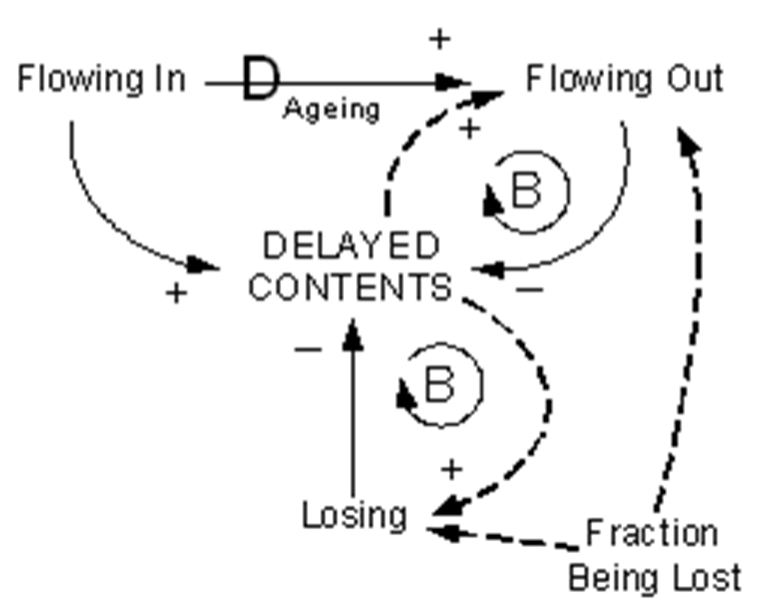
F.11.3 Reference Source
This module is defined after Abdel-Hamid and Madnick (1990: 63-68) and Hines, et al. (2000: 22-23). Delays are described in Sterman (2000: Ch 11) and in the Powersim™ Studio Reference Guide. Ageing chains are described in Sterman (2000: Ch 12).
F.11.4 Application
Detailed treatment of this module is provided in Chapter 5. See, for example, SAPLINGS module Figure 5-7, and definitions in Tables 5-4 and 5-5. Note that the module and its information links enable the governing business rules to operate logically will have to be adapted. Consequently, both the structure and the algebraic relationships will vary somewhat according to the application.
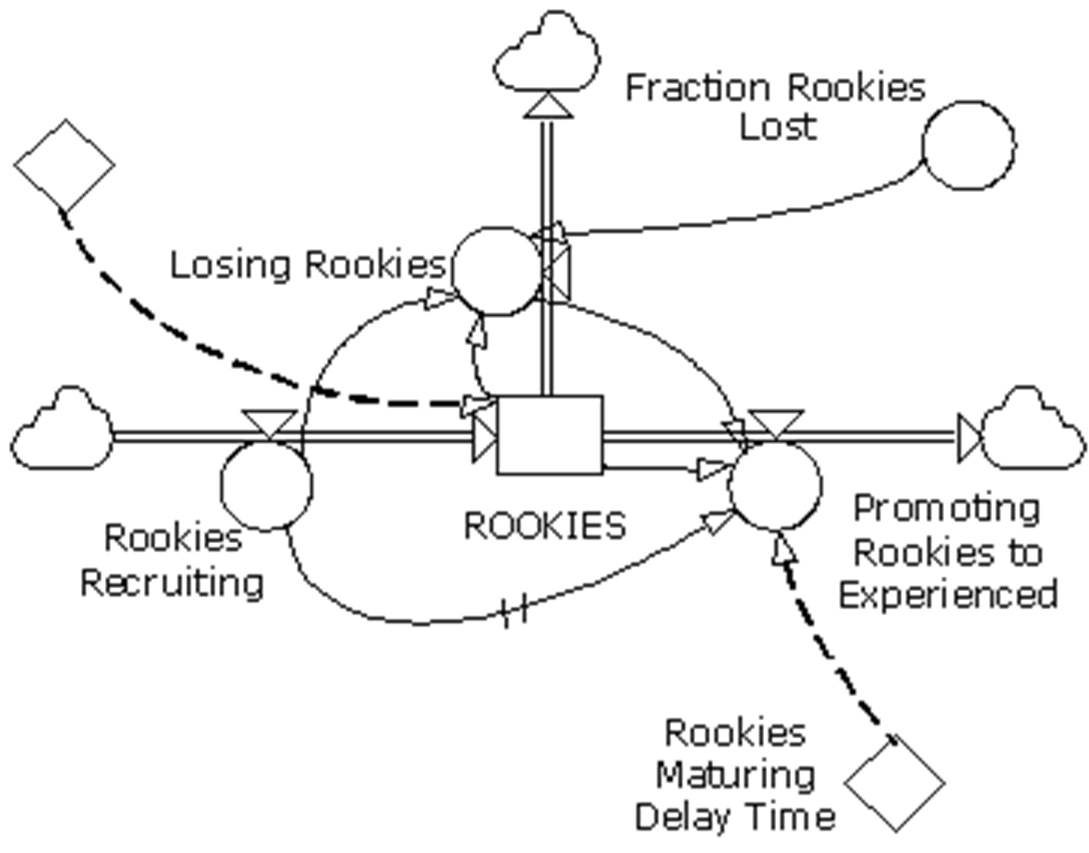
This module forms the basis for analysing human resource management problems such as those analysing career succession planning and knowledge assimilation. The stock-and-flow diagram for a basic module used in the development of a career succession planning model is shown in Figure F10-3.
F.11.5 Functional Description
The functions of the variables contained in the module are described in Table F11-1.
Table F11-1. Functional Description—First-order (Pipeline) Delay—Attrition Example
Variable | Function | Comment |
|---|---|---|
Recruiting Rookies | Defined as required. Units: <<pers/time>> | |
ROOKIES | x | Initial Stock of Rookies + dt * (Recruiting Rookies) – dt * (Losing Rookies) – dt * (Promoting Rookies to Experienced). Initial Stock of Rookie = x Units: <<pers>> |
Losing Rookies | IF ( ROOKIES > 0 <<pers>>, 1, 0) * Fraction Rookies Lost * Recruiting Rookies | |
Promoting Rookies to Experienced | IF ( ROOKIES > 0 <<pers>>, 1, 0) * IF ( Losing > 0 <<pers / time>>, 1, 0) * (DELAYPPL ( Flowing In, Delay Time, 0)—Losing) | Units: <<pers/time>>. Where there is a requirement to change the length of the pipeline delay during the simulation, the material pipeline delay function DELAYPPLMTR must be specified. |
Rookies Maturing Delay Time | Defined as required. Units: <<pers>>. This is the time-in-rank spent by rookies. |
References
- Abdel-Hamid, T. and Madnick, S.E., 1990, Software Project Dynamics: An Integrated Approach, Prentice Hall, Englewood Cliffs, New Jersey.
- Hines, J., et al., 2000, Molecules of Structure: Building Blocks for System Dynamics Models, Version 1.4, LeapTec and Ventana Systems, Inc.
- Sterman, J.D., 2000, Business Dynamics: Systems Thinking and Modelling for a Complex World, Irwin McGraw-Hill.