
1.2 WHAT COMPLEX PROBLEM EXAMPLES HAVE IN COMMON
The double pendulum example and the accumulation of funds in a bank account, through the compounding of interest, may seem unrelated. These two examples have been deliberately chosen because their behaviours over time are complicated by feedback mechanisms, albeit very different mechanisms.
In the double pendulum case, that feedback occurs through the joint B and, whilst the physical joint is simple, the mathematical relationship governing the transfer of energy from one pendulum element to the other is complex (being, highly non-linear). In the case of the bank account, in its simplest form, resultant growth of the state variable ACCOUNT BALANCE is exponential even though the feedback mechanism itself is linear. Because the current balance grows with each increment of time, the incremental amounts added are progressively bigger, resulting in overall growth which is exponential (that is, non-linear).
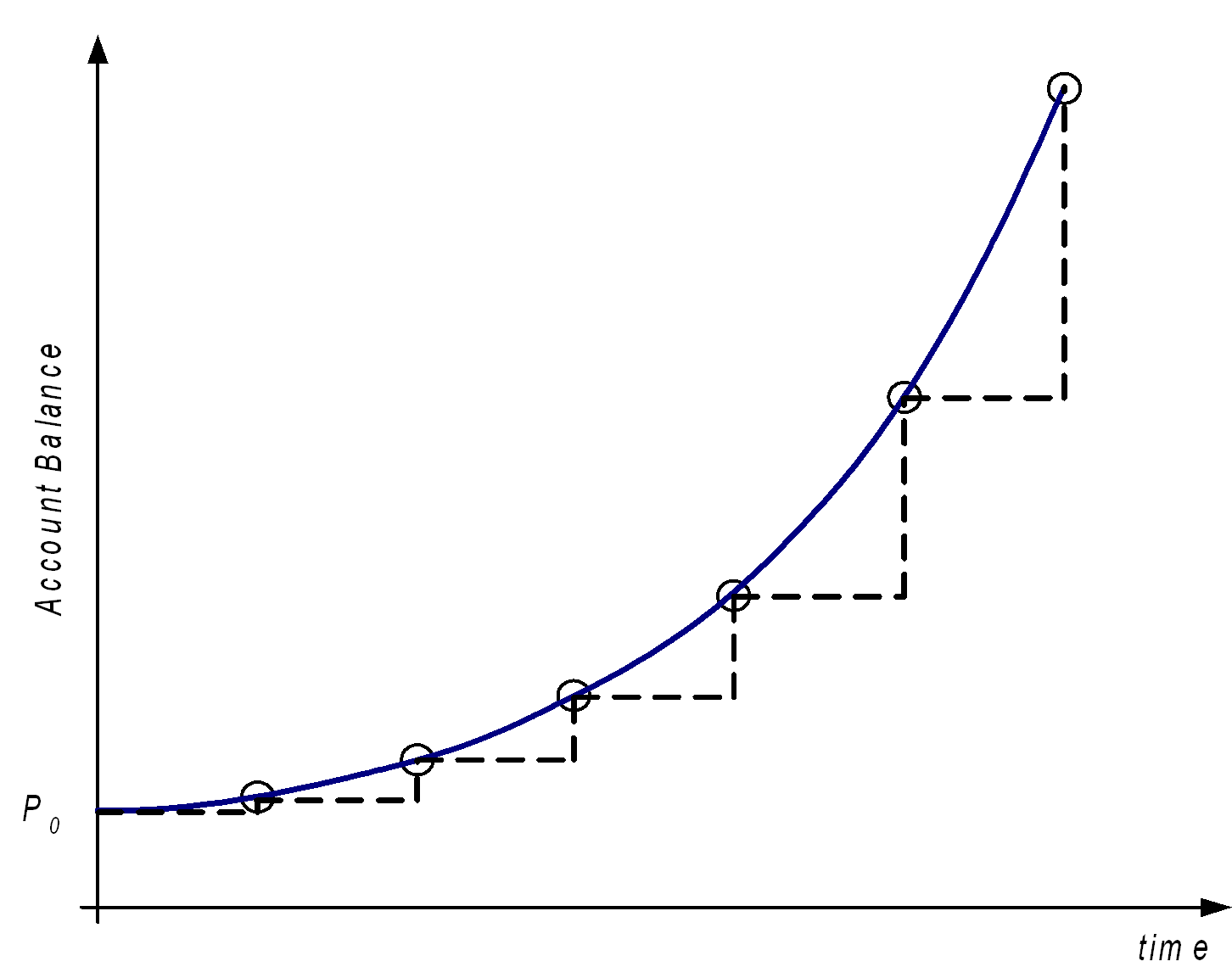
By making a few relatively simple changes to the rules for operating the bank account, vastly different (highly non-linear) feedback structures can result. Very often, systemic problems (those involving feedback mechanisms) behave in ways that are not easily explained. Their behaviour can be counter-intuitive and their management can become exceedingly difficult. This is further explained by extension of the bank account example.
Extending the Bank Account Example
Having a bank account that grows continuously is of little use to us: money only has utility when it is available to be spent. Imagine that, rather than investing money in this account, you decide to convert it into a bank card account. This new account operates primarily as a debit account.
10% per annum interest will be paid as long as the balance remains positive. We refer to this condition as ‘in the black’. If the account becomes negative, that is, ‘in the red’ the bank will lend you money to allow you to keep the account operating, but you will pay a premium for this. The bank will charge 20% per annum interest on all monies owing for the period that the account remains ‘in the red’. This charge will be calculated daily and added to the account at the end of the month.
You decide to convert to this type of account because you chose to share your money with your partner. You agree the following basic rules for the operation of the card account:
- expenditure will be limited to purchases of food and entertainment, with no purchase to exceed $200, without reference to the other partner, and only then if there is at least $600 left in the account; and
- expenditures over $200 can be made provided both partners agree that the expenditure is necessary.
The bank imposes an account keeping charge of $10 per month for each month that the number of cash withdrawals exceeds six. This charge will be applied at the end of the relevant month.
Suddenly, or so it seems, it becomes almost impossible to make simple calculations of how much money is in the account at any time. Why is this so?
The answer lies in examination of the rules which governing the spending of money and the implications of those rules. Factors to be considered are that choices to spend money are dependent upon:
- the perceived existence of a need to spend money;
- previously established spending patterns of partners, whether they have been developed independently or jointly—where each partner has established different patterns of spending, surprises will be inevitable; and
- perceptions of each individual of how much money is available to be spent—perceptions of ACCOUNT BALANCE and reality can be quite different with the consequence that commitments to spend can be made easily, even when there is insufficient money in the account.
This is a simple but realistic example of a real-world problem, which with a few relatively minor modifications becomes both complex and difficult to manage. Effective management of this account will depend upon prior agreement between partners about all planned expenditure and timely, full disclosure about each and every instance of unplanned or un-forecast expenditure. Effective management of the account comes under threat any time one partner ‘forgets’ about a purchase made, until the statement of account arrives in the mail a month later. Just like the extension from a simple pendulum to a double pendulum we find ourselves confronted by a highly non-linear feedback mechanism (or set of mechanisms) and use of judgement and intuition soon become appropriate.
It should come as no surprise that in Australia, for example, a country of around 20 million people, there is more than $20,000 million ($20 billion) of personal debt. Much of this debt is generated through use, or perhaps more correctly misuse, of credit cards.
Now we have some appreciation of the confounding effects of feedback, it is appropriate to ask the question … ‘how might we better understand and manage such problems?’ Without intentionally pre-empting what follows, the answer lies in modelling and simulating the complex dynamics.