6.8.1 Analysis Of Executive Summary Concept MAP
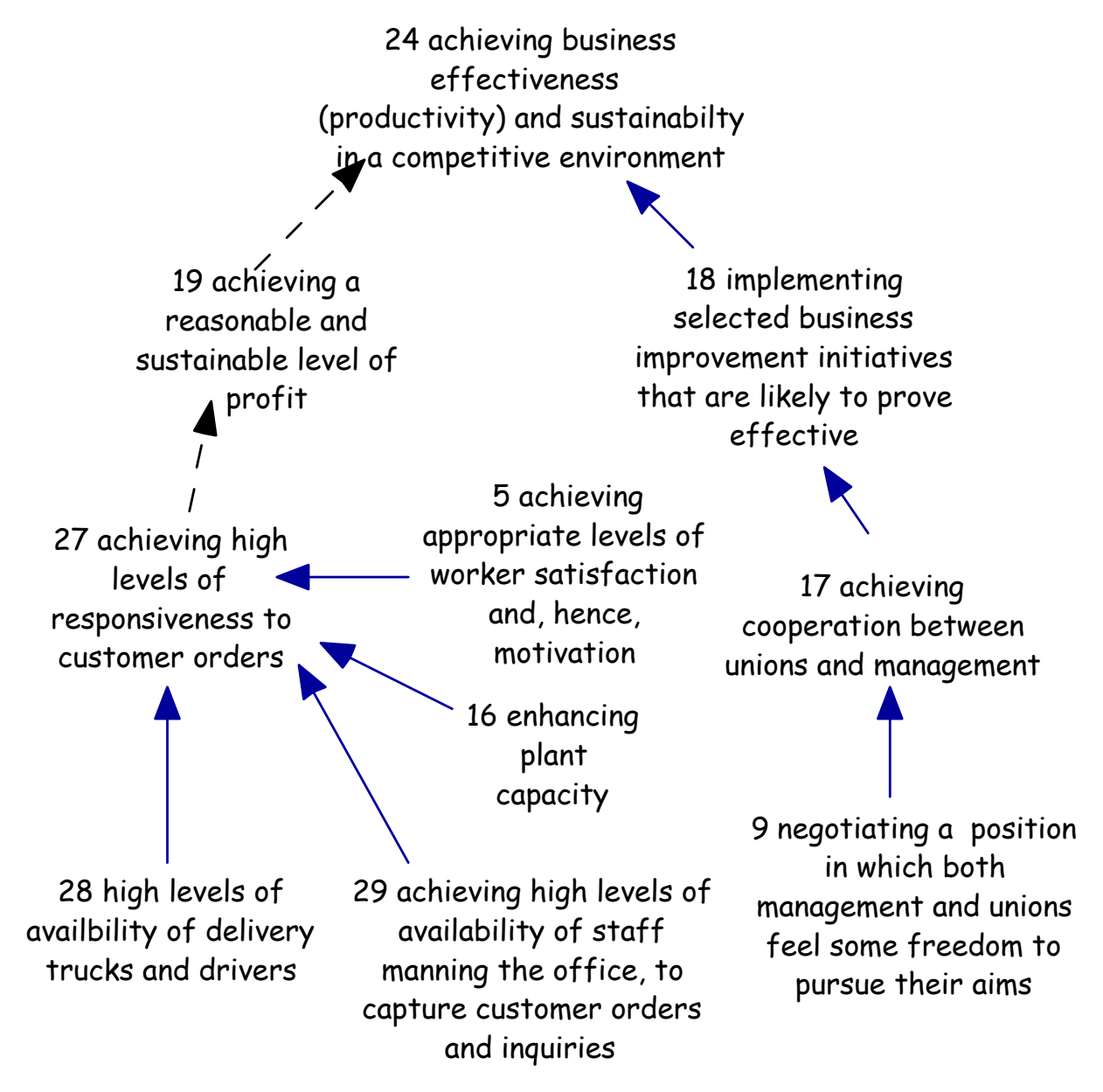
As each concept map is drawn, the more important concepts should be placed at the top. Subgroup maps differ in terms of what is considered more important. In development of the map at Figure 6-6, a conscious choice was taken to focus on achieving long-term viability of the company (Concept 24). This cannot be achieved without making profit (Concept 19), having implemented a number of improvements (Concept 18) and having a workable relationship between union and management (Concept 17). Clearly ThreeTwoOne has to do something serious and do it fairly quickly. Following down the left-hand side of Figure 6-6 it is intuitively obvious that high levels of responsiveness to customer orders (Concept 27) is a foundation to all above and on the left side of the concept diagram. In turn, the ability to achieve this responsiveness is determined by a combination of:
- High levels of availability of delivery trucks and drivers (Concept 28).
- Achieving high levels of staff manning the office, that is, to capture customer orders and respond to inquiries (Concept 29).
- Enhancing plant capacity (Concept 16).
- Achieving appropriate levels of worker satisfaction and, hence, motivation (Concept 5).
All four concepts are critical to achieving ThreeTwoOne’s goals, as is achieving cooperation between unions and management. Indeed, Figure 6-6 could be re-drawn to provide a broad approach in an intervention to correct ThreeTwoOne’s problems. See Figure 6-7.
At this stage, when the conceptual model has been produced (particularly by postgraduate students) the normal reaction is to state that what has been discovered is obviously the problem that ThreeTwoOne faces. Students frequently ask: “why did we need to go through such a detailed systematic process?” A partial answer for students and managers alike, can be derived from Figure 1-2. This suggests the potential gains that accrue from focusing efforts on problem conceptualisation very early in the piece. More importantly, however, is that he more insightful such thinking is, the better we managers will be placed to identify the right problem to be solved and then put in place highly effective remedial strategies. If the wrong problem is addressed or take action too late, the consequence will be the need thereafter to play catch-up, trying desperately to resolve the seemingly unresolvable. It seems incongruous that when faced with problems similar to those described in this chapter, students can happily spend 20, or more, hours building a sophisticated quantitative model that addresses the wrong problem, or ignores some important aspect. My personal observations of ‘experienced’ managers are that, like students, they frequently waste considerable amounts of time skirting around problems they do not really understand. Many managers seemingly have an aversion to committing themselves to the often tedious and vexing task of discovering the underlying problems.
This chapter serves to reinforce that many problems are not what they first appear to be and that there is no substitute for detailed and well-directed analysis. Further, it is knowledge and understanding of the nature of such problems that must be used to guide our analytical activities. Analysis for the sake of analysis is probably worse than no analysis at all, the former threatening to produce ‘paralysis by analysis.’ It must be remembered that a number of people, both internal and external to the company, have already tried to help ThreeTwoOne out of their problem situation, all to no avail. Our challenge is to be much better and much more effective in what we do to help.
The analysis associated with the Simplified Executive Map, Figure 6-7, guides us to where some form more detailed analysis might be useful.
A valuable rule-of-thumb is that one or two hours spent on problem conceptualisation activities will reduce subsequent quantitative modelling time by between one-third and one-half. If undertaken with care and diligence, the analysis described in this tutorial can obviate the need for quantitative modelling.
As will be shown, it would be valuable, but not necessary, to build quantitative models which take into account the processes of receiving and handling of customer orders, the mixing of concrete, and delivery as informants to development of capital investment strategies and gauging likely impact of those strategies.
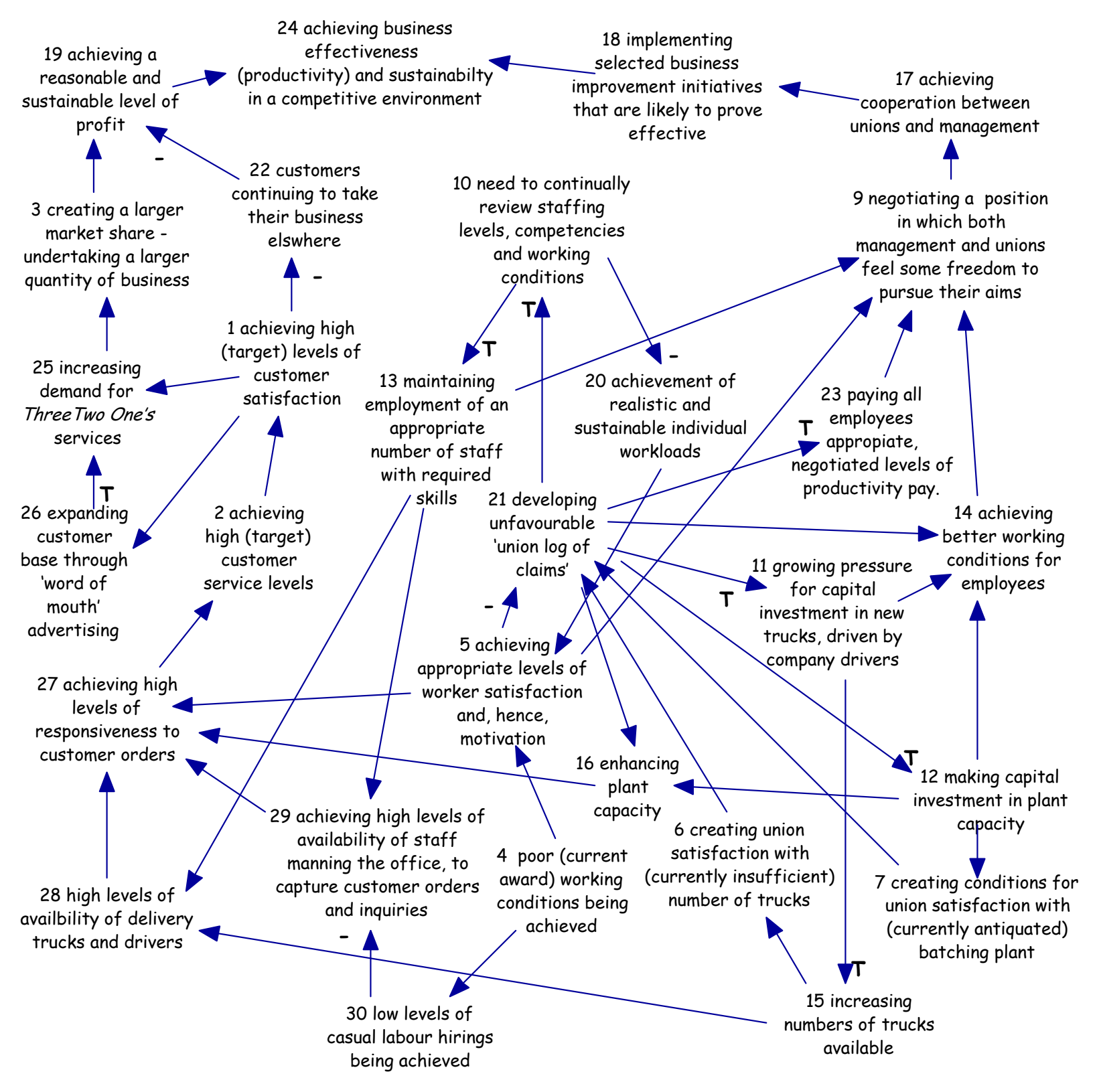
Regardless of which strategies are ultimately implemented, they must take into account the subgroup concerns as expressed in the concept maps, Figures 6-2, 6-3, 6-4, and 6-5. Without this, implementation failure becomes a real possibility.