
3.2.3 Maps Produced From Coroner’s Inquest Report
The maps on the following pages were produced from the Coroner’s Inquest Report (ACT Magistrates Court, 1999). Every attempt has been made to represent as faithfully as possible what the Coroner reported, in the language he used. It is inevitable that some rewording has occurred. Where this has been done, it has been done reluctantly and always with clarity of explanation in mind. Logical omissions have been left uncorrected and duplication or repetitive statements, though there were surprisingly few, were left essentially unchanged. In the following text, where explanations of the various figures have been provided, significant effort has been made to retain the words of the Coroner.
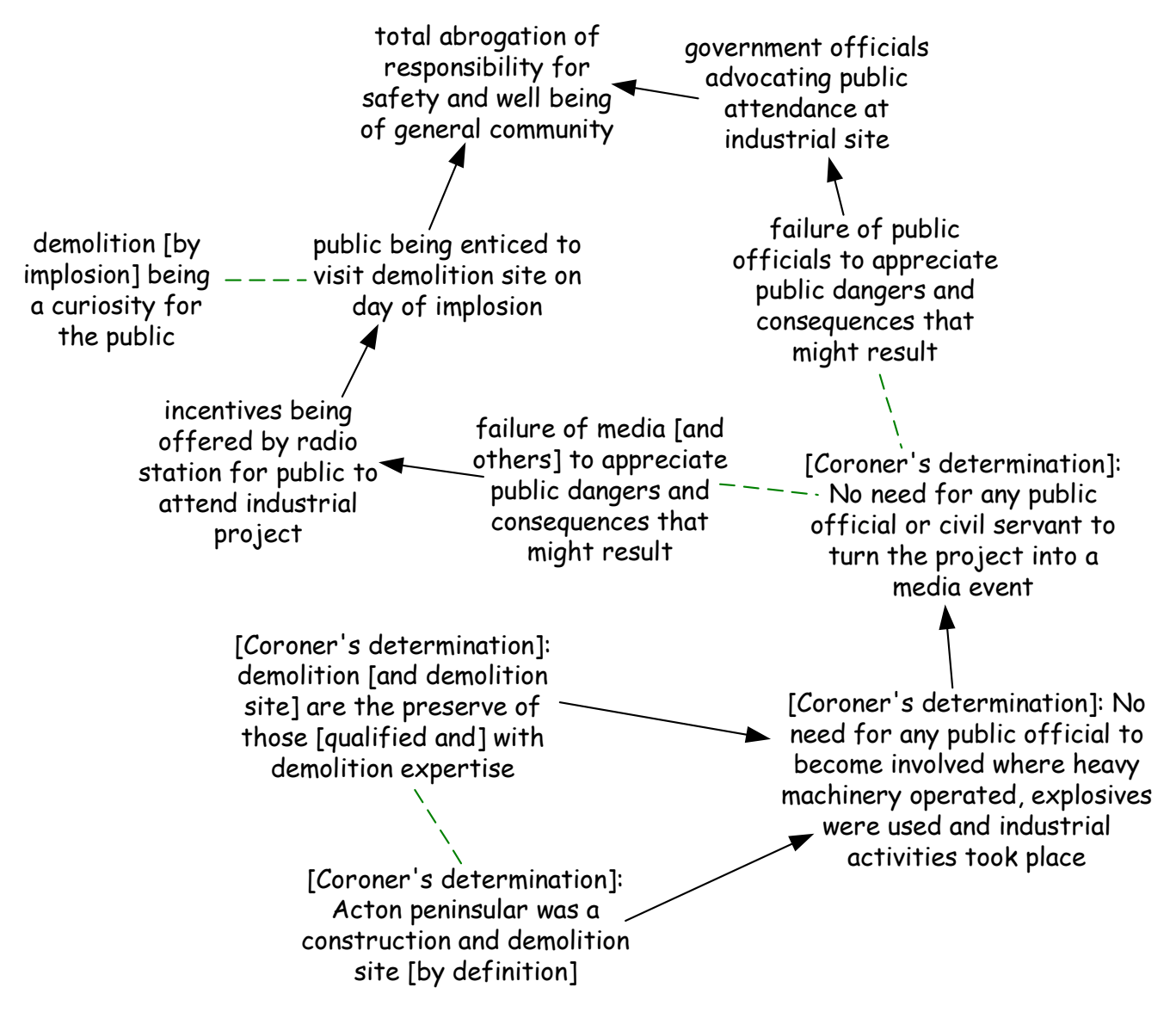
The concept map for the coroner’s executive summary is shown in Figure 3-1. The Coroner’s primary determinations that Acton peninsular was a construction and demolition site and demolition site is the preserve of those qualified with demolition expertise are fundamentally important. The definition of a demolition site also extends to the most distant point that debris might have been displaced during demolition activities. Given that some debris was actually thrown around 600m, should this have been the boundary of the demolition site? Other determinations have then been derived from the primary determinations, that is, there was no need for any public official to become involved… where explosives were used, and there was no need for any public official [including the ACT Chief Minister] to turn the project into a media event. There are two key causal chains here: failure of media [and others] to appreciate public dangers and consequences that might result, which led to incentives being offered by radio station for public to attend industrial project, which led to public being enticed to visit demolition site on day of implosion, and when combined with government officials advocating public attendance at industrial site, derived from failure of public officials to appreciate public dangers and consequences that might result, led to total abrogation of responsibility for safety and well being of general community.
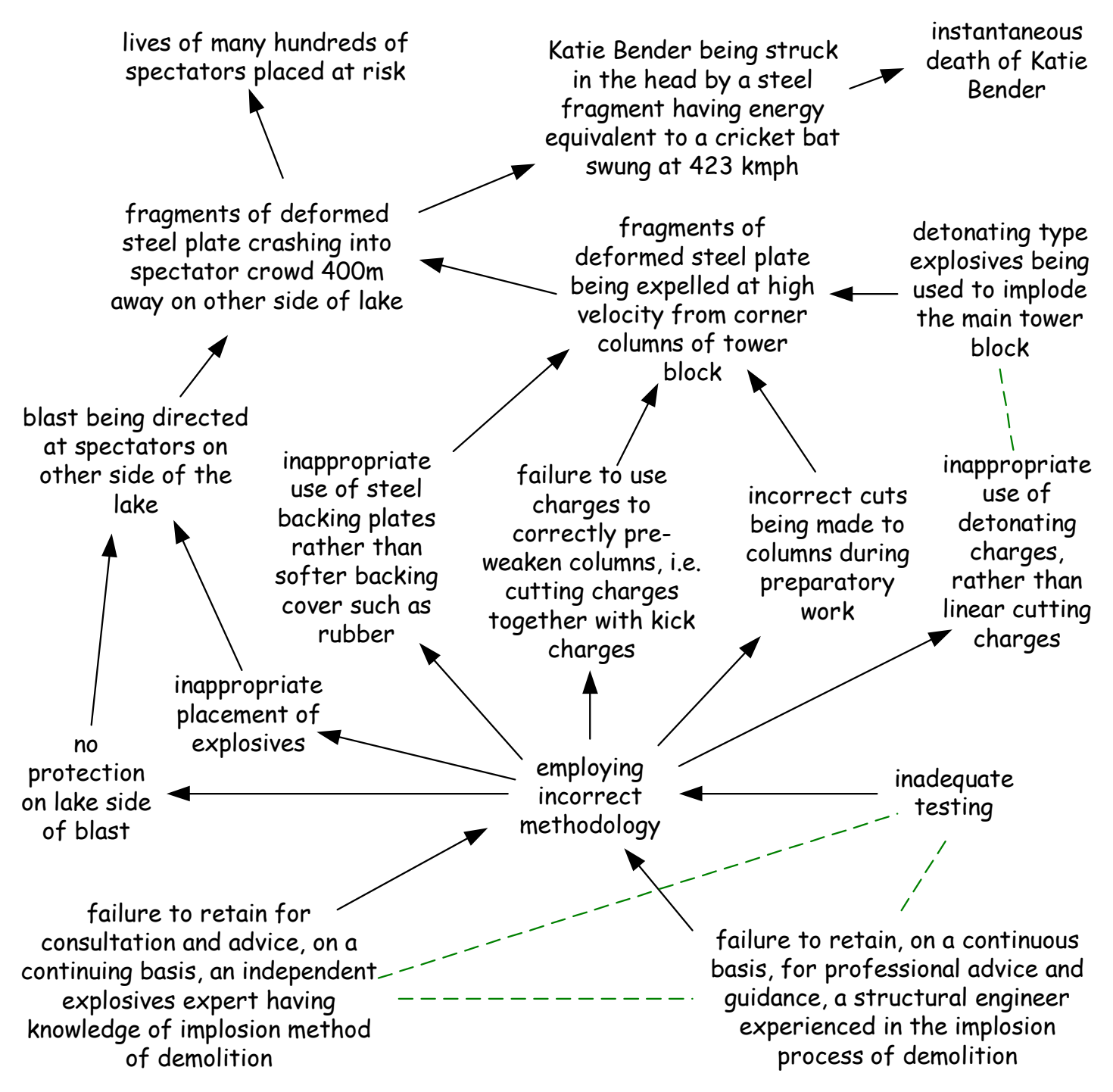
In identifying the cause of death (Figure 3-2), the Coroner noted that it is inappropriate to simply identify the cause of death as being the excessive volume of explosives placed on the columns thereby creating such force that the steel projectile was emitted at great velocity. This factor cannot be isolated, or divorced, from so many other considerations such as the method of cutting the columns, the laying of explosive charges in such a way that the blast was directed out across the lake in the direction of the spectators and the absence of specialists in specific areas, to mention just a few.
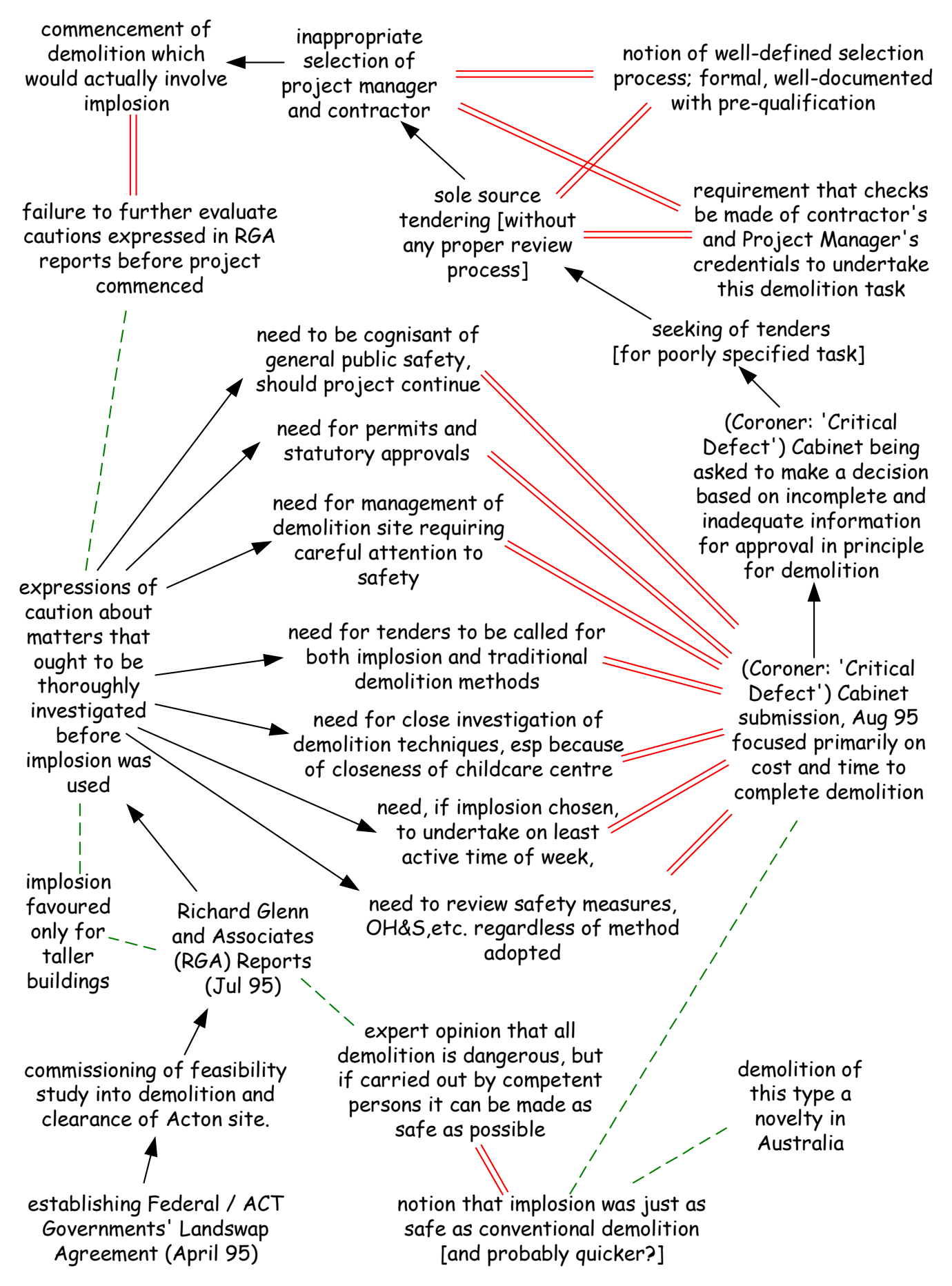
The Coroner noted that there were a number of critical defects in the submission to Cabinet, which ignored the July 1995 RGA Report. He referred to the tendering and selection processes, mentioned towards the top of the map, as ‘a sham’ (Figure 3-3).
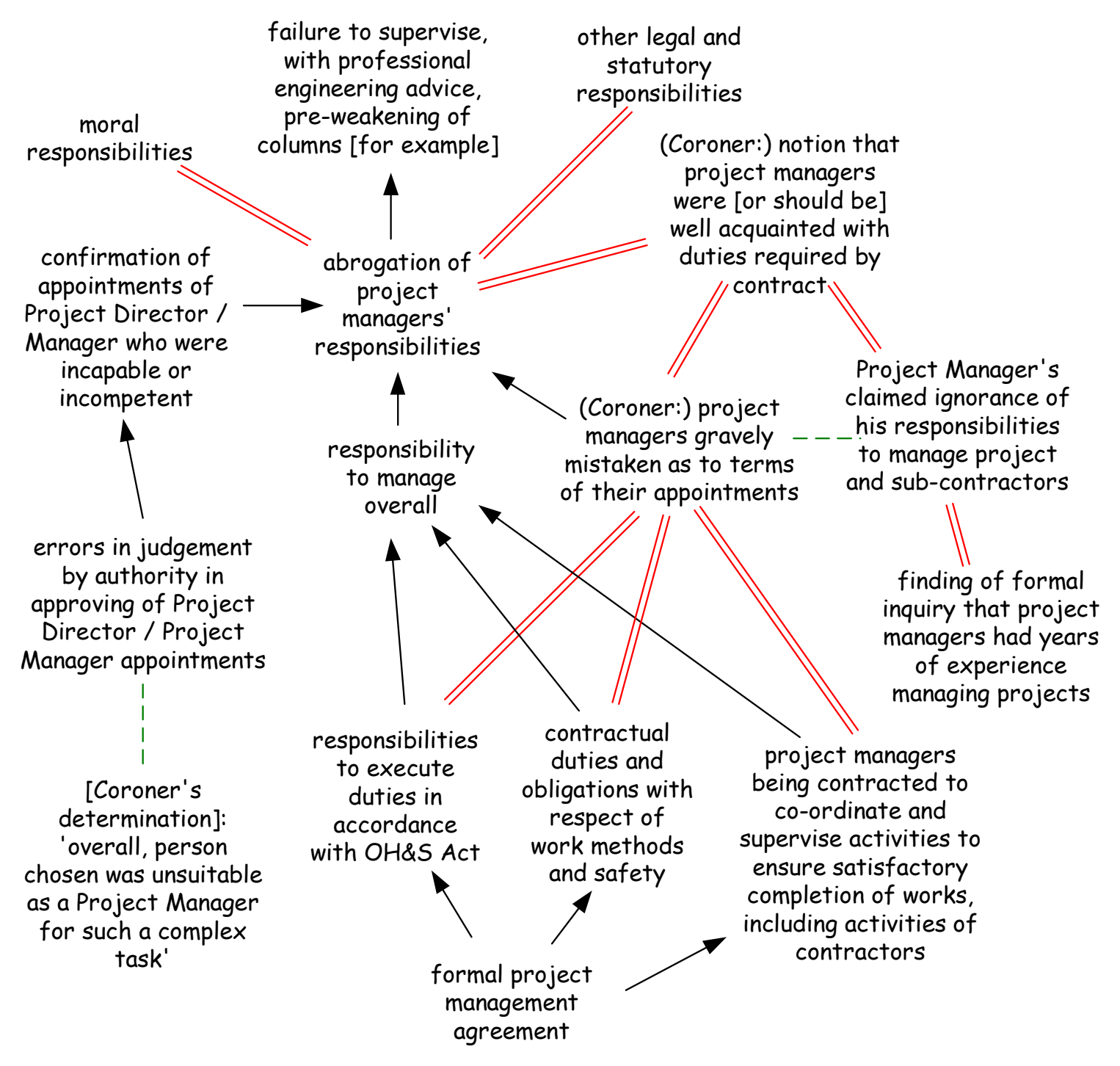
‘Defied any sense of reasonableness’ is how the Coroner described the arrogance of the managers of the project in respect of their appointments (Figure 3-4). He also noted that it is a ‘disturbing feature’ that the Project Manager did not see the project management agreement until after the implosion date.
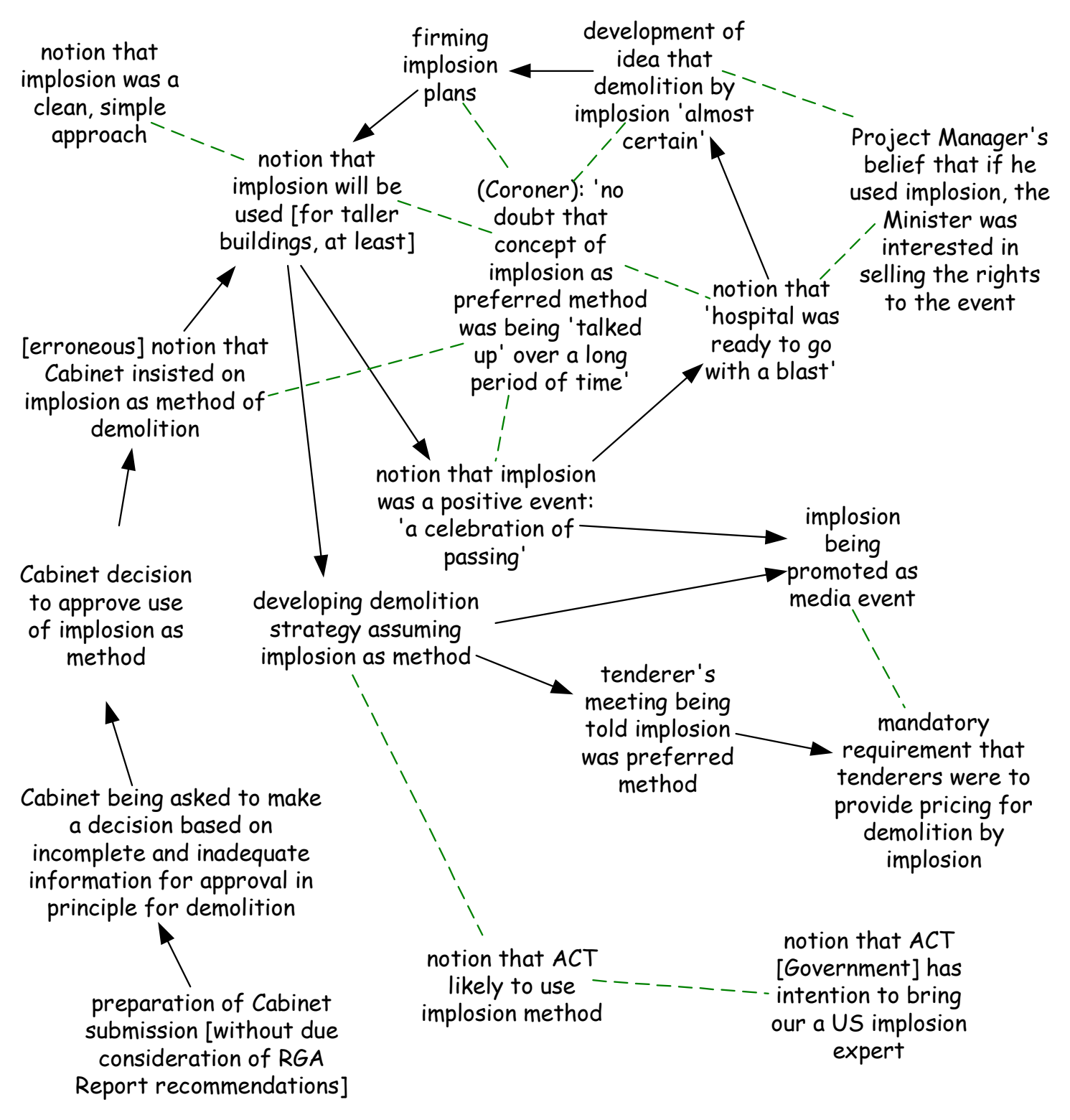
The anti-clockwise circle of arrows at the top of the map in Figure 3-5 suggests, as the Coroner notes … ‘no doubt that concept of implosion as preferred method [of demolition] was being ‘talked up over a period of time’. There could be two mechanisms operating here, groupthink and method of tenacity. An historic example of groupthink was US planning to invade Cuba, which developed from advice by the Joint Chiefs of Staff to President John F. Kennedy during the ‘Bay of Pigs’ incident (Silverstone, 1993). Such action, if taken by the US, could have initiated World War III. The term groupthink is defined in the Glossary; for a more detailed explanation, see Forsyth (1990: 490). Beer (1966) describes the method of tenacity, after American philosopher Charles Peirce, as a mechanism, by which ideas can originate then become cemented in the belief systems of individuals and groups, even though the original idea may be fantasy, exaggeration, or a significant distortion of the facts.
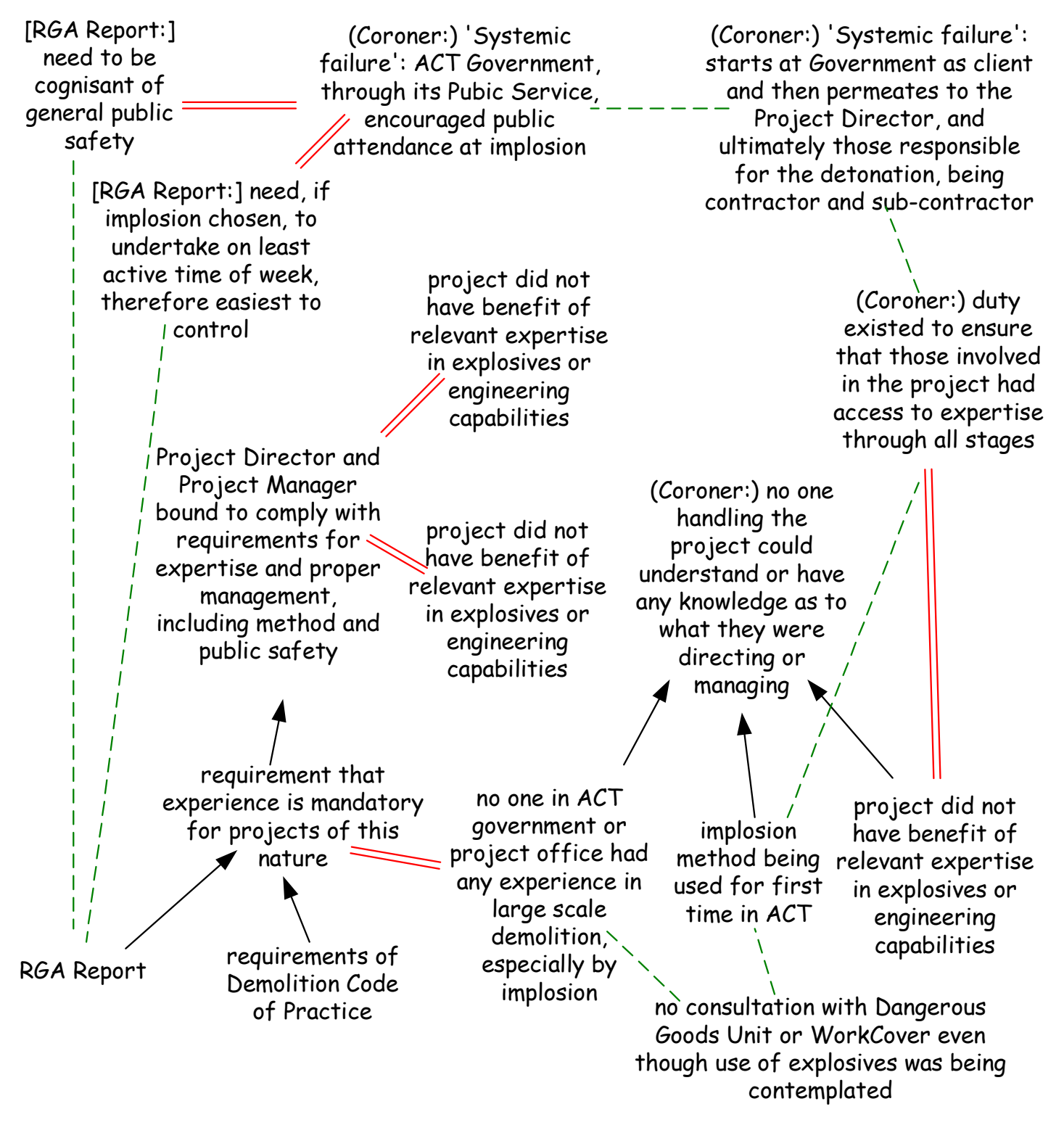
The importance of the RGA Report appears to have been universally underestimated. The systemic failures identified by the Coroner (shown in the concept map in Figure 3-6) started with the ACT Government and permeated through the managers of the project to the contractor and sub-contractor responsible for setting and detonating the explosives. The ACT Government, through its Public Service also encouraged public attendance at the implosion. This was contrary to the clear advice given by Richard Glenn and Associates that, if implosion was chosen as the method of demolition, this should be executed at the least active time of the week when the public were unlikely to be interested in attending and therefore easiest to exclude from the area surrounding the demolition site.
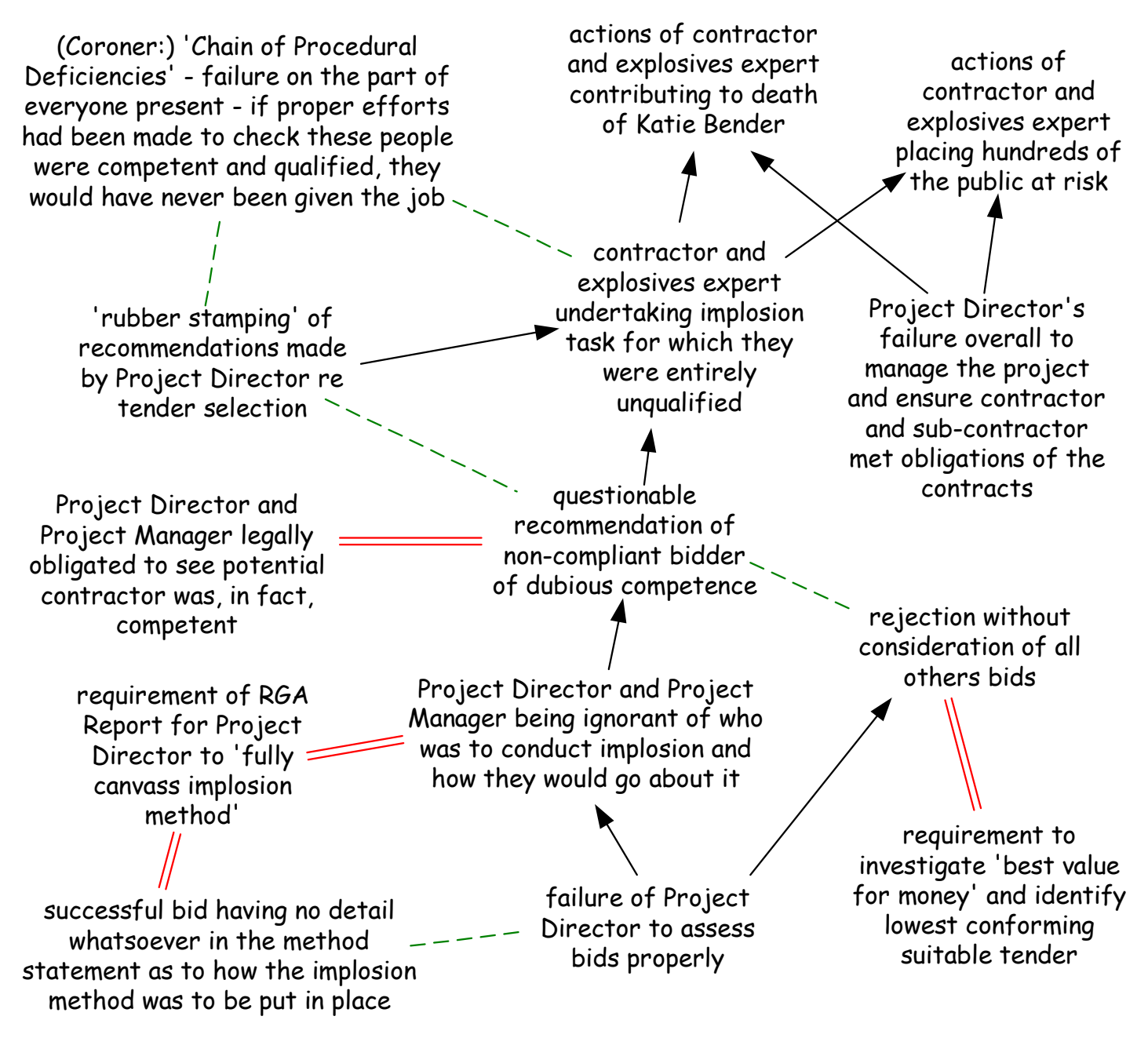
The Coroner’s finding that was a ‘Chain of Procedural Deficiencies’ is certainly damning. As far as the tender-selection process was concerned, he noted that the handling of the selection process was ‘nothing less than appalling’ (Figure 3-7). ‘Rubber stamping’ of recommendations made by Project Director regarding tender selection was done in the absence of any examination of demolition proposal by regulatory agencies such as ACT Building Control, National Capital Authority, ACT Dangerous Goods Unit or ACT WorkCover. Several times in his Report, the Coroner makes the point that an intelligent non-expert, that is, ‘a reasonable person’ should have been able to identify the procedural deficiencies and other systemic failures. That nothing was done to stop the project proceeding is most worrying.
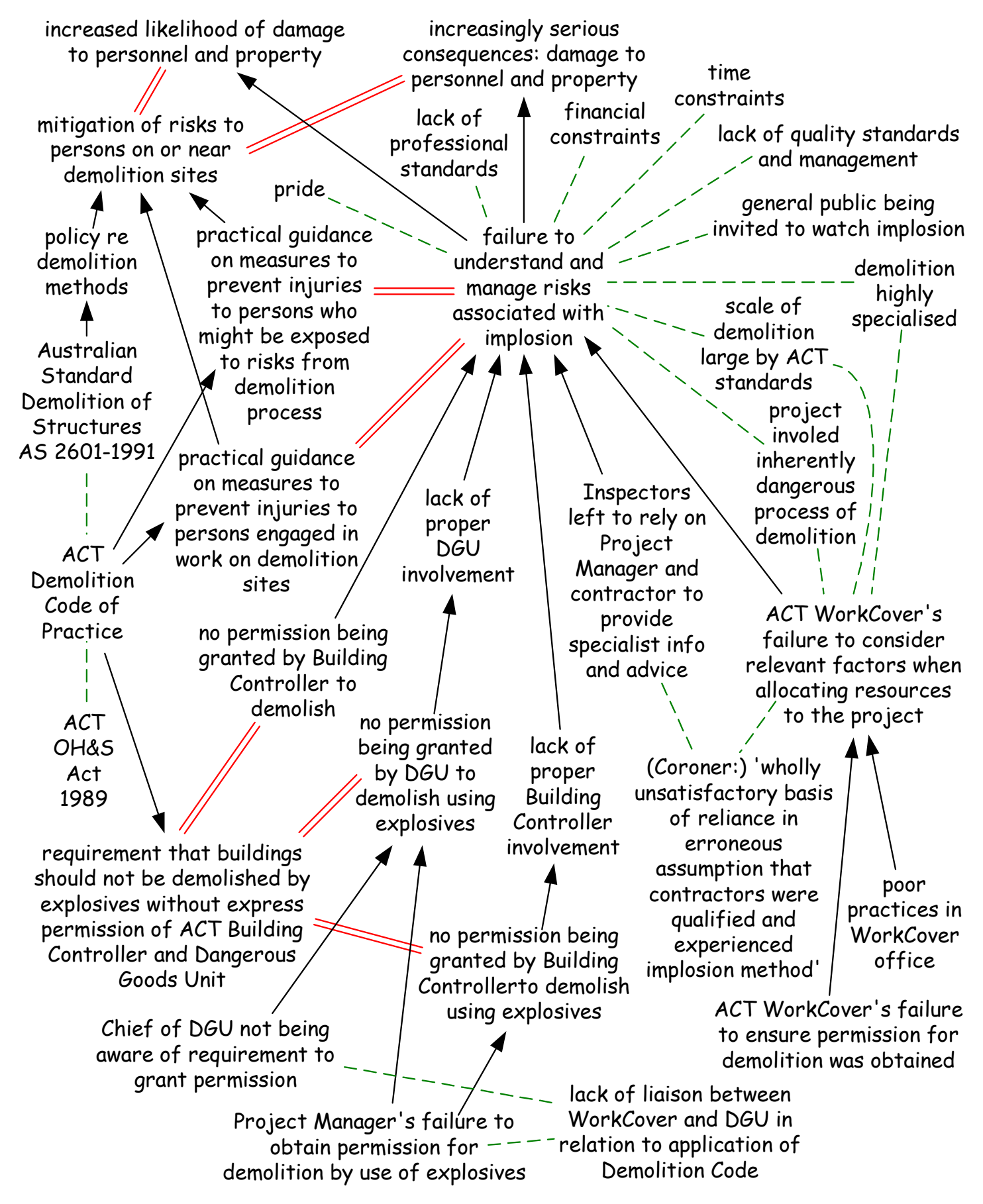
With regard to the Demolition Code of Practice (Figure 3-8), the Coroner identified a clear failure to understand and manage risks associated with implosion. Influences on this failure include pride, which inhibited any individual initiating action to stop the demolition, even though this was within their power to do so. Constraints placed additional pressure on individuals. This map shows a litany of failures, oversights, aversion to getting involved, and failures to follow procedures, shoddy practices, and incompetence. The similarity between the central concept in this figure and Concept No 4 in Figure 2-10 should be self-evident.
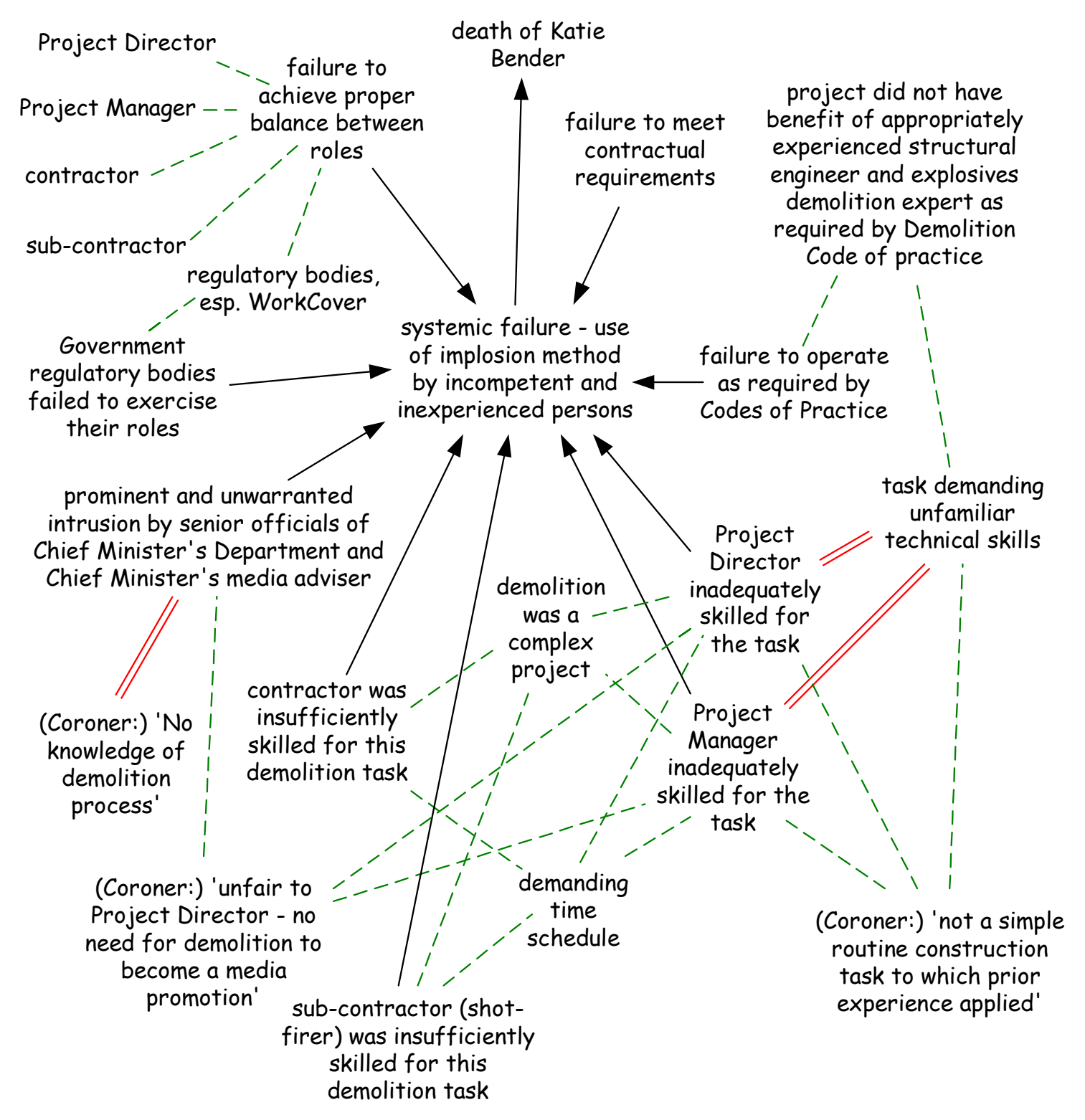
There were numerous examples of systemic failures. Only a few are indicated here in Figure 3-9. This project was not a simple routine construction task to which prior experience applied. The Coroner noted that those managing the project had neither the knowledge nor the experience to manage a project involving demolition by the implosion method. He noted that the shot-firer was also insufficiently skilled in the implosion method, and that it was unfair to the Project Director for this demolition to become a media promotion. Further, the coroner noted that there was prominent and unwarranted intrusion by senior officials of the Chief Minister’s Department and the Chief Minister’s media adviser.
References
- ACT Magistrates Court, 1999, Inquest Findings, Comments and Recommendations into the death of Katie Bender on Sunday 13th July 1997 on the Demolition of the Royal Canberra Hospital Acton Peninsula, ACT, .
- Silverstone, M.J., 1993, The effects of barriers to organisational learning in government institutions: The United States joint chiefs of staff, s organisational effectiveness during the Cuban missile crisis, October 1962’, MSc Thesis, Kansas State University.
- Forsyth, D.R., 1990, Group Dynamics, 2nd ed, ITP Brooks/Cole Publishing, Belmont California.
- Beer, S., 1966, Decision and Control: The Meaning of Operational Research and Management Cybernetics, John Wiley and Sons, Chichester, UK.