
1.11 SYSTEMS OF KNOWLEDGE-POWER
In all organisations, systems of knowledge-power operate. Flood (1999) describes knowledge-power:
‘… the idea that people in positions of power determine what is considered to be valid knowledge and consequently valid action. ‘Systems of knowledge -power’, in which executive decision makers are central players, militate against the sharing and flow of information (Flood, 1999: 116-122).’
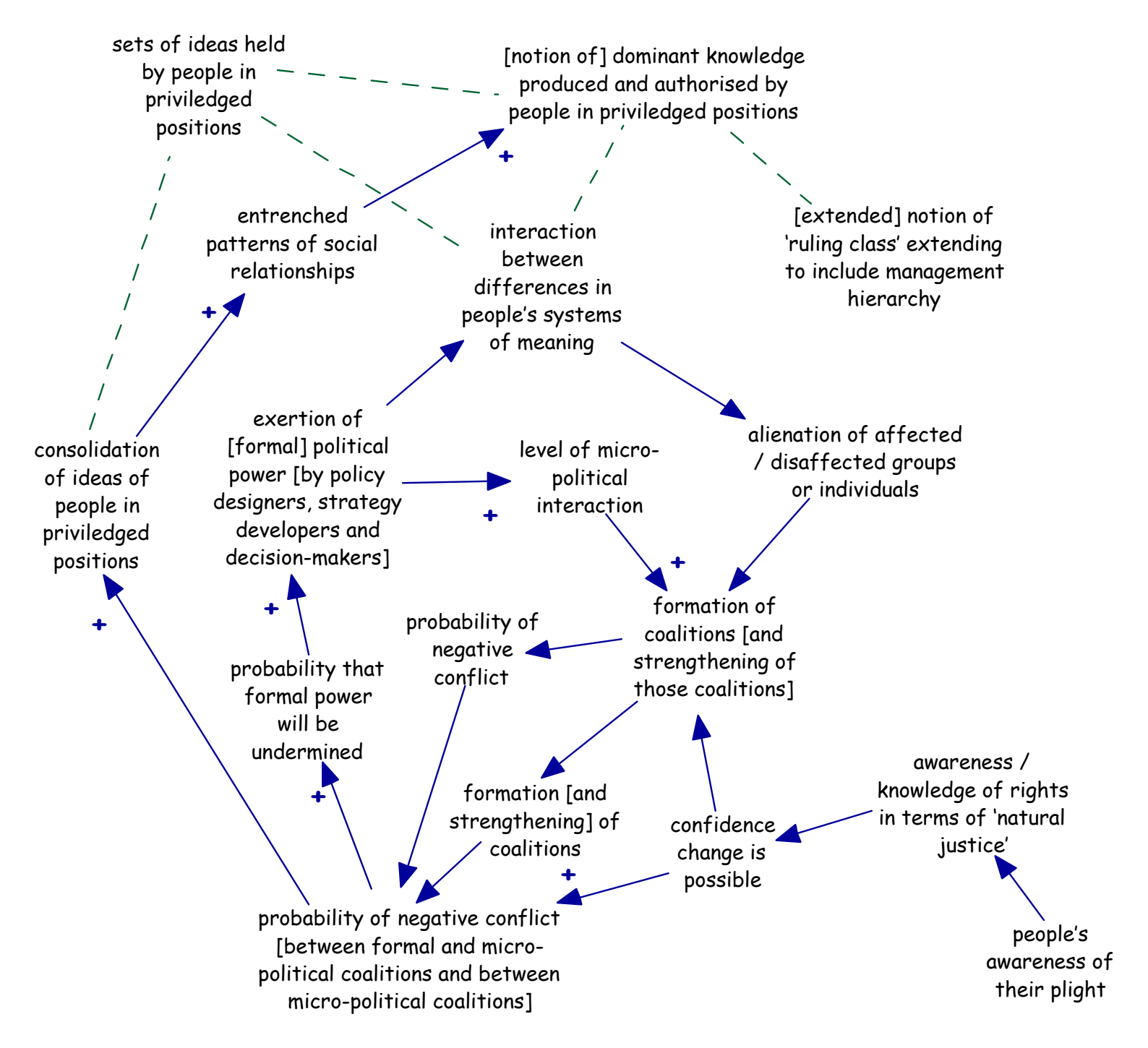
How systems of knowledge-power operate in organisations is depicted diagrammatically at Figure 1-8.
The existence of systems of knowledge-power means that individuals, the power brokers in the organisation, will stifle initiatives to improve communications or build a shared reality. In relation to shared reality in organisations, Espejo (1994) observes that:
‘Organisations are the outcome of ongoing processes in which people negotiate with each other—not necessarily with the same negotiating power—their organisational constructs and thereby constitute their organisations. Indeed, participants generate distinctions of their own, which they use to coordinate their actions, and through recurrent coordination of actions (i.e., language) they create a consensual domain of action, or shared reality … (Espejo, 1994: 204).’
Systems of knowledge-power militate against development of shared reality because less powerful stakeholders are told what they must believe, or are constrained in their thinking. Those wielding power are not necessarily best equipped or supported intellectually to manage risks most effectively. Failure to acknowledge the pervasive nature of systems of knowledge-power when developing risk-management strategies can be a significant threat to individual and organisational learning and creation of shared reality in organisations.
Footnotes
- [8] Concept map was derived from textual description by Flood, 1999: 116-7. ‘+’ sign suggests positive polarity, where a change at the tail of the arrow will produce a change in the same direction at the head of the arrow. back
References
- Flood, R.L., 1999, Rethinking the Fifth Discipline: Learning Within the Unknowable’, Routledge, London.
- Espejo, R., 1994, “What is systems thinking”, System Dynamics Review, vol. 10, no. 2-3, pp 199-212.