
1.12 FINDING OUT ABOUT A PROBLEM SITUATION
In risk management, the ever-present challenge is to find out about that problem situation. Whatever the method we use to find out about the problem situation, we need to accommodate the complexity of human affairs. This includes catering for the notions of systemicity, and weltanschauung. Systemicity describes the complex, dynamic behaviour exhibited by systems, or systems-of-systems. Weltanschauung is a German word, with no English language equivalent, which stresses the importance of a world or worldly view, which accommodates varying perspectives about a problem. Checkland does not suggest we attempt to contemplate complete systems. Rather, like Flood, he suggests we acknowledge the complexity of the world and that the world is whole. So, the notion of weltanschauung is complementary to systemicity.
Figure 1-9, is a concept map that depicts diagrammatically what an effective conceptualisation methodology contains. This depiction serves to identify the elements of the methodology, and to highlight the elements. Similar elements can be found in other successful methodologies we might use when investigating a problem situation.
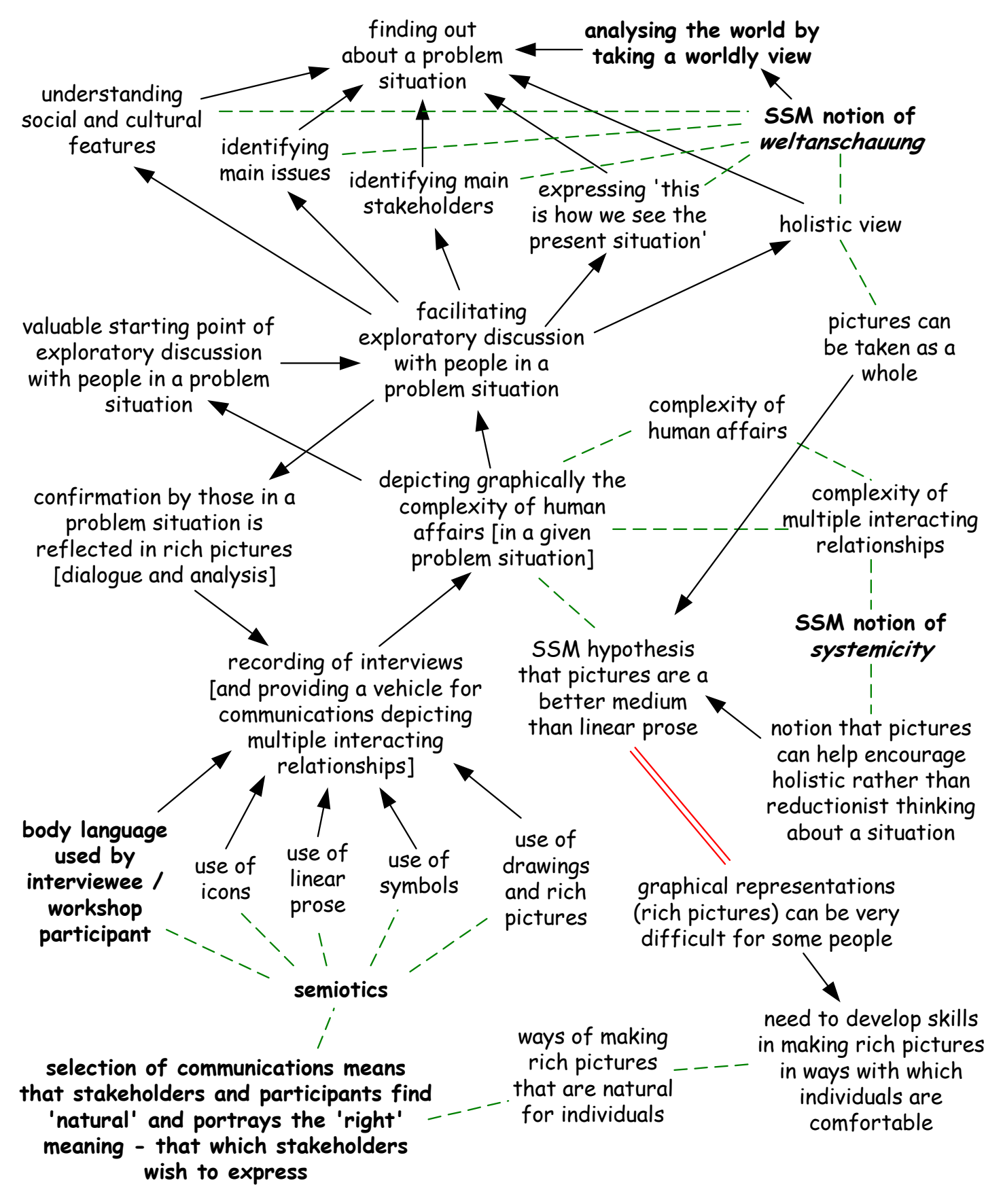
Our aim in risk management is to seek out and reveal assumptions and mental models, and development of exploratory discourse among people who are grappling with a particular problem situation. It should be noted that, as is revealed in subsequent chapters, these people already hold or have access to the vast majority of what can be know about the problem situation. We are trying to bring about a process of social inquiry, participatory management, which aims to bring about improvement in areas of concern by articulating a learning cycle, based on systems concepts, which can lead to action.9
This involves an iterative process, a vehicle for dialogue and discourse even as more and more becomes known about the problem at hand.
Systems thinkers use various methodologies and employ a variety of devices to assist thinking and communication about systemic issues12. Each of these relies on semiotics, that is, the use of symbols, icons and text to describe sometimes quite complicated concepts. Sutton (2000) warns of linguistic problems that very often arise in formulating requirements and knowledge elicitation and, hence, during problem conceptualisation.
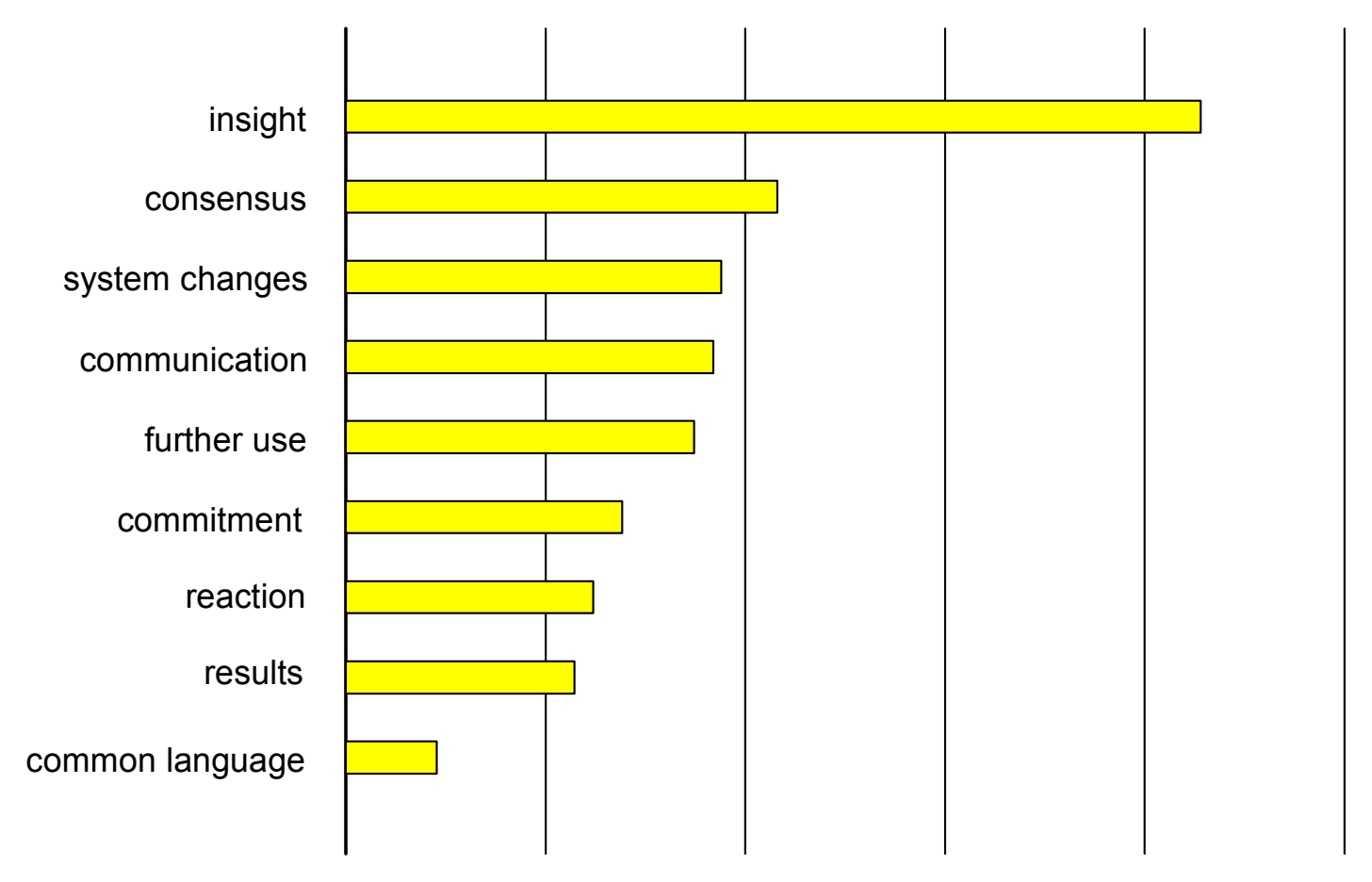
In an extensive study of results attained during group model building, an activity of participatory management, Rouwette, et al., (1999) found, ‘insight’ was found to be the greatest effect achieved and development of ‘common language’ was the least. See Figure 1-10. Developing and using common, domain-relevant, completely understood risk-management language remains a constant challenge. Churchman (1971) and Mason and Mitroff (1973) identify preferred modes of gathering and processing information generally used by decision makers. Choice of which intellectual, semiotic devices to use and how to communicate should be informed by client preferences regarding gathering and processing of information. Further, communications must be facilitated in a non-threatening way. Knowledge elicitation, assumption surfacing and testing can be threatening to individuals. These activities demand highly effective communications skills among workshop participants, facilitators and all involved.
Footnotes
- [10] This depiction of Soft Systems Methodology is derived primarily from the textual description contained in the 30-year retrospective on Soft Systems Methodology (Checkland and Scholes, 1999: A15-A17), as interpreted by the author. Detail shown in normal text is from Checkland and Scholes. Augmentation, in bold, is that of the author. back
- [9] See Checkland and Scholes, (1999: A40). back
- [12] For explanations and demonstrations of a selection of these, see Rosenhead (1989). back
- [11] After Rouwette, et al., (1999). back
References
- Sutton, D.C., 2000, “Linguistic problems with requirements and knowledge elicitation”, Requirements Engineering, no. 5, Springer-Verlag, London, pp 114-124.
- Churchman, C.W., 1971, On the Design of Inquiring System: Basic Concepts in Systems and Organisation, Basic Books, New York.
- Mason, R.O. and Mitroff, I.I., 1973, “A program for research on management information systems”, Management Science, vol. 19, no. 5, pp 475-487.