
2.5 FOCUS ON CRITICAL NODES
Further to our analysis of feedback loops, analysis of nodes brings further valuable insight. Nodes are points where influences converge or diverge. Nodes have influence over concepts to which they are linked, or are influenced by linked concepts, depending on the direction of causality shown by arrows. In the case where the link is connotative, causality may change in direction: concepts appear to influence each other. With few exceptions, links may change in strength and causality over time and may depend on initial conditions. Singular, direct, linear causal relationships are the exception rather than the norm.
Some nodes are much more important than others. We need to be able to identify them, and why they are more important. Intuition suggests that counting the number of arrows in, or out, gives an indication of the importance of a node. This count is an excellent guide but cannot be used alone. The nature of each link needs to be considered. Further, when a node is common to a number of circular feedback loops, it has extraordinary influence or is influenced to a greater extent. It is to such nodes we should direct development of our management strategies.
See Figure 2-10, which depicts the situation that existed months before the crash. Some aspects were in place years before. Those loops linking declining morale which have already been discussed have been put into the background for the time being, to minimise distraction.
In their absence, read Concept No. 21: loss of experience base, noting that loss of experience base is a key input to Concept No. 4 failure to inform the judgement of those responsible for designing combined arms training and associated safety [and support] and Concept No. 36 errors of judgement. The latter contributed directly to the final tragic events. In order to inform development of management strategies, consider Concept 4 and those concepts linked to it, firstly those that comprise feedback structures:
- Concepts 4 → 14 → 2 → 4: failure to inform the judgement of those responsible for designing combined arms training and associated safety → inadequate oversight and control of this combined arms activity (CT/SRO training exercise) → failure to recognise complexity of tasks 5 Avn Regt were required to undertake to support CT/SRO and capability development → failure to inform the judgement of those responsible for designing combined arms training and associated safety.
- Concepts 4 → 3 → 13 -- 2 → 4: failure to inform the judgement of those responsible for designing combined arms training and associated safety → failure to recognise importance of reporting aircraft incidents in training → lack of combined risk assessment and management procedures in training → failure to inform the judgement of those responsible for designing combined arms training and associated safety, and
- Concepts 4 -- 30 → 31 -- 4: failure to inform the judgement of those responsible for designing combined arms training and associated safety → lack of attention to detail → anomalies in orders, instructions and manuals relating to operation and support of 5 Avn Regt → failure to inform the judgement of those responsible for designing combined arms training and associated safety.
Note should be taken of the connotative links 4 -- 30, 31 -- 4, and 13 -- 2 in the latter two feedback loops. These links are open to interpretation. They are
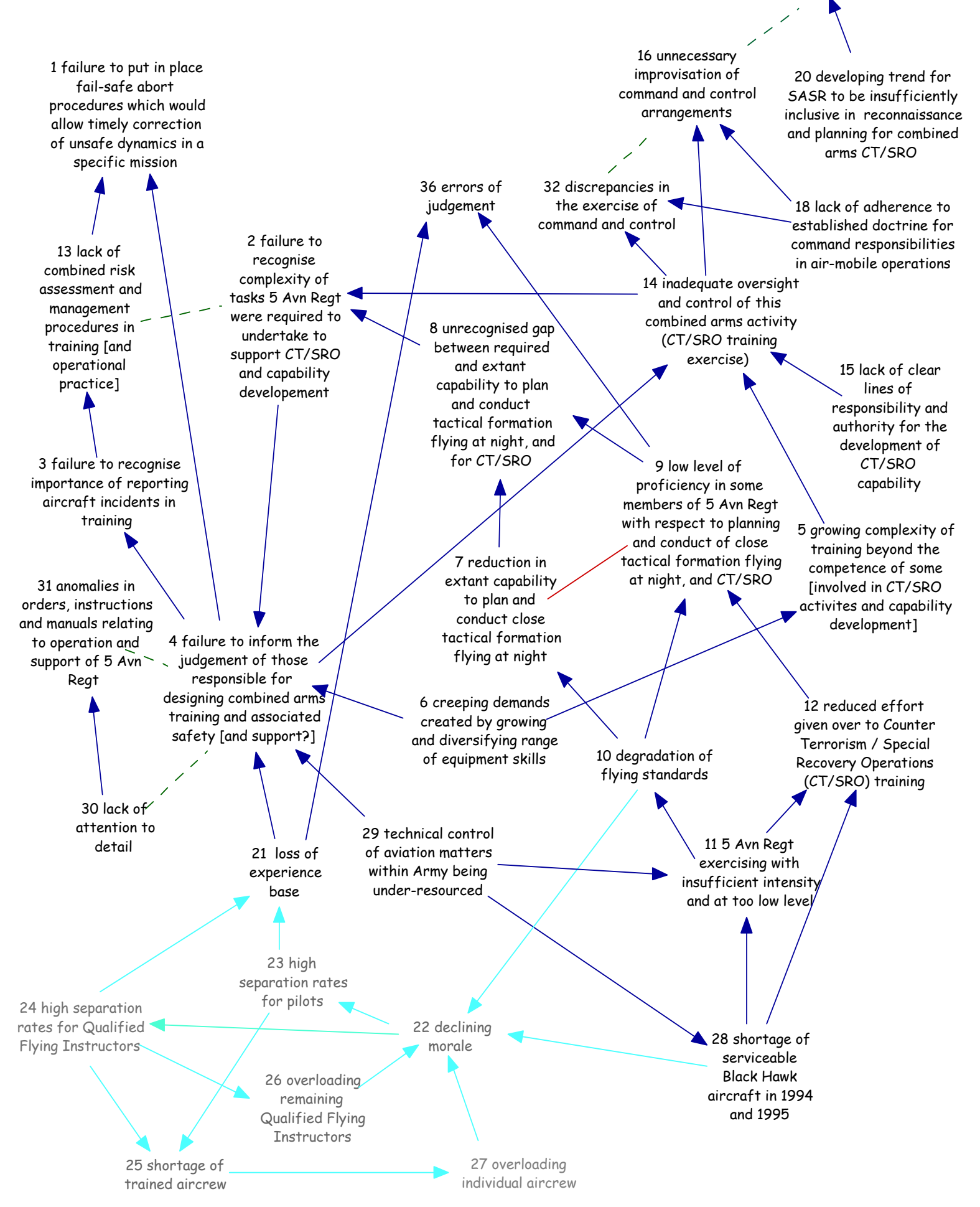
considered to be pseudo-feedback loops because for at least part of the time their influence is in the same direction as the causal links. When this occurs, the loop is complete.
Concept No 4 has nine links. It is a critical node. Intuitive reasoning also suggests that failure to inform the judgement of those responsible for designing combined arms training and associated safety, is critical, even when considered in isolation.
Further, the concepts to which it is linked are important in their own right. Consider, for example, the following:
- Concept No 2: failure to recognise complexity of tasks 5 Avn Regt were required to undertake to support CT/SRO and capability development;
- Concept No 14: inadequate oversight and controls of this combined arms activity (CT/SRO) training exercise; and
- Concept No 1: failure to put in place fail-safe and abort procedures which would allow timely correction of unsafe dynamics in a specific mission.
There should be no doubt that Concept 4 is a critically important pressure point. Changing Concept No 4 or the nature of the links to or from it, that is the extent to which it affects other concepts or the influence it has, may have significant influence on the likelihood or consequence of possible outcomes. Intensively managing Concept No 4 would have been very likely to produce enduring improvements. Tackling a difficult problem is often a matter of seeing where the leverage lies.
In addition to our consideration so far, we might view concepts as sources or sinks. Those that are sources have influence on several concepts, whilst those that are sinks are influenced by several concepts. In most cases, concepts are sources and sinks at the same time.
Concepts at the boundary of the map are either sources or sinks. Sources are more likely to appear lower in the map and sinks near or at the top. Referring back to Figure 2-6 and focusing on Concept No 28, we see it is a source with influence on three concepts, Nos 22, 11, and 12 respectively. It is also a sink with influence from Concept No 29. The fact that Concept No 28 shortage of Blackhawk aircraft in 1994 and 1995 is an influential source is most important in this map.
Clearly, another map focusing on aircraft serviceability would give a picture of what influenced the 1994/95 shortage. But, that is outside the boundary set for the extant map. Reiterating, Concept No 28 is an influential source worthy of closer consideration. Much earlier, serviceability of Black Hawk helicopters should have been better managed, but it was not.
In the early 1990s, after considerable inter-Service bickering, Army had taken control of the helicopter fleet from the Royal Australian Air Force (RAAF). RAAF had flown troop-carrying helicopters with distinction in Vietnam and was reluctant to lose this capability. RAAF also had extensive expertise maintaining helicopters. Further, the purchase of Black Hawk helicopters had been an embarrassment to the government, Minister for Defence and Chief of Defence Force (CDF). The Black Hawks had proven very expensive both to procure and to maintain, much more so than their predecessor the Bell Huey UH-1 series aircraft. Their procurement occurred almost concurrently with the hand-over from RAAF to Army. Army was faced with taking over from RAAF and bringing a new and more sophisticated aircraft into service, with all the concomitant training and logistics demands. It was little surprise to many, particularly the RAAF, that a chronic shortage of spares occurred and unserviceability became a serious problem in 1994/95. Many RAAF officers had predicted this years before.
While it might seem obvious after the fact, and after the Board of Inquiry had completed its deliberations, these concepts and relationships should have been understood earlier, and managed routinely. Had this been so, the accident might have been averted.
Indeed, a strategy to avoid training incidents or accidents in the future would be directed at correcting critical concepts such as those identified by our analysis here. The Board of Inquiry’s observation that failure to inform the judgement of those responsible for designing combined arms training and associated safety … suggests the worst failure, the failure to learn. In general, failure to understand and to learn leads to a breakdown in the management of risks.
Before leaving this point, it is most important to note that effective approaches designed to fix problems should be multi-pronged. Problems should be attacked simultaneously at strategic, operational, and tactical levels.
At the strategic level, those concepts most worthy of attention are:
- Concept No 4: failure to inform the judgement of those responsible for designing combined arms training and associated safety;
- Concept No 2: failure to recognise complexity of tasks 5 Avn Regt were required to undertake to support CT/SRO and capability development;
- Concept No 14: inadequate oversight and control of this combined arms activity (CT/SRO training exercise); and
- Concept No 1: failure to put in place fail-safe and abort procedures which would allow timely correction of unsafe dynamics in a specific mission.
Whether Concepts No 3, 6 and 21 also directly linked, should be included is a matter for risk assessment.
At the operational level, Concept No 22, declining morale, certainly would be worthy of attention. Figure 2-5 does not really cover tactical issues. To identify appropriate tactical level issues would require more detailed investigation and analysis.
Identification of critical issues and their continual review are fundamental risk-management activities. It is not at all surprising that the Board of Inquiry’s first recommendation attends to the matter of risk analysis, and subsequent recommendations relate to treatment of identified risks.
Footnotes
- [2] Also see Major Risk Key Performance Indicators—Black Hawk at Table 3-1. back