
5.3 UTILITY OF QUALITATIVE ANALYSIS
Ackermann, Eden, and Williams (1997), Coyle (1996), and Eden and Ackermann (1998a) have demonstrated how qualitative system dynamics modelling techniques can be used in the analysis of complex problems. For example, Ackermann, Eden and Williams’ cognitive mapping was used to support the development of critical legal arguments in litigation over delays in project management of the construction of the Channel Tunnel. Techniques, similar to those demonstrated earlier in this book, were used to support interviews with the client when the scope and nature of the problem were being investigated. It was then used throughout to record perceptions of the interrelationships between factors affecting the problem. Ackermann, Eden and Williams employed large cognitive maps, an example of which is reproduced at Figure 5-3, in conjunction with system dynamics modelling and simulation to enhance learning, understanding and making the complex legal case defensible. Ackermann, Eden, and Williams explain that their approach involved capturing then analysing mental models of those with relevant knowledge, experience and perception of the problem at hand. This experience and application of technique are directly transferable to risk management.
Ackermann, Eden, and Williams produced a series of individual (cognitive) and group (concept) maps in order to create influence diagrams of the complexity inherent in the Channel Tunnel Project. See Figure 5-3.
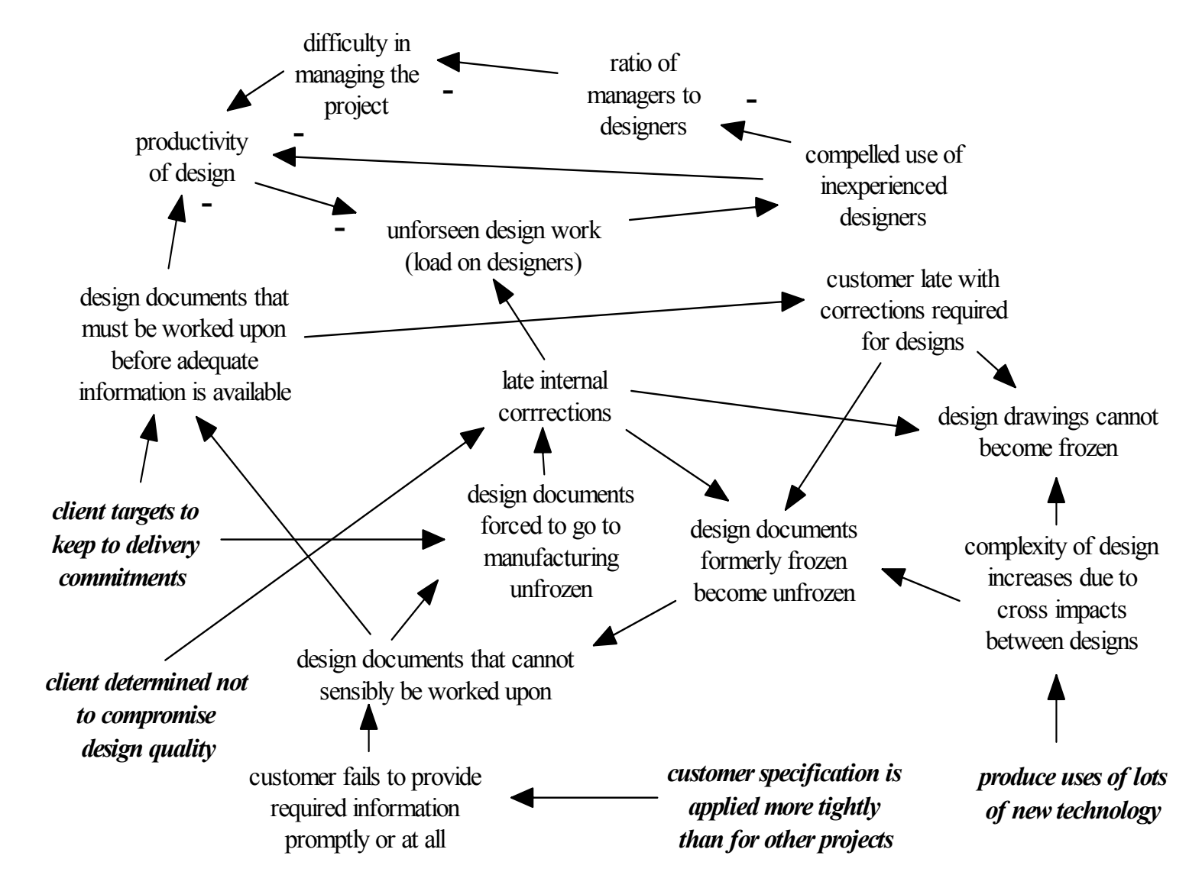
Ackermann, Eden, and Williams explain that building cognitive maps then developing influence diagrams of interrelationships in this complex project were effective in aiding the client, barristers and solicitors to develop an understanding sufficient to build a case sound enough to be placed before the courts. Note that in Figure 5-3 concepts in bold italics show influences of particular importance to the legal case. Iterative and Interactive Strategy Development (IISD), described in this chapter, builds on work by Ackermann, Eden and Williams (1997) and the basic system dynamics modelling approach founded by Forrester (1961). IISD is generally applicable to strategy development and is very applicable to development of risk mitigation strategies.
Footnotes
- [6] Ackermann, Eden and Williams (1997: 52). back
References
- Ackermann, F., Eden, C. and Williams, T., 1997, “Modelling for litigation: Mixing qualitative and quantitative approaches”, Interfaces, vol. 27, pp 48-65.
- Coyle, R.G., 1996, System Dynamics Modelling: A Practical Approach, Chapman and Hall, London.
- Eden, C and Ackermann, F., 1998a, Making Strategy: The Journey of Strategic Management, Sage, London.
- Forrester, J.W., 1961, Industrial Dynamics, Productivity Press, Portland, Oregon.