
4.7 STAKEHOLDER MANAGEMENT
Given that identifying all the stakeholders may be a difficult enough task, the proposition that we might ‘manage’ the stakeholders in a particular purposeful human activity must appear very ambitious indeed. However, we have little option but to attempt to, at least, identify the key stakeholders and assess the extent of their influence. The greatest influence might be exerted by gatekeepers, as mentioned in Section 1.2, so priority must be assigned to identifying them and their influence, and keeping them aligned as far as possible with our risk-management goals.
The main aim of stakeholder management, once we know who the stakeholders are, is to make assessments of where each stands in terms of their influence on, and interest in, what we are trying to achieve by way of risk management. The stance of each stakeholder must be assessed according to the power they wield or how belligerent they could be if the worst circumstances arose, and the interest they have. A highly powerful stakeholder who is disinterested does not pose a threat until his or her level of interest changes for whatever reason.
The influence or power of each stakeholder might be depicted on one axis and the extent to which each stakeholder might be affected by events (such as implementation of a proposed risk-management strategy) that is, their interest might be depicted on the other.
The resulting grid is conveniently divided into four quadrants that might be labelled, as shown in Figure 4.3:
- Highly disaffected, belligerent, wields little power.
- Highly disaffected, belligerent, powerful.
- Supportive, wields little power.
- Supportive, powerful.
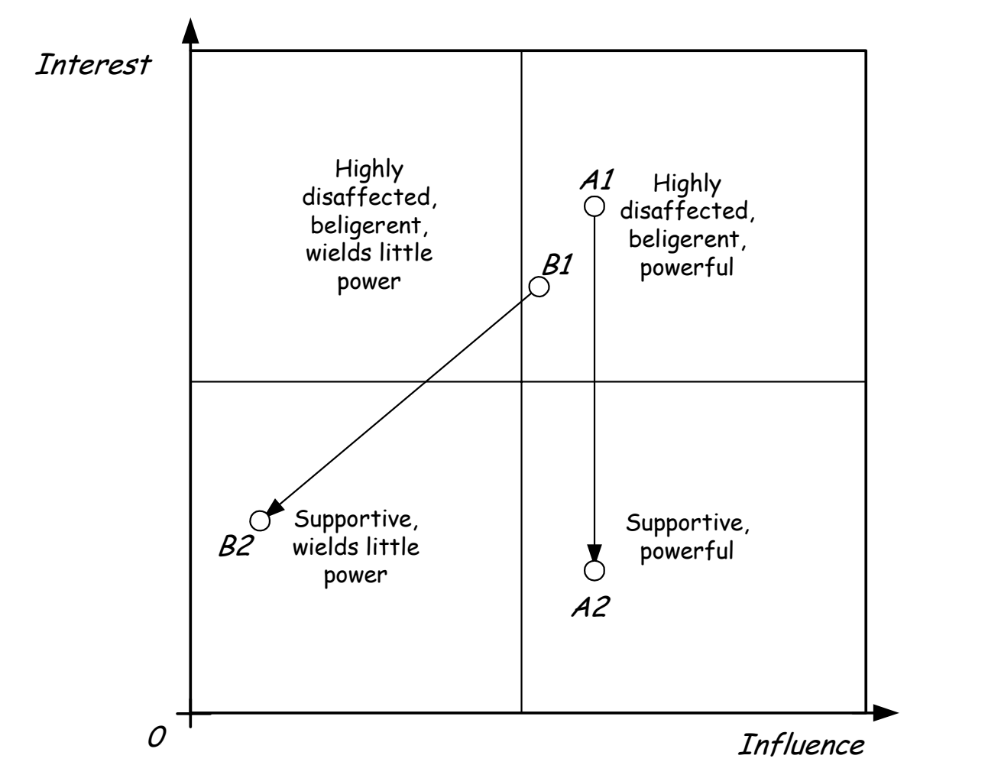
If the position of the stakeholder is unfavourable, a strategy must be devised to move the assessed position of the stakeholder to a more favourable position. A strategy is developed for each line or planned transformation.
In the instance of A, moving that particular stakeholder from A1 to A2 may involve a concerted education and publicity campaign. In the instance of B, moving that particular stakeholder from B1 to B2 would demand the additional challenge of reducing their influence or power. This could be considerably more problematic.
Each of these strategies, to move stakeholder A from A1 to A2 and stakeholder B from B1 to B2 must be developed without the knowledge of stakeholders A or B or their allies. This demands strictest confidence. Similarly, enacting the stakeholder management strategies must be conducted in strictest confidence.
All significant shifts in the position of stakeholders on our grid must be monitored, and the efficacy of the strategy for that particular stakeholder must be reviewed regularly. The process described is an iterative one and, in itself, is an essential risk-management activity.
All wicked problems are difficult to manage. Stakeholder management is just one more facet to be considered in the principles of method we might employ.