
4.5 CULTURAL IMPEDIMENTS—BEING INSENSITIVE TO RISKS
Following his study of the 1994 Moura Mine Disaster in which 11 miners died, Hopkins (1999: 54) makes the point that management decision making [and risk-management processes] must be structured so as to counteract cultural impediments to recognising and responding to risks. The main impediment referred to in this case is associated with the existence or development of a culture of denial.
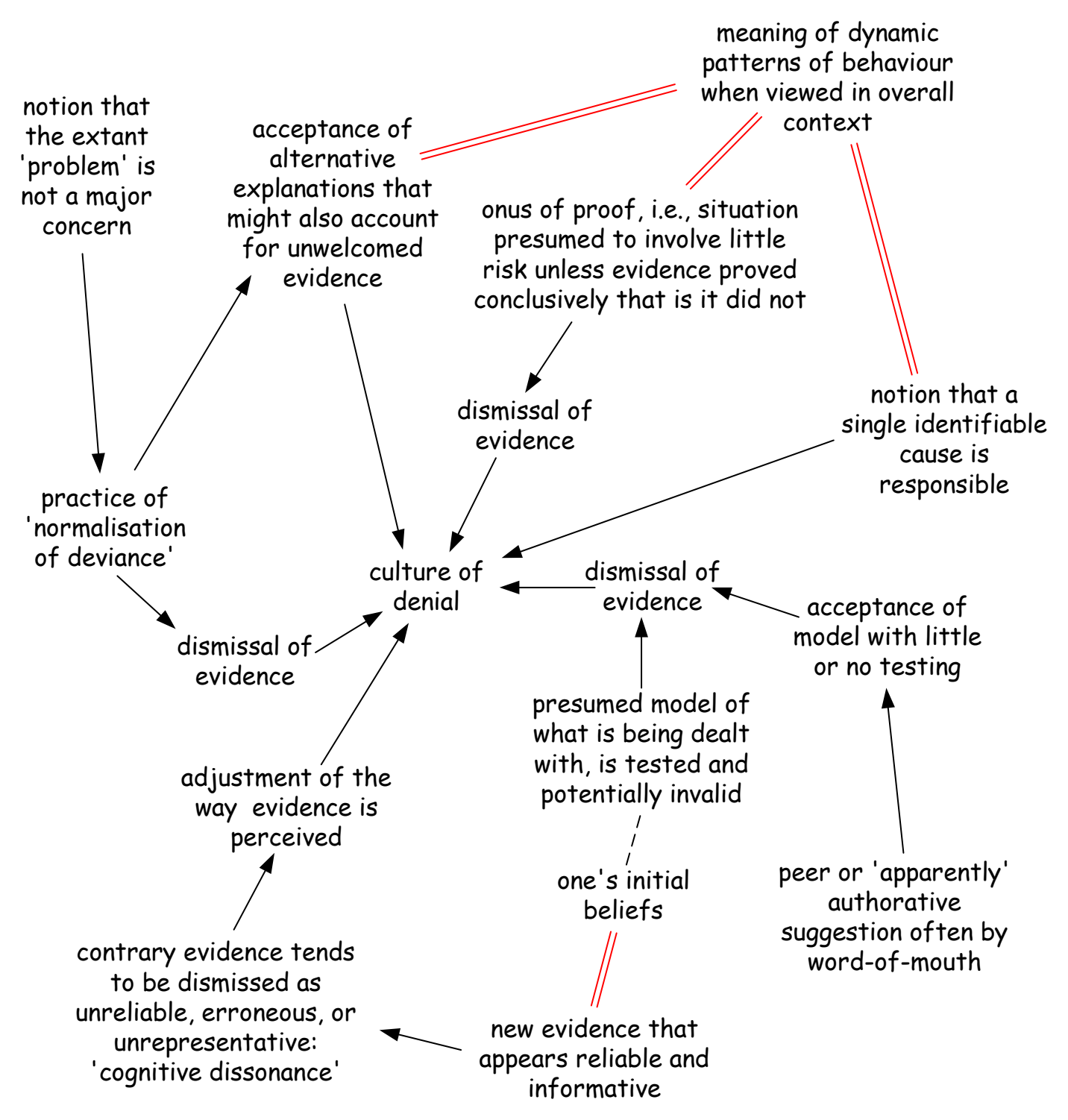
Such a culture routinely denies that problems exist. If problems are seen to exist, the organisation as a whole, and individuals in the organisation, seemingly pass off the associated risks as insignificant, or less significant than they might be. Hopkins’ explanation of the mechanisms that contribute to a culture of denial is depicted in the form of a concept map at Figure 4-1.
In a culture of denial, individuals either dismiss contrary evidence that presents, or actively adjust that evidence to fit their purposes. The adjustment process may involve cognitive dissonance, the groupthink or method of tenacity mechanisms. Systems of knowledge-power described at Section 1.11 may also play a part.
References
- Hopkins, A., 1999, Managing Major Hazards: The Lessons of the Moura Mine Disaster, Allen and Unwin, Sydney.