
1.5.7 Human Decision Making—Belief And Learning
Heuristics are not the only devices we call upon in our decision-making activities. Kline (1995) explains we have the ability to rapidly recall schemata, that is, all the ideas in a person’s head which are used to represent and interact with the world. In contrast to Kline, Senge (1990) calls these schemata ‘mental models’ whilst Kelly (1955) calls them ‘personal constructs’. Complex schemata are learned:
‘Some of our human schemata are simple, some moderately complex and some relatively very complex… Complex schemata constitute the basis for a doctor in diagnosing illness, for a musician in playing his or her instrument, for an engineer designing a device, and so forth. These more complex schemata are not merely a string of information but, rather, form complex relational networks that are acquired by and only by long experience and usually focused study… all disciplinary knowledge is based on relatively complex, learned schemata… (Kline, 1995: 31-32).’
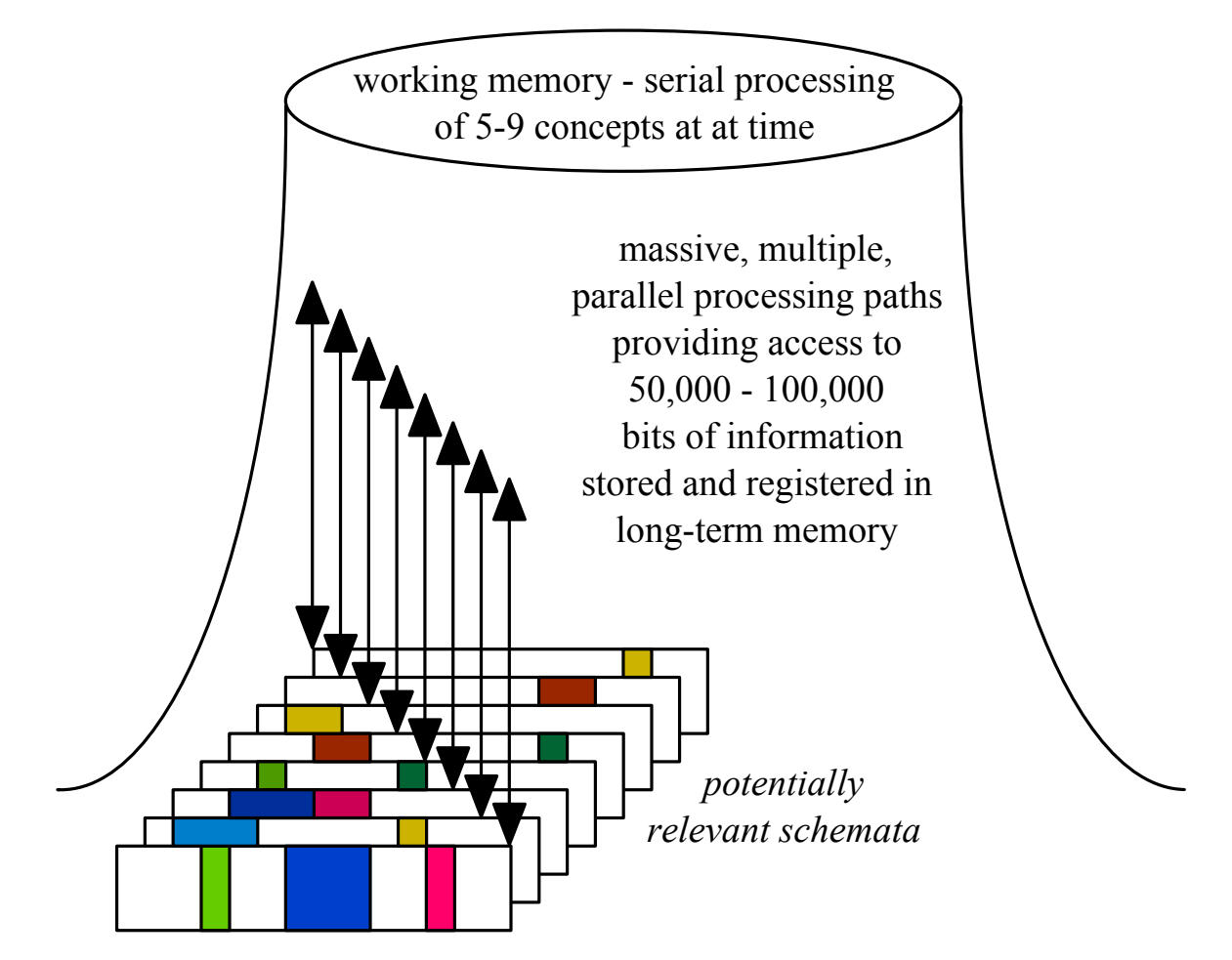
In our minds, schemata are broken down into chunks. Our working memory can hold about four chunks, or about seven bits [‘bits of information’, not to be confused with digital bits], whilst our long-term memory can hold about 50,000 bits of information for a single area, and around 100,000 bits in total. These can be rapidly recalled using the brain’s multiple, parallel processing capability. Dennett (1991) hypothesises that parallel processors throw up multiple drafts—that is, possible solutions from our long-term memory—and working memory chooses which one to follow. Gigerenzer’s work suggests that our heuristics are called upon to aid that choice.
Dennett (1991) and Kline (1995: 16-46) reinforce what Miller (1956) observed, that the processes of our working memory are serial and relatively slow compared to the ability recall from our long-term memory.
Miller’s 7-Bit-Rule has been checked and rechecked by many researchers in many areas of mental activity. It is established empirically beyond reasonable doubt. The “7-bit-limitation” on the human working memory, imposed by Miller’s 7-Bit-Rule, is probably the most important single constraint on the human mind regarding how we form sysreps (Kline, 1995: 16-46). Sysreps are truth assertions we hold and recall when we want to discuss, analyse, think about or write about the following: a picture, an equation, a mental image, a conceptual model, a word description, and etc. The relationship between working and long-term memory and schemata may be as depicted by Figure 1-4.
This has important ramifications for the way we go about solving problems. Sysreps, schemata, mental models, or personal constructs are only really valuable as bases for understanding and learning if they have been developed from valid and relevant experiences. Situation awareness and option choice are more involved in complex problem solving, so we need more deliberative and more publicly defensible decision making.
References
- Kline, S.J., 1995, Conceptual Foundations for Multidisciplinary Thinking, Stanford University Press, Stanford, California.
- Senge, P., 1990, The fifth discipline: The art and practice of the learning organisation, Doubleday, New York.
- Kelly, G.A., 1955, The psychology of personal constructs: A theory of personality, Norton, New York.
- Dennett, D.C., 1991, Consciousness Explained, Little, Brown: Boston.
- Miller, G.A., 1956, “The magical number seven, plus or minus two: Some limits on our capacity for processing information”, Psychological Review, vol. 63, no. 2, pp 81-97.