
5.4.2 IISD—Inputs And Outputs
The key inputs to IISD from stakeholders and the environment, that is, from the problem space are: knowledge; experience; information; perception; and motivation. The key outputs into the solution space, from IISD to the individual and organisation are: learning; consensus; commitment to action; and strategy. Here, the term ‘client’ includes all important stakeholders.
5.4.2.1 Knowledge
Knowledge of the factors affecting the problem and their interrelationships is held primarily by those faced with the problem at the outset; the key stakeholders, managers and decision-makers. An important task of the analysts is to elicit that knowledge. The relationships between managerial cognition, operative knowledge, knowledge elicitation and problem definition were examined earlier.
5.4.2.2 Experience
Experience may be resident both in a consulting team assisting in the development of risk-management strategies and in various stakeholders. It can be problematic that the extent to which experience exists and where this experience resides is not readily known.
It may be necessary to solicit help from those specialist, or knowledgable, in a relevant area. Hypotheses developed during problem conceptualisation, strategy formulation and analysis should be subjected to testing against experience, in order to facilitate continued validation and revision of mental models, and to enable experiential learning. Developing mental agility through scenario planning or building and testing of models (either qualitative or quantitative or both), may help in developing experience more rapidly than might occur otherwise, thereby producing more effective learning.
5.4.2.3 Information
Throughout, the requirements for information will need to be reviewed as the focus on various parts of the problem changes. Sufficiently accurate and timely information is critical to both development of strategy and to learning. The information needed must be identified and obtained. Seeking out, and obtaining, the necessary information can be hampered by deliberately placed or naturally occurring barriers. Sometimes we may have to struggle against adversity to win information.
5.4.2.4 Perception
Perception is inextricably linked to our mental models and is shaped by physical and emotional experiences throughout our lives. It is tied to deeply ingrained assumptions, values, generalisations, and mental images, which in combination influence how we view the world. Perception can be both an aid and a significant barrier to understanding, problem conceptualisation and model building. Perceptions are not static. Ackermann, Eden, and Williams (1997) observed that perceptions changed as their study proceeded, thereby reinforcing the requirement for an iterative approach. Similar observations were made by Klein and Cooper (1982). Vennix observes:
‘… research has convincingly shown that differences of viewpoint [perception] can be very productive. They may help to challenge the implicit assumptions about situations and thus help prevent a premature problem definition. The more different perspectives taken into account, the smaller the chances of premature problem definition and ‘solving the wrong problem’.” (Vennix, 1996: 1).’
A suitable problem-solving methodology should recognise and exploit differences in perception. Checkland, in SSM, recognises this and expresses it through the notion of weltanschauung, the need to accommodate varying perspectives. The elements of SSM are described at Figure 1-8, have been identified to emphasise the importance both of perception, and of a holistic view, in the process of finding out about a problem situation.
5.4.2.5 Motivation
Having a strong desire to solve a problem or, alternatively, to resist change are manifestations of (a lack of) motivation. Stakeholder motivation needs to be gauged then carefully monitored. It is important to remain aware of political influence as a motivating factor. As various strategies are offered, reviewed and evaluated, their political acceptability will be a matter for debate. Ultimately, the chosen strategy will have to be fully supported by the client organisation and, especially, its senior executives. The likelihood of acceptance will be considerably higher if decision-makers have been involved through every step of the process. The process, cognitive maps and models must be accessible and understandable to the decision-maker in order to encourage his involvement and foster positive motivation. Remediation of wicked problems involves change. Frequently this is organisational change. Organisational change demands strong leadership and the generation of considerable effort to maintain high levels of motivation to see the change through to completion. Brigadier (retired) Chris Roberts, AM, CSC formerly Commanding Officer of the Special Air Service Regiment, a tough uncompromising professional military officer who trained me when I was a young officer cadet and later was Chief of Staff in my superior headquarters when I was a Commanding Officer, in a recent personal communication made the strong point that to take positive steps to correct insidiously developing risky situations, motivation is essential but not sufficient; individuals must also have moral courage.
Often, as the cases in this book evince, individuals saw things that should have been corrected, but they did nothing or the action they took was ineffective. A variety of pressures exist to convince us that inaction, or a minimalist course of action, is appropriate. These pressures included misguided pride; artificial and unnecessary time constraints, systems-of-knowledge power, groupthink, cognitive dissonance and the existence of a culture of denial. These pressures, individually and in combination, militated against action being taken by individuals or organisations. Sometimes, one must make a stand on the basis of what one feels and believes to be right. To make a real difference to a developing risky situation demands moral courage to act, to do something that will make a real change. Moral courage is necessary in those circumstances when the views one holds are contrary to the organisation or are contrary to those in the organisation who hold greater influence. It is a brave person, or an ordinary person through their individual brave acts, who challenges established ways of doing things and demands that an unsafe act or set of activities stops, or that corrective action, or a totally different direction be taken. Exercising one’s moral courage is scary and unnerving, and a very lonely experience. It can test the very fibre of one’s being. But, when it comes to taking action on the basis of one’s beliefs and understanding of moral and ethical issues, there can be no compromise; if it must be done, it must be done.
5.4.2.6 Learning
Learning about the problem will alter stakeholder’s views and may well change the nature of the problem. To foster individual and organisational learning (Bennett and Brown, 1995; Strata, 1989; Wick and Leon, 1993), models need to be developed with intimate involvement of, and interaction with, the decision-makers. Testing and validation of models must be undertaken progressively throughout.
Through double-loop learning, we continually develop and test hypotheses of real world behaviour and retain this learning as our personal mental models. The term mental model stresses the implicit causal maps of a system we hold, our beliefs about the network of causes and effects that describe how a system operates, the boundary of the model (the exogenous variables) and the time horizon we consider most relevant—our framing or articulation of a problem (Sterman, 1994: 294). An overview of interaction between our mental models and the real world is depicted diagrammatically at Figure 5-5.
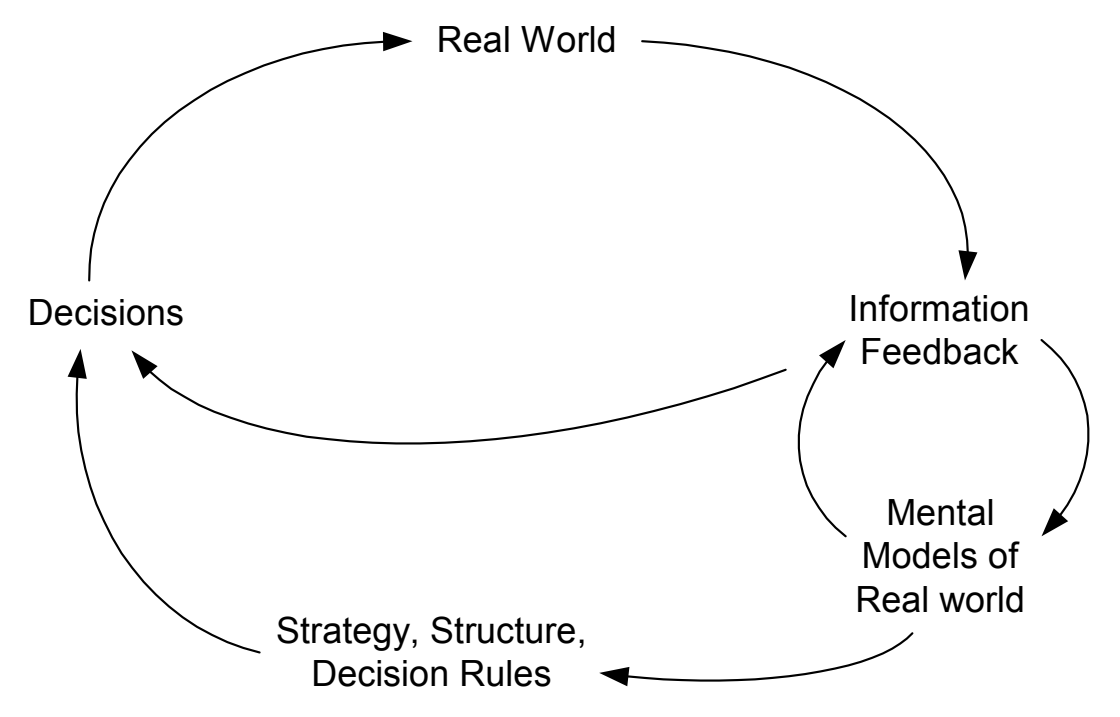
Feedback from the real world provides a basis upon which we revise our mental models and, in turn, devise future strategies and personal decision rules. Sterman explains:
‘For learning to occur, each link in the two feedback loops must work effectively, and we must be able to cycle around the loops quickly relative to the rate at which changes in the real world render existing knowledge obsolete. Yet, in the real world... these feedbacks often do not operate well.”
(Sterman, 1994: 296).’
Sterman also explains that various impediments slow or prevent these learning feedbacks from functioning, allowing erroneous and harmful behaviours and beliefs to persist. The barriers to learning include the dynamic complexity of the systems themselves; inadequate and ambiguous feedback; inability to simulate mentally the dynamics of our cognitive maps; poor interpersonal and organisational inquiry skills; and poor scientific reasoning skills. To be successful, methods to enhance learning about complex systems must address all these impediments (Sterman, 1994: 291-2). Sterman suggests an idealised set of learning loops, which involve testing and validation of mental models and the development of these into more formal models capable of withstanding detailed scrutiny. This idealised learning process, shown diagrammatically at Figure 5-6, is fundamental to IISD.
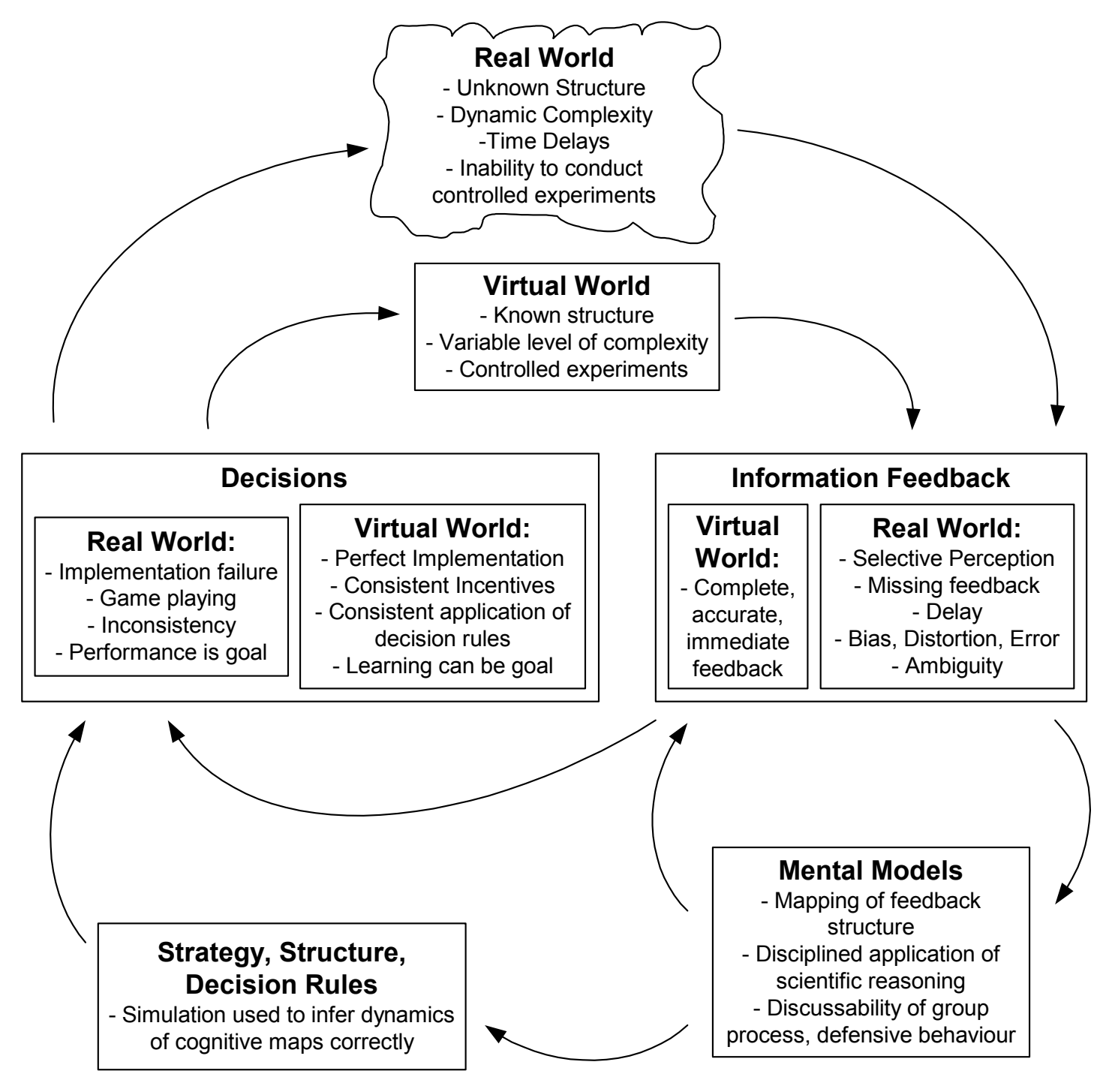
Before attempting to develop alternative strategies or evaluate them in the virtual world, IISD captures the mental models of decision makers, experienced personnel, stakeholders and gatekeepers as appropriate. These mental models must be in a form understandable and transparent to all, and amenable to analysis. IISD sets out to enhance learning and exploit individual mental models, meld them into a perspective accepted, agreed, and owned by the decision makers. This becomes shared understanding or a shared reality. An important aim of IISD is to develop shared reality into a group model for further analysis.
Shared reality in organisations is such that:
‘Organisations are the product of ongoing processes in which people negotiate with each other—not necessarily with the same negotiating power—their organisational constructs and thereby constitute their organisations. Indeed, participants generate distinctions of their own, which they use to coordinate their actions, and through recurrent coordination of actions (ie. language) they create a consensual domain of action, or shared reality... This reality is grounded in cultural processes based on language.
The risk is to forget that a shared reality depends on this generative process...
Forgetting this simple point may be a source of many conflicts and naïve assumptions (Espejo, 1994: 204).’
Specifically, IISD builds on Sterman’s idealised learning loops to reduce barriers to learning by:
- encouraging continual and intimate involvement of the decision-making team;
- eliciting knowledge, defining problems, and conceptualising systems using soft operations research techniques;
- articulating and re-framing perception through individual interviews and group workshops;
- developing and communicating ideas using influence diagrams of the feedback structure of the problem;
- developing, as appropriate, system dynamics models and undertaking interactive simulations which permit the client to experiment with alternate strategies; and
- methods to improve scientific reasoning skills, strengthen group processes, and overcome defensive routines for individuals and teams.
5.4.2.7 Consensus And Commitment To Act
Consensus cannot be mandated nor is it an automatic by-product of problem analysis. It can only be achieved through concerted and well-directed effort from the earliest stages, and at carefully selected times subsequently. Soft operations research methods such as presented in this book have greatest applicability to problem definition and conceptualisation. Close cooperation between decision-maker and analyst through these stages builds understanding and, therefore, is more likely to lead to consensus. Other benefits are: ‘It is our belief [Eden and Simpson], and it seems to be the belief of our clients, that it is a focus on the ‘softer’ issues at the beginning... which later enables participants to use more traditional analysis in an effective manner (Rosenhead, 1989: 70).’ ‘…the primary goal is not to build the model of the system, but rather to get a team engaged in building a … model of a problem in order to see to what extent this process might be helpful to increase problem understanding and to devise courses of action to which team members will feel committed... team members exchange their perceptions of a problem and explore such questions as: what exactly is the problem we face? How did the problematic situation originate? What might be the underlying causes? How can the problem be effectively tackled?... ‘fact’ is separated from ‘value’. The primary focus is descriptive and diagnostic: the way the team members think a system works is separated from the question how they would like a system to work (Vennix, 1996: 3)’. Because when properly applied, soft operations research techniques require closer cooperation between analysts and decision makers, they have reputed strength in enhancing consensus and commitment to action (Pidd, 1996)8. Among the most important stakeholders in strategic issues are the decision-makers themselves. IISD sets out to involve them as far as their busy schedules permit. Further, IISD recognises the need to accommodate manager’s preferences for:
- face-to-face dealing;
- verbal communications and briefings rather than written reports; and
- graphical presentation of information (concepts, influence diagrams and models), and dynamic demonstration of strategic alternatives.
Nutt (1989: 112-116) observes that decision makers often prefer one information type and processing option, with four broad choice-making styles being identified:
- Systematic—sensation thinking (ST)—style. Managers using an ST style consciously structure their decisions by developing ways to look for cues in evaluating data. The tactics they use stress hard data and logical analysis, and rules that will govern the decision process. The preference for careful analysis with hard data suggests that systematics would prefer to use analytical decision aids such as mathematical models. Statistical significance and mathematical logic are used to validate the need for action. Systematic decision makers prefer to compare options by using quantitative criteria and to base their decisions on the findings of the analysis. ST managers become uneasy with decisions that are not amenable to this type of treatment. Unwarranted theorising and moralising are believed to result when qualitative information or personalities clutter up a decision. ST-managers see people with different styles as misusing quantitative information. The systematic decision-maker feels no compelling urge to consider context.
- Speculative—intuition thinking (NT)—style. The NT-style decision maker tries to subject hypothetical possibilities to logical analysis. Like ST decision makers, NT individuals follow logical steps in the analysis, but are more concerned about contextual factors, using analysis to devise and test various premises. Decision aids congruent with this style are decision trees and sensitivity analysis. The NT regards future possibilities, expressed as data-assumption linkages, as key facts suggesting a warrant of assumptional flux. To isolate a preferred course of action, NTs relax assumptions about key factors to see if a pessimistic as compared to an optimistic view of these factors would call for different choices. Speculative decision makers want to use a structure to organise their decisions.
- Judicial—sensation feeling (SF)—style. An SF-style decision maker prefers to rely on consensus to select a course of action. Decisions are treated as unique and each is considered on its merits. Reality in an organisation is what decision makers can agree about. The judicial decision maker seeks quantitative information but processes the information by seeking agreement about the information’s meaning. Interaction with other decision makers to sort and reconcile data is preferred. People’s perceptions of the current situation are facts to a judicial. Action taking follows negotiations in which an acceptable course of action has been identified. Judicial managers prefer to consider information from a variety of sources, using decision aids such as group process, to do so. Only interpersonal contact can cater to judicial decision makers’ preference for hard data and their need to understand the views of their peers when making choices.
- Heuristic—intuition feeling (NF)—style. NF-style managers rely on choice according to extent of fit with their experiences. Analytical approaches are viewed as unable to capture complexity. The NT-style manager believes that values are a crucial aspect of most decisions. To make a decision, the heuristic decision-maker attempts to balance conflicting claims. Politics and bargaining through mutual adjustment are preferred approaches. Heuristics believe that important decisions can seldom be uncoupled from the personal views and desires of powerful stakeholders. Heuristic decision makers see decision making as a practical exercise catering to the whims of key people and the culture of the organisation they represent. Heuristic decision makers view analytical approaches as inappropriate because they ignore or fail to capture the political and moral concerns posed by alternatives. Group decisions are avoided because a group may force the decision-maker to disclose information before the consequences of disclosure can be assessed.
The existence of these choice and decision styles leads us to realise that we simply cannot treat all those with whom we work in developing risk-management strategies think or act the same way when faced with the same choices or information. Individuals will go about making decisions or developing strategies in different ways. We need to recognise and accommodate this.
5.4.2.8 Strategy
Successful implementation of an appropriate strategy depends on the inputs listed above in an environment of close and continuous decision-maker involvement, where learning is fostered and models are jointly and progressively developed. The importance of continuous decision-maker involvement is often overlooked. This can lead to non-acceptance of lessons learned from modelling.
Modelling ‘fails’ when courses of action or alternatives offered by, or derived from, modelling do not result in implementation of a strategy, policy or decision by management. Likelihood of failure increases when modelling efforts lack support or detailed understanding by those for whom they were designed or, indeed, by management who sponsored model development in the first place. A high level of client involvement is critical to ultimate strategy implementation.
Footnotes
References
- Ackermann, F., Eden, C. and Williams, T., 1997, “Modelling for litigation: Mixing qualitative and quantitative approaches”, Interfaces, vol. 27, pp 48-65.
- Kline, J.H. and Cooper D.F., 1982, “Cognitive maps of decision-makers in a complex game”, J. Operations Research Society, vol. 33, pp 63-71.
- Vennix, J.A., 1996, Group model building: Facilitating team learning using system dynamics, John Wiley and Sons, Chichester, UK.
- Bennett, S., and Brown, J., 1995, “Mindshift: strategic dialogue for breakthrough thinking”, in: Learning Organisations: Developing Cultures for Tomorrow’s Workplace, Chawla, S. and Renesch, J. (eds.), Productivity Press, Portland.
- Strata, R., 1989, “Organisational learning—the key to management innovation”, Sloan Management Review, pp 63-74.
- Wick, C.W. and Leon, L.S., 1993, The learning edge: how smart managers and smart companies stay ahead, McGraw Hill: New York.
- Sterman, J.D., 1994, “Learning in and about complex systems”, System Dynamics Review, vol. 10, no. 2-3, pp 291-330.
- Espejo, R., 1994, “What is systems thinking”, System Dynamics Review, vol. 10, no. 2-3, pp 199-212.
- Rosenhead, J. (ed), 1989, Rational Analysis for a Problematic World: Problem Structuring Methods for Complexity, Uncertainty and Conflict, John Wiley and Sons, Chichester, UK.
- Pidd, M., 1996, Tools for thinking: Modelling in management science, John Wiley, London.
- Nutt, P.C., 1989, Making tough decisions: Tactics for improving managerial decision making, Jossey-Bass, San Francisco.