6.7.2 Results Of Workshops Conducted With Each Subgroup
Groups working together are allocated 50 minutes to develop their concept maps and verify that data had been properly recorded. A nominated spokesman then formally explains the content and structure of the map to the group in a reflective process. This spokesman then presents the problem situation perceived by his /her group. This is a deviation from the procedure, intended to reveal as far as possible the considerations of each of the other groups. Typical concept maps produced as a result of workshops are:
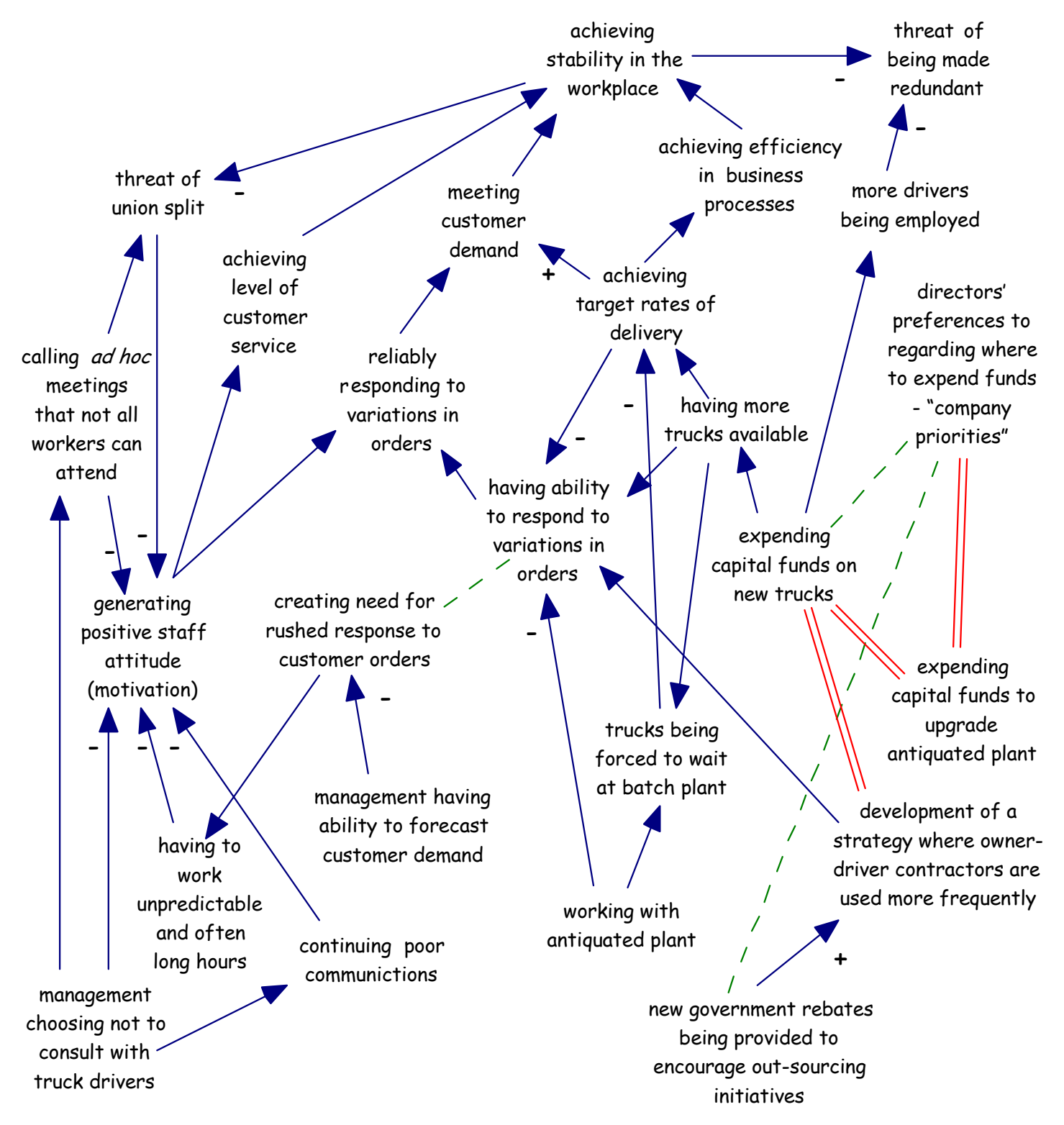
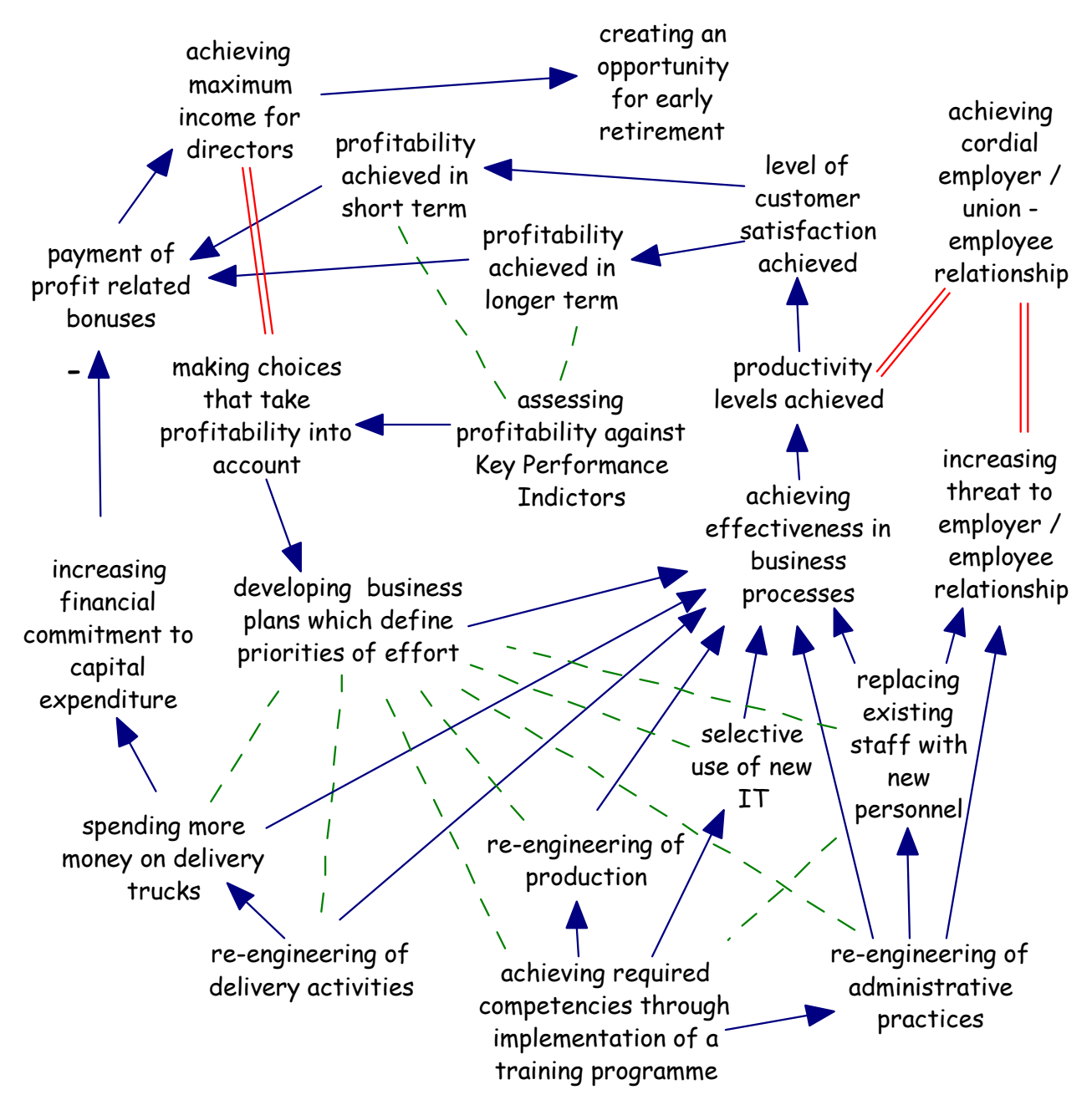
- Figure 6-2. Problem Situation as Perceived by ThreeTwoOne’s Directors.
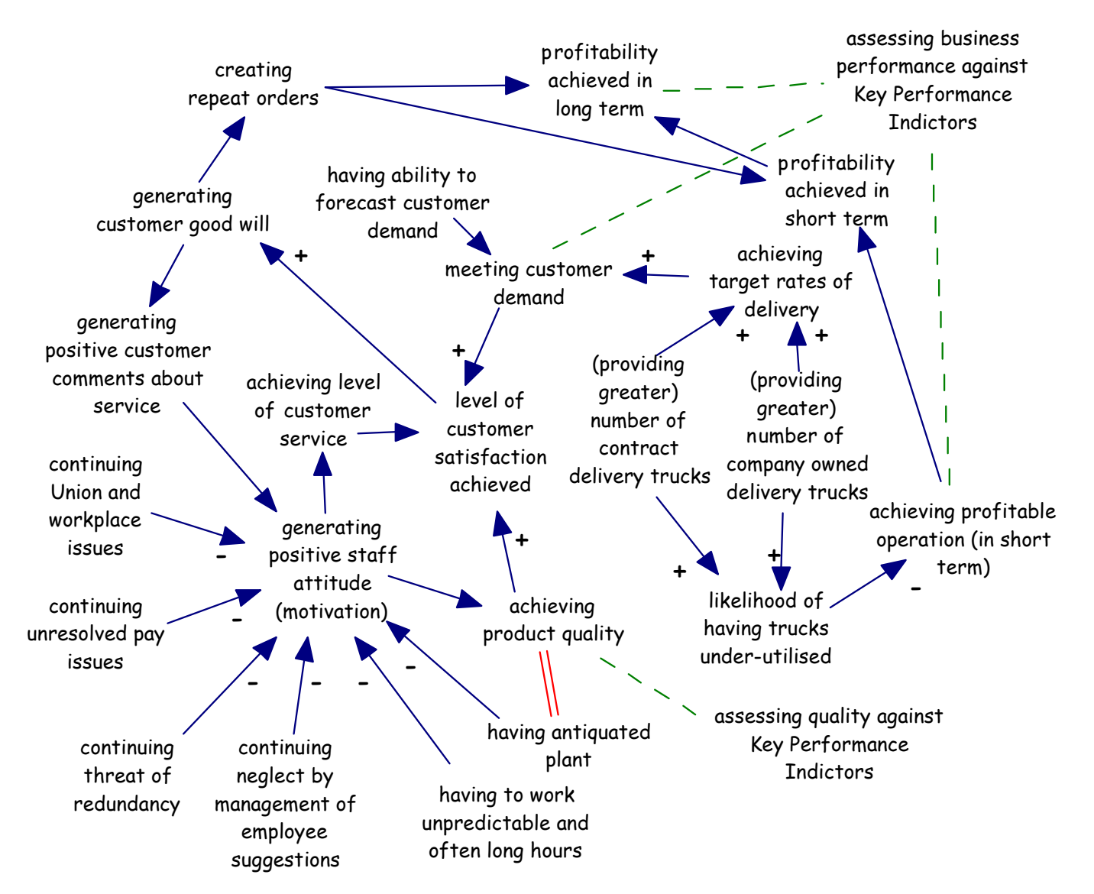
- Figure 6-3. Problem Situation as Perceived by ThreeTwoOne’s Managers.
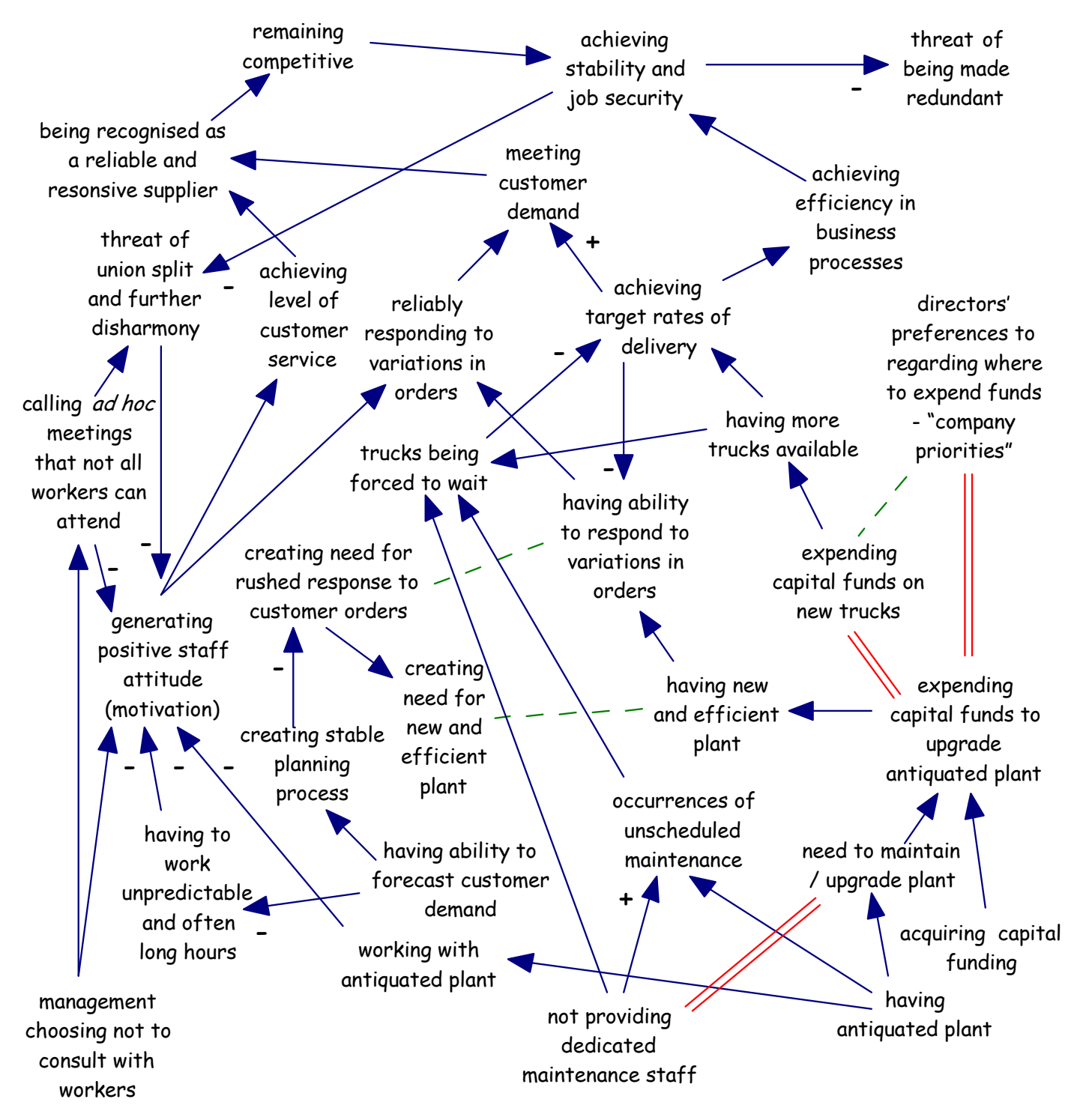
- Figure 6-4. Problem Situation as Perceived by ThreeTwoOne’s Plant Workers.
- Figure 6-5. Problem Situation as Perceived by ThreeTwoOne’s Truck Drivers.
The shared focus of the directors, whose perception is illustrated in Figure 6-2, appears to be that they want to achieve effectiveness in ThreeTwoOne’s business processes. This effectiveness is seen by them to lead to satisfied customers both in the short term and, more importantly, in the long term. With the achievement of high levels of customer satisfaction comes greater profitability and increased likelihood of payment of profit-related bonuses to the individual. Of course, the goals of the individual in terms of maximising income do not necessarily accord with actions needed to improve profitability of the company. For example, committing to capital expenditure in the short term will reduce the funds available for the payment of bonuses. The directors know that there is a need to spend more money to buy trucks. A range of activities is needed to build effectiveness in business. These include better use of information technology and re-engineering of production, delivery and administrative practices. A training programme would be needed to improve the competencies of employees. The actions of the directors cannot be considered in isolation: the demands of working relationships with employees also need to be taken into account. The directors see the need balance these things, but there a number of conflicting considerations. These include their own individual selfish goals and the essential need to achieve cordial relationships with the employees.
The managers are closer to the day-to-day problems than the directors are (Figure 6-3). So, the managers have quite a different view of the world. They have to work closely with the clerical staff and plant operators as well as the truck drivers. The managers continually juggle the competing demands of the various groups, and the issues they raise from time-to-time. The managers identify with the need to generate a positive attitude among the staff particularly as such an attitude will be reflected in dealings with customers and in the delivery of product quality. If that attitude is positive, then it should follow, all other things considered, that customer service will be good and product quality will be consistent. It is only when customer demands are met by service and delivery of product quality that they will be satisfied. The managers are fully aware that the truck drivers are a particularly important group. It is the truck drivers who have closest dealings with customers when they deliver concrete. As a group the managers are instrumental in achievement of profitable operations. The managers have to deal with vexed the question of how to determine how well the company is doing on a daily basis, noting that much of what they do in reaction to their own assessment of performance could well impact on profitability of the company in the long term. Whilst they have not identified it here, the managers are well aware that it is the profitability of ThreeTwoOne’s operation that will assure their longevity in employment. However, this is less important because the managers know that they are more likely to lose their jobs in the short term if customers complain or are seen by the directors to be dissatisfied.
For the plant workers, having to work with antiquated plant is a daily issue (Figure 6-4). This has a detrimental impact on their motivation. It also impacts on truck drivers when trucks are forced to wait when unscheduled maintenance delays the mixing of concrete. This means delivery rates are affected. Plant workers have it firmly in their minds that money would be spent to upgrade plant if there was not such a pressing need, as it seems to be seen by the directors, to spend money on new trucks. The plant workers believe they are getting a raw deal compared to others, particularly the truck drivers. They have to work harder when things go wrong, things that are beyond their control. Because of the pressure on them as a group, more than any other, to react to incidents of breakdown or apparent mismanagement, they have little opportunity to routinely communicate with and express their dissatisfaction to management. Managers seemingly appear to choose not to consult with the workers, as they should. Adding to the disharmony is the threat of a union split involving the truck drivers. Uppermost in the minds of the plant workers is the need to achieve stability and job security. Clearly, plant workers are an unhappy group.
In many ways the truck drivers see their problems as the plant workers do (Figure 6-5), except that the truck drivers see themselves as being more important. They see that they have a pivotal role in the achievement of targe rates of delivery and the importance of this in meeting customer demands. They see that it is important to achieve stability in the workplace. They also want to take things into their own hands, and a change to an alternate union by some drivers is seen as a possible, albeit partial, solution to their problems.