
6.6 ACCOMMODATING STAKEHOLDER PERSPECTIVES
Psychological make-up creates individuals’ preferences for particular types of reasoning. This can influence how knowledge elicitation and problem conceptualisation are approached, and how managers and decision-makers are engaged. During each stage of problem conceptualisation and investigation of individual stake-holdings, it is important to remain cognisant of preferred modes individuals have for gathering and processing information. These preferences and choice styles cannot be ignored simply to make use of elicitation and conceptualisation workshops, or group modelling techniques, that are convenient for the modelling support team. The keys to conceptualisation are openness, honesty and accommodation of stakeholder perspectives and, as far as is practical, their choice and decision-making styles.
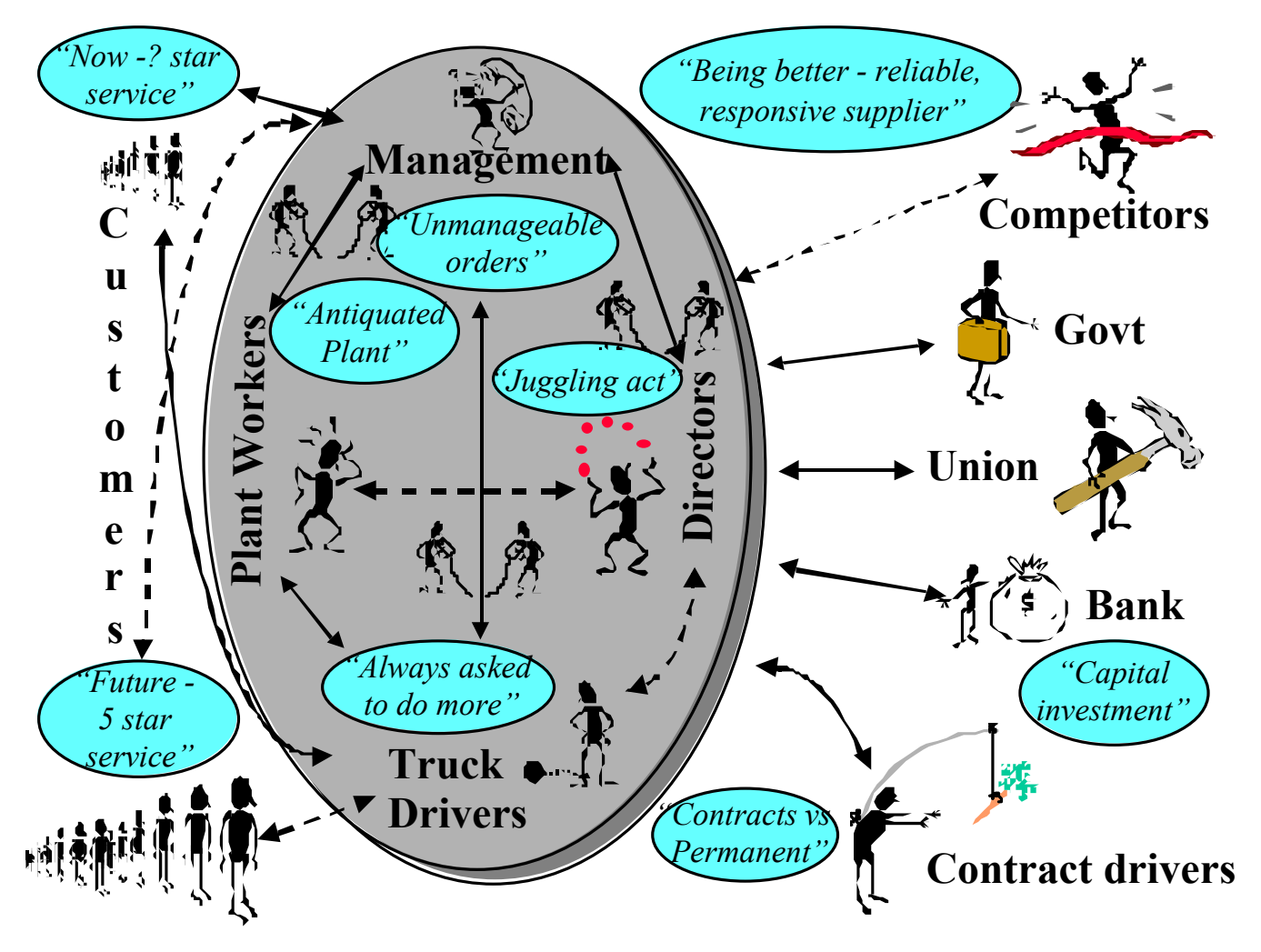
Experience suggests that few people feel comfortable with a prescriptive approach to problem conceptualisation. It is a real challenge to accommodate different stakeholder views through the elicitation process, accommodate preferences for different types of information whilst presenting information in ways with which stakeholders are comfortable. Checkland and Scholes (1999) make a similar observation about how comfortable stakeholders feel about using rich pictures. This is because some people do not have very good drawing skills. So, rich pictures developed from Microsoft® Clip Art can be an alternative to hand drawn rich pictures. The use of Clip Art in developing rich pictures was suggested by Williams (2000: 643).
Figure 6-1 is a Clip Art rich picture illustrating the flow of communications in ThreeTwoOne between the company’s internal and external entities. Clip Art rich pictures, such as this can be useful in encouraging the use of Soft Systems Methodology, which might otherwise be denied to stakeholders because of their inability, or reluctance, to draw. The accompanying Soft Systems Methodology Root Definition might be expressed as:
‘ThreeTwoOne is a privately owned, limited liability commercial system which takes locally available materials and uses plant and equipment to produce concrete, which is mixed in direct response to customer phone orders and delivered by truck to individual customers at building sites in the local area.’
References
- Checkland, P.B. and Scholes, J., 1999, Soft Systems Methodology In Action, John Wiley and Sons, Chichester, UK.
- Williams, M.C., 2000, “A soft systems case study investigating the information system of a small business and demonstrating the usefulness of rich pictures”, in: Proc. 1st Int. Conf. on Systems Thinking in Management, 2000, Deakin, Victoria, Australia.