
4.5.1 Apparent Insensitivity To Risks—An Example
A recent report regarding the exposure of Royal Australian Air Force F-111 maintenance workers to toxic chemicals identified 20 years of unsafe maintenance practices and repair programs (RAAF, 2001). The report estimates that in excess of 400 people have suffered long-term damage to their health as a result of their exposure (RAAF, 2001: Appendix 5). For 20 years maintenance workers have been working inside the fuel tanks of F-111 aircraft, and in the process becoming exposed to fuel vapours and the chemicals used in the repair and overhaul of fuel tanks.
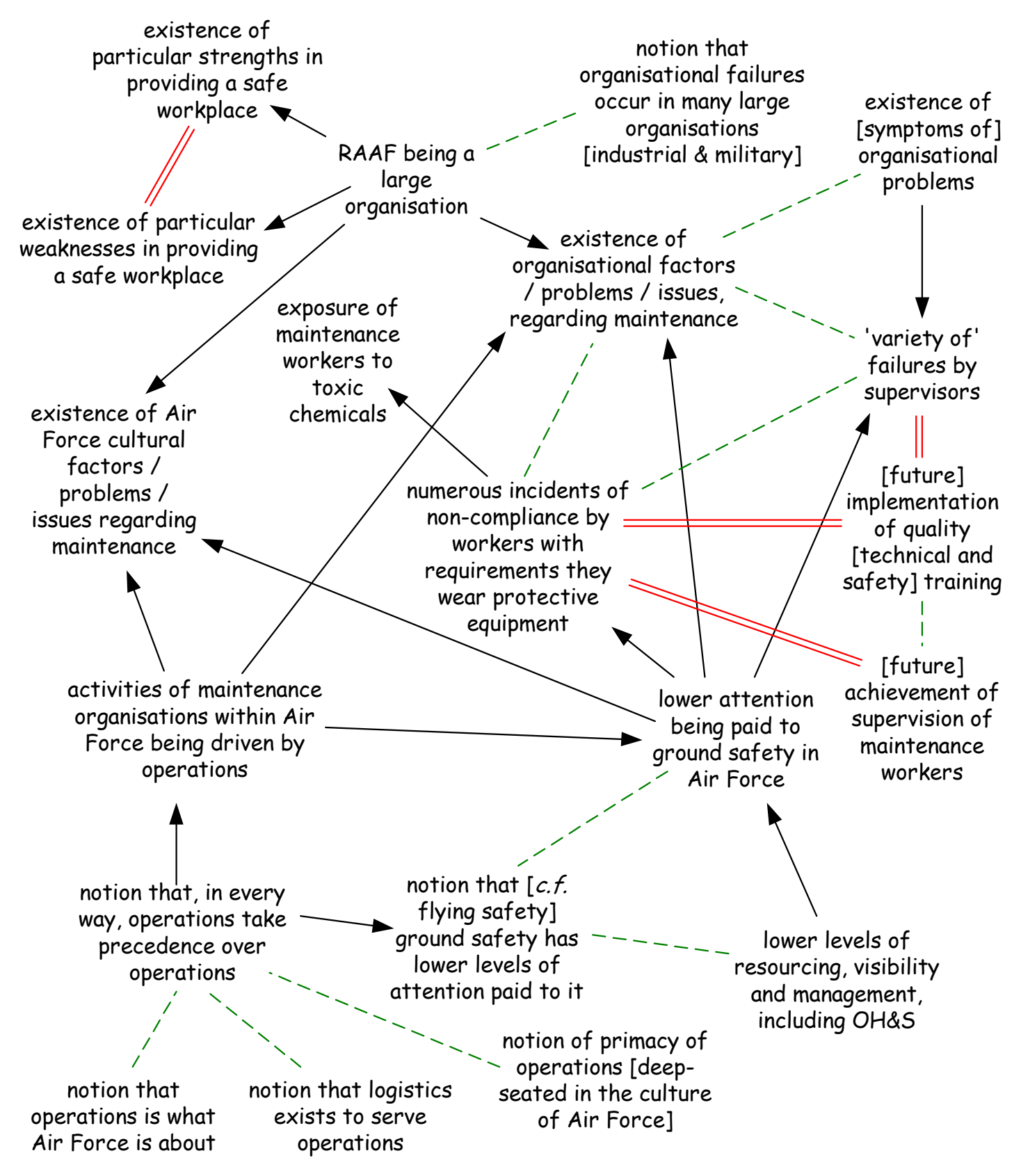
Whilst the report does not explicitly identify it in these terms, in the past when much of the damage was done, a culture of denial appears to have existed among workers and those that managed this dangerous work. There were numerous incidents of non-compliance by maintenance workers with the requirements they wear personal protective equipment. This was linked, in part at least, that is as a connotative link, to the existence of Air Force cultural issues regarding aircraft maintenance. More directly, lower attention was paid to ground safety than flying safety. Maintenance organisations and maintenance activities were generally considered subservient to flying operations. There was a cultural notion that in every way, operations take precedence over logistics. This notion of primacy of operations over maintenance is deep-seated in the culture of the RAAF (RAAF, 2001: 1-4). It is hardly surprising, then, that the risks of entering a fuel tank or being exposed to potentially toxic or carcinogenic chemicals used in the maintenance of F-111 fuel tanks were downplayed. See Figure 4-2.
Inter alia, the Board of Inquiry found (RAAF, 2001: Vol 1, Ch 1):
‘Investigators are sometimes content to identify the actions or inactions of individuals as the cause of an accident. Human error, carelessness or procedural violations by front line operators are readily apparent in the early stages of most accident investigations, and too often, investigations seem to terminate at this point…
But identifying the way in which the actions or inactions of individuals contribute to an accident is only the beginning. Any event has a potentially infinite network of causes or contributing factors, and pushing the investigation some distance back along these causal pathways provides far greater insight into why an event occurred, it is important to identify the organisational causes of the event, some of which may be remote in time and place from the event in question1. The value of such an analysis is that it may uncover a variety of ways in which accidents can be avoided.
Our analysis adopts this approach and seeks to identify the organisational and cultural factors which led to the failure of the Air Force to protect the health of its F111 fuel tank repair workers. The Board’s investigation rapidly revealed numerous incidents of non-compliance by maintenance workers with requirements that they wear personal protective equipment—goggles, respirators and the like—as well as a variety of failures by supervisors, but we treat them as symptomatic of the organisational problems we seek to identify, not in themselves the causes on which it is most useful to focus. Thus while we support better training and tighter supervision of maintenance workers, our principal recommendations concern the way the Air Force does business and they highlight the need for significant cultural and organisational changes.
We should stress that many of the organisational failures which we shall identify are by no way unique to the Air Force. The RAAF is a large organisation with many of the strengths and weakness of other large organisations, particularly large organisations. We shall draw these parallels at various points. There are however some features of the Air Force which stem from its military nature, which generates particular weaknesses as well as particular opportunities to provide a safe work place…
Air safety has a very high priority, in part because of public visibility of aircraft crashes. Ground safety failures are less visible and therefore less likely to be able to command the attention and resources which air safety enjoys…
The distinction between operations and logistics is one of the fundamental cleavage lines of the Air Force. Operations refers to all flying activities of the aircraft squadrons, including training. Logistics supports operations and includes aircraft maintenance work. Some maintenance work is done by personnel attached to the flying squadrons but the more extensive maintenance, including much of the fuel tank repair work, has been done by maintenance organisations with no operational role. The distinction between operations and logistics is therefore not only a conceptual one; it is mirrored in the way the Air Force is organised.
In almost every way, operations take precedence over logistics…
The priority of operations over logistics is deep-seated in the culture of the Air Force. The fact that several of the organisational failures which we shall identify stem from this priority means that they will not be easily rectified…’
The members of the Board of Inquiry, recognising the complexity and systemic nature of the issues, expressed fear that these organisational failures will not be easily rectified.
References
- RAAF, 2001, “Chemical Exposure of Air Force Maintenance Workers”, Report of the Board of Inquiry into F-111 (Fuel Tank) Deseal/Reseal and Spray Seal Programs, Vol. 1, Air Force Headquarters, Royal Australian Air Force, Russell Offices, Canberra, Australia.