
1.6 IMPORTANCE OF COMMUNICATIONS IN DECISION CYCLES
The interdependence of the various activities in decision making is shown in the Decision Cycle at Figure 1-7.
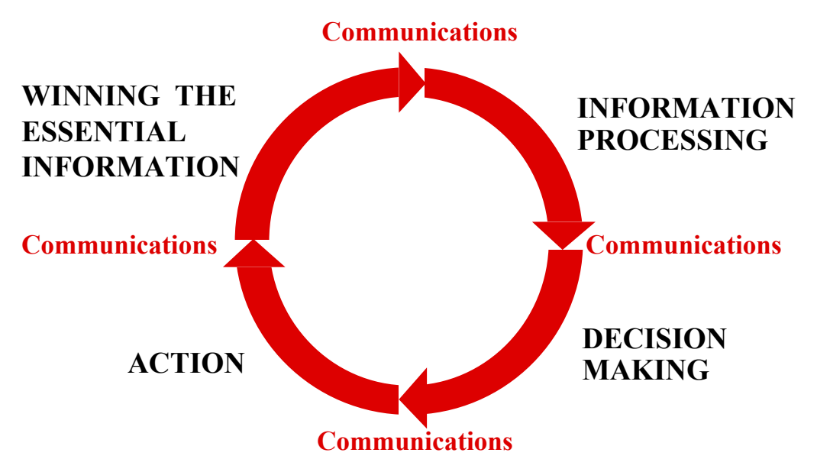
This diagram emphasises the requirement for effective communication. Mis-communication is possible at four separate interface points we must cross as we navigate the Decision Cycle. Mis-communication may come about for many reasons including:
- errors in the transmission process because we are unable to express perfectly, through verbal or non-verbal communication, exactly what we are thinking;
- errors occur in the reception process because we are unable to interpret perfectly what is transmitted, either as verbal or non-verbal communication;
- noise levels being high relative to the signals (to fully appreciate this, it might help to reflect on our introductory metaphor of searching for the polar bear);
- misuse of language; or
- confusion in the use of terminology.
Effective communication is an essential enabler to knowledge elicitation. Equally, poor communications can stifle efforts to find out about a problem situation. The decision cycle depicted at Figure 1-7 must be navigated iteratively and endlessly. Facilitating effective communications at each of the interface points at the head of each of the arrows in the Decision Cycle is critical to assuring understanding, and avoiding errors in interpretation of what is being said by stakeholders, for example.
Footnotes
- [7] Originally the Boyd Cycle, after Colonel Boyd USAF, a fighter pilot in the Korean War. This is also known as the OODA Loop, involving cycles of Observing the changing situation, Orienting to what is occurring, Deciding what action to take and Acting. Adapted from the Command and Control (C2) Cycle (after Ryan, 1997). back