
1.5.13 Harnessing Human Recognitional Capacity
Exploiting human recognitional capacity is the key to harnessing human intellect in dealing with complexity. In a study of decision making under pressure of time, Klein (1998) and his team of researchers observed and classified 156 decisions and found 127 involved ‘recognitional decisions’ (Klein, 1998: 23-24). They found that when more time was available, people deliberated about options and this became a substitute for recognising a situation as ‘typical’. As a result of separate decision research, Carroll and Johnson (1990) also conclude human intellect is best applied to recognition.
There is evidence to suggest that even when time is available and information is relatively complete, heuristics are invoked, recognitional decisions are made and mental simulation is used to evaluate strategies. When more time is available it is often devoted to mental simulation of strategies such as how risk situations might play out.
In risk management our main goals include strengthening situation awareness and the process Klein describes as mental simulation in his Integrated Version of Recognition-Primed Decision Model (Klein, 1998: 17-30; Lipshitz and Shaul, 1997). See Figure 1-6. This recognition-primed decision (RPD) model fuses two processes: the way decision makers size up the situation to recognise which course of action makes sense, and the way they evaluate that course of action by imagining it. Decision makers recognise the situation as typical and familiar. Failures to recognise, when risks are involved, are revealed at Chapters 2 and 3. Once the situation has been recognised as familiar, decision makers proceed to plan out their course of action. They understand what types of goals make sense, so priorities are set, which cues are important, so there is not an overload of information, what to expect next, so they can prepare themselves. They then prepare typical ways of responding in a given situation.
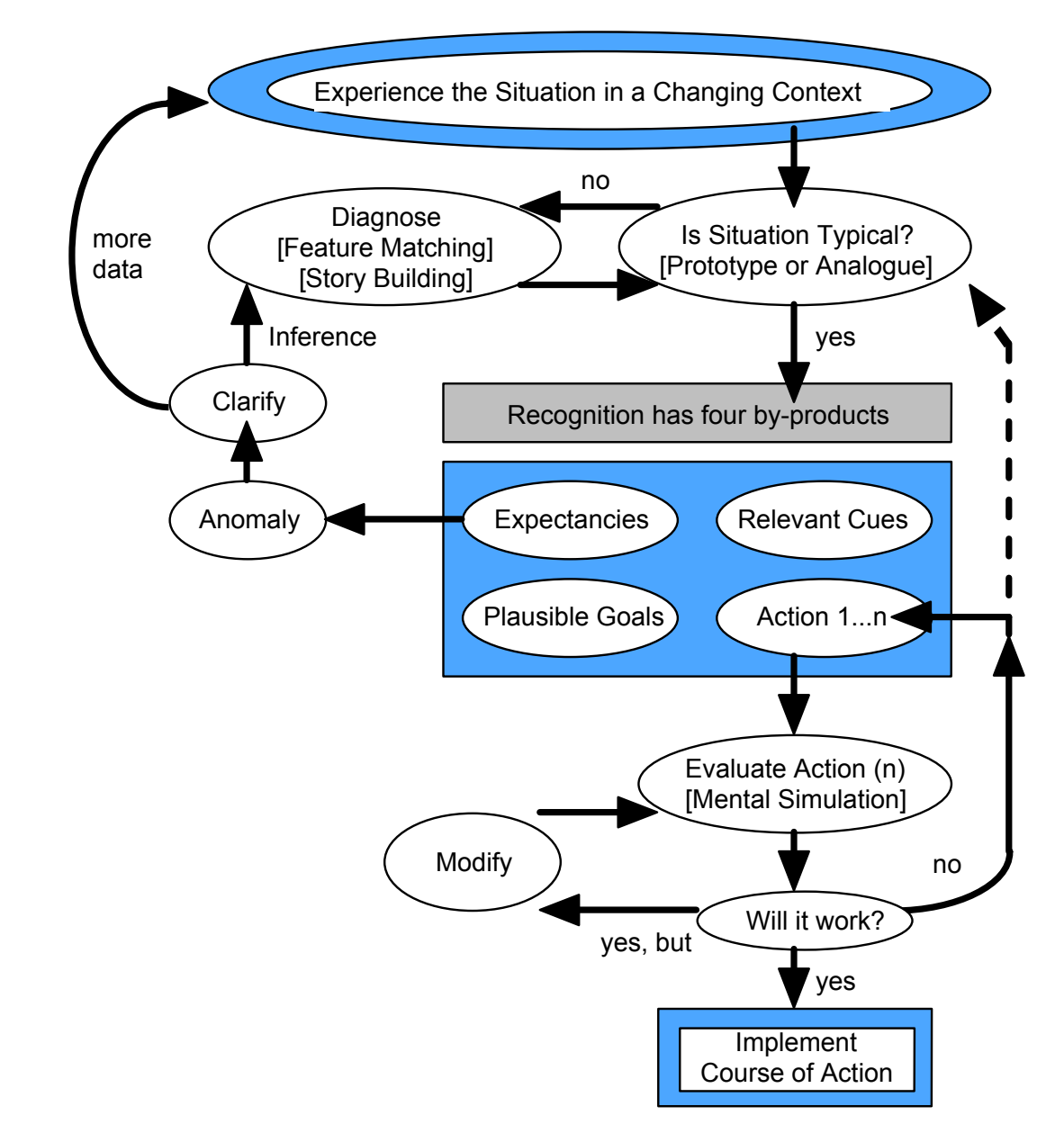
By recognising a situation as typical, they also recognise a course of action that is likely to succeed. The recognition of goals, cues, expectancies, and actions is part of what it means to recognise a situation. That is, decision makers do not start with the goals or expectancies and figure out the nature of the situations. Under some circumstances, the decision maker may have to devote more attention to diagnosing the situation, since the information may not clearly match a typical case or may map onto more than one typical case. The decision maker may need to gather more information in order to make a diagnosis.
Another complication is that the decision maker may have misinterpreted the situation but does not realise it until some expectancies have been violated. That is, assumptions or elements of existing mental models or personal constructs are found to be inadequate or flawed or in need of adjustment. At these times, decision makers will respond to the anomaly or ambiguity by checking which interpretation best matches the features of the situation.
Decision makers may also evaluate single options by imaging how the course of action will play out. To do this, they use mental simulation. As a result of this mental simulation, a decision maker may anticipate difficulties. This may demand adjustment to the course of action. It maybe rejected and a search for another option may be initiated. This process of evaluation involves making a series of “if…then” choices.
Klein observed an excellent fit of empirical research results with his integrated RPD model. He concludes that RPD is frequently and consistently used in situations where options came from experience. That is, the RPD model is not considered applicable to situations where a person deliberately compares several options. When that occurs the decision making becomes one of comparative evaluation.
It is argued that in many risk-management situations, choices about risk are make on the basis of recognition and evaluation of possible action by mental simulation, even though the pressure of time witnessed by Klein does not exist. Recognition-primed decision making is used to build experience and, in turn, that experience is called upon to support future decision making. It is further argued that even when comparative evaluation is used, the experience gained from prior recognition-primed decision making will be called upon. Without that experience an alternative form of support to decision making is needed; this is particularly the case where problems involve systemic feedback or where problems are complex.
Footnotes
- [6] After Klein (1998: 17-30). back
References
- Klein, G., 1998, Sources of Power: How People Make Decisions, MIT Press.
- Carroll, J. S. and Johnson, E. J., 1990, Decision Research: A Field Guide, Sage Publications, Newbury Park, California.
- Lipshitz, R., and Shaul, O.B., 1997, “Schemata and mental models in recognition-primed decision-making”, Naturalistic Decision Making. Erlbaum, Mahwah, NJ, pp 293-304.