
1.5.11 Systems Of Meaning
Heuristics, schemata, sysreps and mental models may be the building blocks of understanding and learning, but they are only part of an individual’s cognisance. An individual’s cognisance fits within systems of meaning.
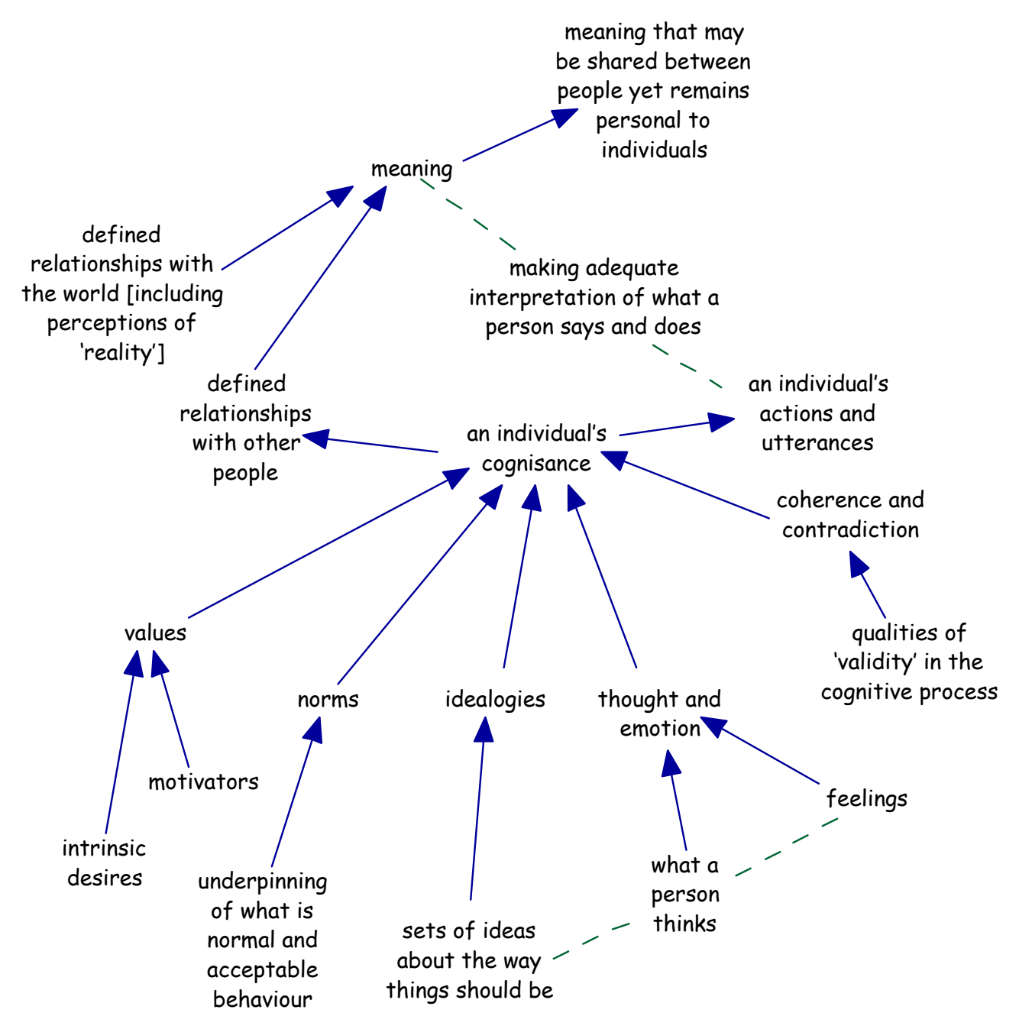
The relationship between cognisance and meaning is depicted diagrammatically at Figure 1-5. It is described by Flood (1999) as follows:
Meaning arises from people’s cognitive processes and the way that, for each person, their cognisance defines their relationship with other people and the world. Cognitive processes might be conceived of in terms of values, norms, ideologies, thought and emotion, coherence and contradiction. A person’s actions and utterances cannot be made sense of without reference to this texture of what they think. Values are intrinsic desires and motivators. Norms underpin what is considered to be normal and acceptable behaviour. Idealogies are sets of ideas about how things should be. Thought and emotion refer to what a person thinks and how they feel about that, as well as the impact that feelings have on what a person thinks. Coherence and contradiction are qualities of ‘validity’ in cognitive processes. All of these things are key in making an adequate interpretation of what a person says and does.
Cognitive processes constitute meaning that may be shared in some way between people and yet remains somehow personal to individuals. Systems of meaning that people employ may coexist and adapt in relative harmony and/or degrees of conflict. That is, systems of meaning may yield cohesion in cultural ways of living and/or tension arising from disagreement, perhaps leading to coalition building and political interaction. Appreciation of what people mean and the temperament of their coexistence are therefore of central interest when seeking ‘agreement’ on improvement strategies. (Flood, 1999: 110).’
Amongst other things, this means choices or decisions we might make cannot be divorced from feelings. Alternatively stated, there are links between cognition, emotion and cognitive behaviour; choices and decisions frequently appear not to be made on logical and rational bases. Choices may be logical and rational to the decision maker even if the observer does not understand or believe that. We need to accept that this happens and we need to recognise that decision makers have feelings. This will affect how we design ways of supporting their risk management and strategy development. Further, they will only act when they feel strongly enough about a problem to do something meaningful about it (Forrester, 1985: 133-4; Checkland and Scholes, 1999).
References
- Flood, R.L., 1999, Rethinking the Fifth Discipline: Learning Within the Unknowable’, Routledge, London.
- Forrester, J.W., 1985, “The ‘model’”, versus the modelling ‘process’’, System Dynamics Review, vol.1, no.1.
- Checkland, P.B. and Scholes, J., 1999, Soft Systems Methodology In Action, John Wiley and Sons, Chichester, UK.