
1.4.5 Products Of Mapping
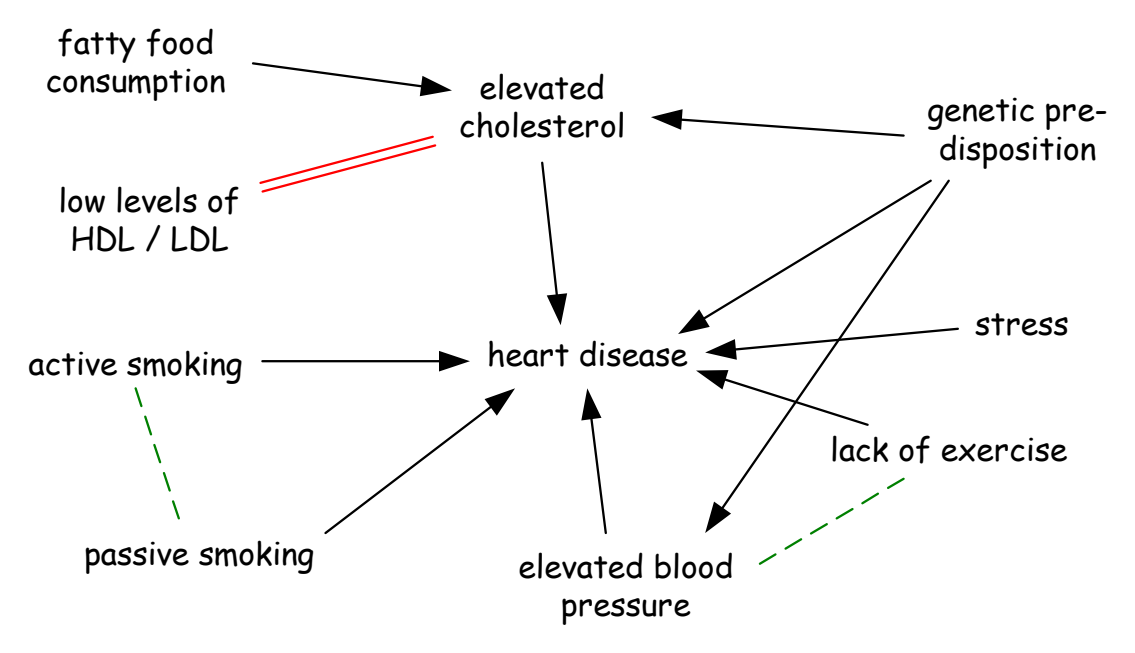
While the group of students could not possibly uncover the whole story of smoking and heart disease in a single workshop session, it became obvious to them that the focal problem was a multi-factorial one with many strongly coupled concepts and complex interrelationships. The final form of the concept map produced after about 30 minutes of discussion by a group, who had not seen concept mapping before, is shown in Figure 1-3. It is important at this point to note that the students felt such maps are a powerful form of relational shorthand, but:
- the final form of the map could not be unanimously agreed because they had neither the data nor the medical expertise to validate the model so depicted; and
- a strong sense of ownership because they had developed the model—they did not accept so readily models built by other groups—invariably they treated them with cautious respect, whilst noting the richness in ideas they contained.
A short period of contemplation should lead the reader to the same conclusions reached by the students:
- Even with a relatively small number of concepts, as shown in this map, the interrelationships exhibit strong coupling.
- Several other concepts might have been included. For example, age of persons involved, or period of exposure to pathogenic environments, were not identified or included in this initial map.
- There are several links we might question. At this stage there is nothing to suggest that increasing the amount, or frequency, of exercise might reduce blood pressure and, hence, the risk of having a heart attack. Heart attack is a greater concern than the existence of heart disease, per se.
- Further to the point made earlier about a strong sense of ownership, acceptance of the map is much more likely if the reader is involved in its development. Particular stakeholders may not accept a map developed without their close involvement.
Footnotes
- [3] The conflict link between low levels of HDL / LDL and elevated cholesterol indicates that cholesterol is not all bad. Low-density lipids (LDL) have been identified as causes of blockages in blood vessels. Whilst a person may have elevated cholesterol, the risk to heart disease this presents depends on the ratio of high-density lipids (HDL) to low density lipids. The higher the proportion of LDL, the greater the likelihood of heart disease. back